. 2018 Dec 19;285(1893):20181987.
doi: 10.1098/rspb.2018.1987.

High species richness and lineage diversity of reef corals in the mesophotic zone

Affiliations

High species richness and lineage diversity of reef corals in the mesophotic zone

Paul R Muir et al. Proc Biol Sci. .

Abstract

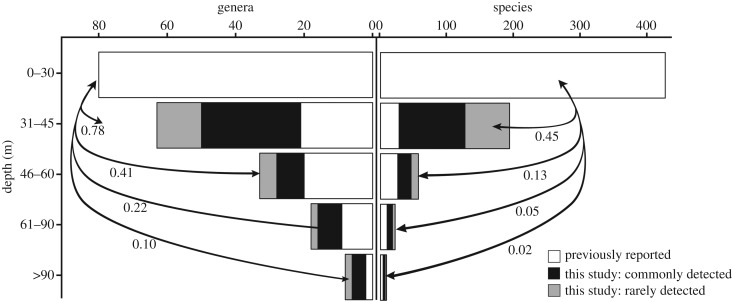
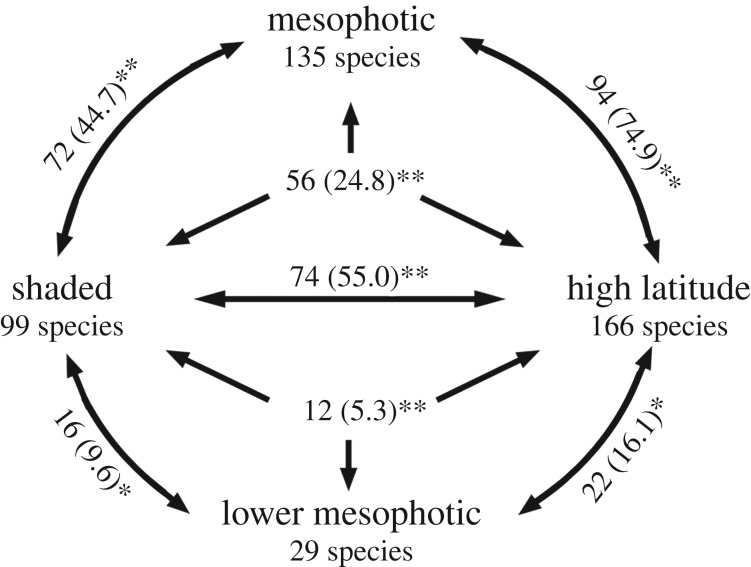
Coral reefs are increasingly threatened by thermal bleaching and tropical storm events associated with rising sea surface temperatures. Deeper habitats offer some protection from these impacts and may safeguard reef-coral biodiversity, but their faunas are largely undescribed for the Indo-Pacific. Here, we show high species richness of scleractinian corals in mesophotic habitats (30-125 m) for the northern Great Barrier Reef region that greatly exceeds previous records for mesophotic habitats globally. Overall, 45% of shallow-reef species (less than or equal to 30 m), 78% of genera, and all families extended below 30 m depth, with 13% of species, 41% of genera, and 78% of families extending below 45 m. Maximum depth of occurrence showed a weak relationship to phylogeny, but a strong correlation with maximum latitudinal extent. Species recorded in the mesophotic had a significantly greater than expected probability of also occurring in shaded microhabitats and at higher latitudes, consistent with light as a common limiting factor. The findings suggest an important role for deeper habitats, particularly depths 30-45 m, in preserving evolutionary lineages of Indo-Pacific corals. Deeper reef areas are clearly more diverse than previously acknowledged and therefore deserve full consideration in our efforts to protect the world's coral reef biodiversity.

Keywords: deep reef; faunal overlap; phylogeny; refuge; scleractinia.


Conflict of interest statement

We declare we have no competing interests.

Figures
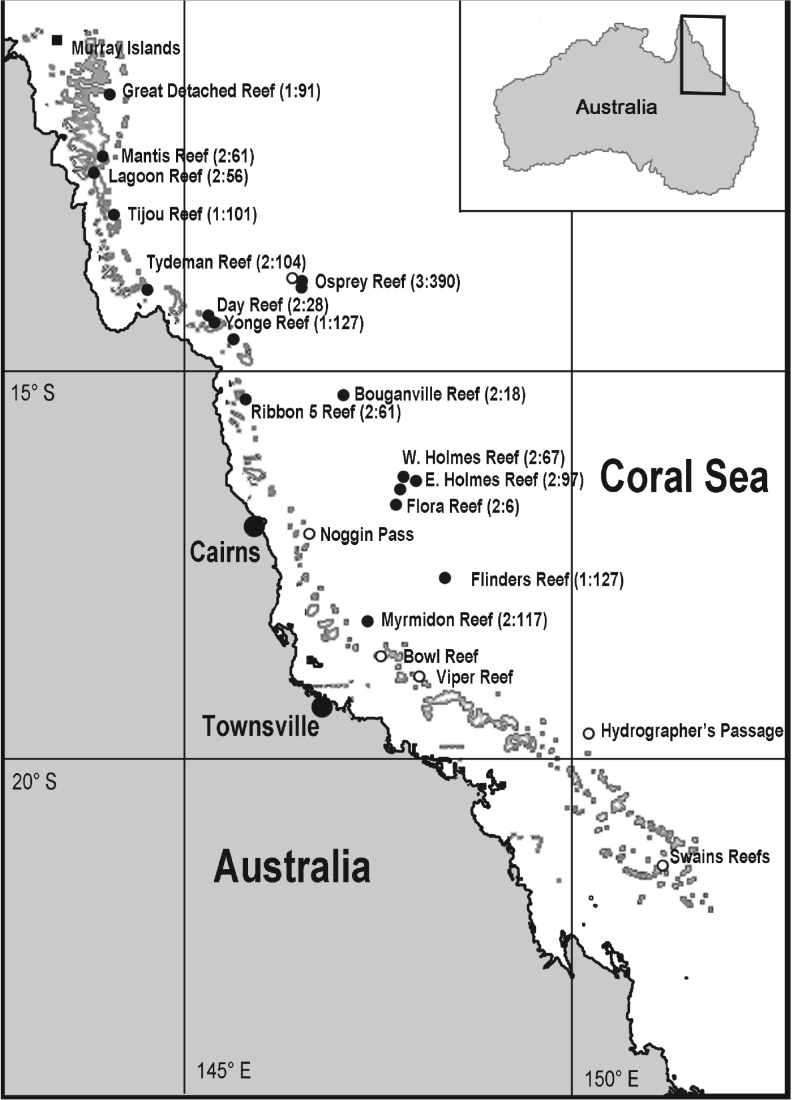
Figure 1.
Figure 1.
Locations with sites: number of specimens collected used in this study (filled circles), from unpublished museum records (squares), and previous studies [–30] (open circles).
Figure 2.
Figure 2.
Summary of reef-coral taxa detected at depth and the proportional overlap with shallow-reef fauna [21] for the northern GBR region. According to current nomenclature [22], species detected exclusively in the mesophotic were excluded, ‘this study’ includes preliminary records reported previously by our group [33,34]. Previously reported [–30], see electronic supplementary material, tables S1 and S2 for details.
Figure 3.
Figure 3.
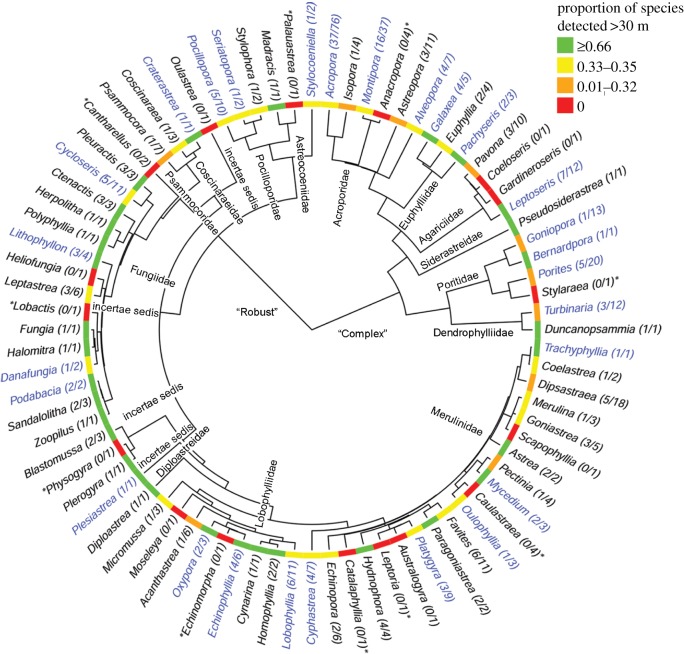
Each family of scleractinian reef corals and a wide range of genera occurred deeper than 30 m depth, with many extending to 60 m or deeper (in blue font). Tree is based upon the median tree of [35] and is shown for species documented for the northern GBR region [21] according to current nomenclature [22]. Number of species for genus in brackets, *reported greater than 30 m depth for other geographic regions. (Online version in colour.)
Figure 4.
Figure 4.
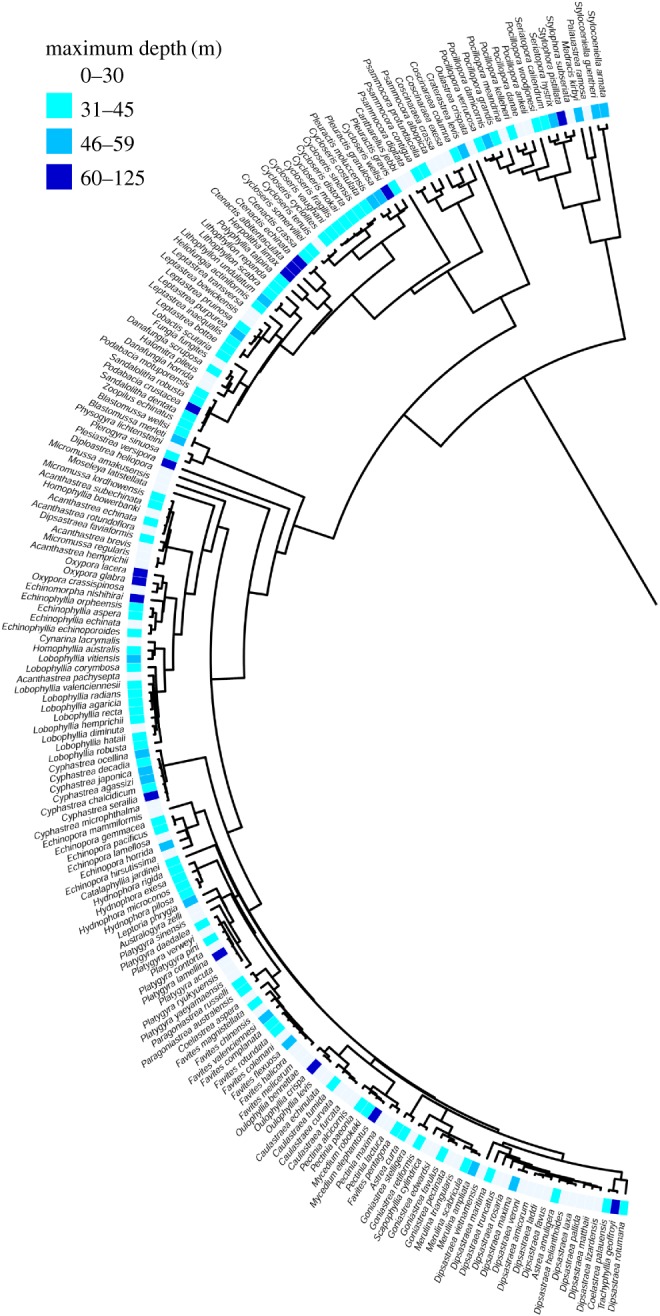
The ability to extend to depth varied widely within genera and was only slightly related to phylogeny (Blomberg's K = 0.006, p = 0.137, Pagel's λ = 0.780). Here, the ‘Robust’ clade for scleractinian corals reported for the northern GBR region [21] with current nomenclature [22] is shown. The median tree of [35] is used, with additional depth data from [38]. For the complete tree, see electronic supplementary material, figure S2. (Online version in colour.)
Figure 5.
Figure 5.
Species that occurred at mesophotic (30–150 m) and lower mesophotic (60–150 m) depths in the northern GBR region were significantly more likely to extend to higher latitudes (greater than 34°) and into shaded microhabitats. Numbers indicate species shared with expected values in brackets, ** denotes p ≪ 0.01, * denotes p < 0.05 from Pearson's and Mantel–Haenszel χ2. Species for the region according to [35], shaded habitats [39] and latitudinal extent [38]. Genus Acropora excluded here, details and further analyses can be found in the electronic supplementary material table S2 and figure S3.

References

    1. Hoegh-Guldberg O, et al. 2007. Coral reefs under rapid climate change and ocean acidification. Science 318, 1737–1742. (doi:101126/science1152509) - PubMed
    1. Hughes TP, et al. 2017. Global warming and recurrent mass bleaching of corals. Nature 543, 373–377. (doi:101038/nature21707) - PubMed
    1. Hughes TP, et al. 2018. Spatial and temporal patterns of mass bleaching of corals in the Anthropocene. Science 359, 80–83. ( 10.1126/science.aan8048) - DOI - PubMed
    1. Richards ZT, Day JC. 2018. Biodiversity of the Great Barrier Reef—how adequately is it protected? PeerJ 6, e4747 ( 10.7717/peerj.4747) - DOI - PMC - PubMed
    1. van Hooidonk R, Maynard J, Tamelander J, Gove J, Ahmadia G, Raymundo L, Williams G, Heron SF, Planes S.. 2016. Local-scale projections of coral reef futures and implications of the Paris Agreement. Nat. Sci. Rep. 6, 39666 (doi:101038/srep39666) - PMC - PubMed