. 2019 Apr:3:1-16.
doi: 10.1200/CCI.18.00075.

Immunologic Consequences of Sequencing Cancer Radiotherapy and Surgery

Affiliations

Immunologic Consequences of Sequencing Cancer Radiotherapy and Surgery

Juan Carlos López Alfonso et al. JCO Clin Cancer Inform. 2019 Apr.

Abstract

Purpose: Early-stage cancers are routinely treated with surgery followed by radiotherapy (SR). Radiotherapy before surgery (RS) has been widely ignored for some cancers. We evaluate overall survival (OS) and disease-free survival (DFS) with SR and RS for different cancer types and simulate the plausibility of RS- and SR-induced antitumor immunity contributing to outcomes.

Materials and methods: We analyzed a SEER data set of early-stage cancers treated with SR or RS. OS and DFS were calculated for cancers with sufficient numbers for statistical power (cancers of lung and bronchus, esophagus, rectum, cervix uteri, corpus uteri, and breast). We simulated the immunologic consequences of SR, RS, and radiotherapy alone in a mathematical model of tumor-immune interactions.

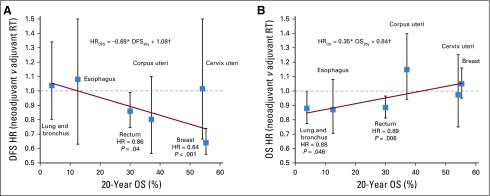
Results: RS improved OS for cancers with low 20-year survival rates (lung: hazard ratio [HR], 0.88; P = .046) and improved DFS for cancers with higher survival (breast: HR = 0.64; P < .001). For rectal cancer, with intermediate 20-year survival, RS improved both OS (HR = 0.89; P = .006) and DFS (HR = 0.86; P = .04). Model simulations suggested that RS could increase OS by eliminating cancer for a broader range of model parameters and radiotherapy-induced antitumor immunity compared with SR for selected parameter combinations. This could create an immune memory that may explain increased DFS after RS for certain cancers.

Conclusion: Study results suggest plausibility that radiation to the bulk of the tumor could induce a more robust immune response and better harness the synergy of radiotherapy and antitumor immunity than postsurgical radiation to the tumor bed. This exploratory study provides motivation for prospective evaluation of immune activation of RS versus SR in controlled clinical studies.


Conflict of interest statement

Jan Poleszczuk

Patents, Royalties, Other Intellectual Property: US Patent 9,990,715: Radiotherapy targeted to promote a systemic abscopal effect

Travel, Accommodations, Expenses: Roche

Sungjune Kim

Patents, Royalties, Other Intellectual Property: Provisional patent for lung adenocarcinoma biomarker to predict distant metastasis among stage I patients (Inst)

Shari Pilon-Thomas

Research Funding: Iovance Biotherapeutics, Provectus

Patents, Royalties, Other Intellectual Property: Moffitt Cancer Center has licensed intellectual property (on which S.P.-T. is an inventor) related to the proliferation and expansion of tumor-infiltrating lymphocytes to Iovance Biotherapeutics

Jose J. Conejo-Garcia

Stock and Other Ownership Interests: Anixa Biosciences, Compass Therapeutics

Honoraria: Compass Therapeutics, Anixa Biosciences

Consulting or Advisory Role: Anixa Biosciences, Compass Therapeutics

Research Funding: Anixa Biosciences, Compass Therapeutics

Patents, Royalties, Other Intellectual Property: FSH-targeted T cells for the treatment of ovarian cancer (Inst); anti-CD277 antibodies (Inst)

Travel, Accommodations, Expenses: Compass Therapeutics, Anixa Biosciences

Hatem Soliman

Consulting or Advisory Role: Celgene, AstraZeneca, Eli Lilly, Novartis, Pfizer

Research Funding: Amgen (Inst)

Travel, Accommodations, Expenses: AstraZeneca, Eli Lilly

Brian Czerniecki

Research Funding: ImmunoRestoration

Patents, Royalties, Other Intellectual Property: Patent filed DC1 activation through University of Pennsylvania (Inst)

Heiko Enderling

Patents, Royalties, Other Intellectual Property: US Patent 9,990,715: Radiotherapy targeted to promote a systemic abscopal effect

No other potential conflicts of interest were reported.

Figures
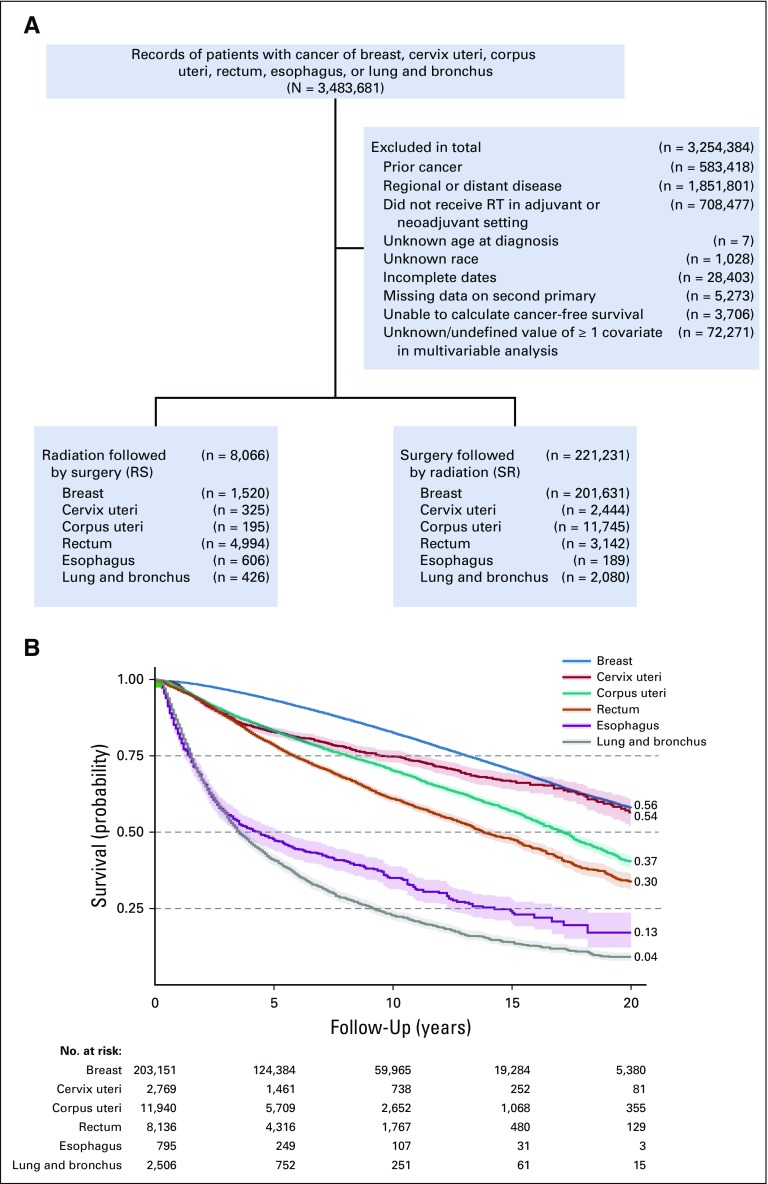
FIG 1.
FIG 1.
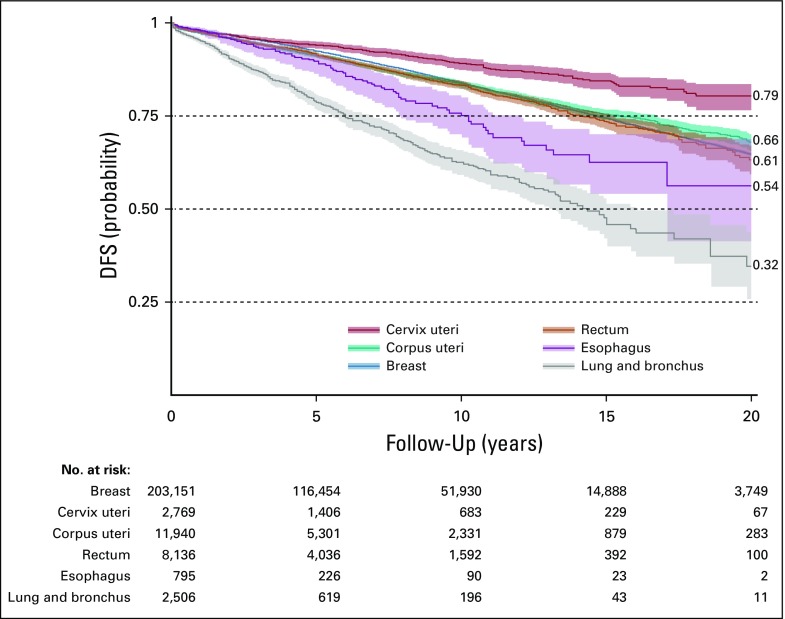
(A) SEER inclusion/exclusion. (B) Kaplan-Meier 20-year survival.
FIG 2.
FIG 2.
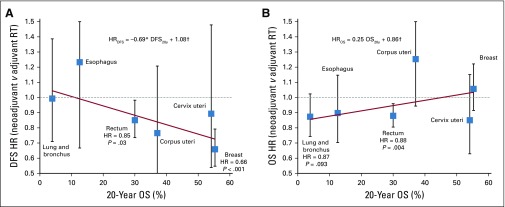
Hazard ratios (HRs; with 95% CIs, P values, and linear least squares regression lines weighted by the inverses of site-specific CIs) for (A) disease-free survival (DFS) and (B) overall survival (OS) after preoperative (neoadjuvant) RT (RS) compared with postoperative (adjuvant) RT (SR). HRs were adjusted for age, sex, year of diagnosis, histology, type of surgery, type of applied radiation, and tumor size. Equation describes the trend line, and coefficients were tested for significant difference from 0 using t test. (*) P < .05. (†) P < .001. RT, radiotherapy
FIG 3.
FIG 3.
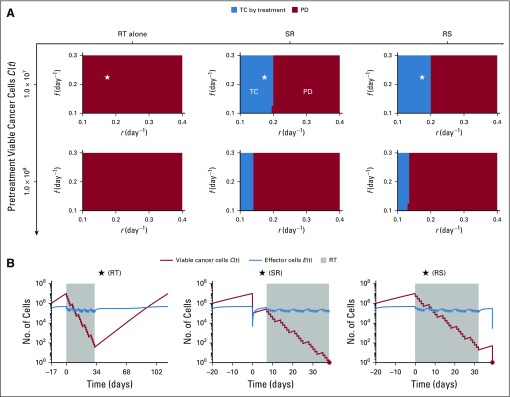
(A) Model-predicted treatment outcomes of radiotherapy (RT) alone, RT after surgical resection (SR), and RT before surgical resection (RS) without RT-induced immunity (ie, q = 0.0 day−1 in Equation 2) in a cohort of virtual patients with different combinations of pretreatment tumor size, tumor growth rate (r), and immune recruitment rate (f) in response to tumor burden. Radiation is delivered to a total dose of 50 Gy in 25 daily fractions at 2 Gy per day, 5 days per week. Tumor control (TC) by treatment (blue) and progressive disease (PD; red) refer to tumor eradication and escape after treatment, respectively. (B) Time evolution of tumor and effector T cells corresponding to the location marked by stars in panel A.
FIG 4.
FIG 4.
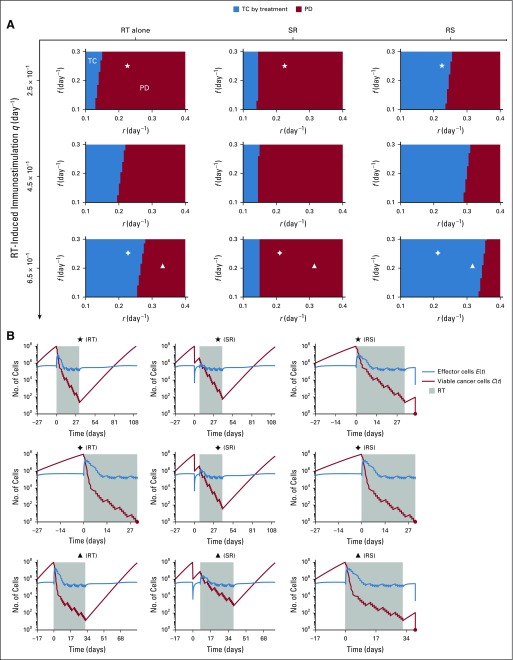
(A) Model-predicted treatment outcomes of radiotherapy (RT) alone, RT after surgical resection (SR), and RT before surgical resection (RS) for tumors of 108 viable cancer cells pretreatment and increasing strength of RT-induced immunostimulation (q, day−1 in Equation 2) in a cohort of virtual patients with different combinations of tumor growth rate (r) and immune recruitment rate (f) in response to tumor burden. Radiation is delivered to a total dose of 50 Gy in 25 daily fractions at 2 Gy per day, 5 days per week. Tumor control (TC) by treatment (blue) and progressive disease (PD; red) refer to tumor eradication and escape after treatment, respectively. (B) Time evolution of tumor and effector T cells corresponding to the locations marked by diamonds, triangles, and stars in panel A.
FIG 5.
FIG 5.
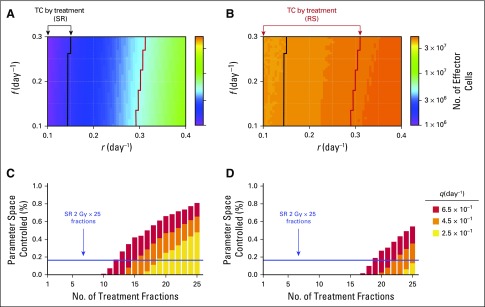
Comparison of immune recruitment and treatment outcomes for tumors of 108 viable cancer cells pretreatment with tumor growth rate (r) between 0.1 and 0.4 day−1 and immune recruitment rate (f) in response to tumor burden between 0.1 and 0.3 day−1. (A) Recruitment of effector T cells to the tumor bed as a result of radiotherapy (RT) –induced immune responses by surgery followed by RT (SR). (B) Recruitment of effector T cells to the tumor bed as a result of RT-induced immune responses by RT followed by surgery (RS). Recruitment of effector T cells after both SR and RS is estimated by the integral of the term qD in Equation 2, with q = 4.5 × 10⁻¹ day−1. Arrows point to the parameter combinations that yield tumor control (TC) by SR and RS (c.f. Fig 4A). (C) Proportion of parameter space controlled for SR (25 daily fractions at 2 Gy per day, 5 days per week; blue line) compared with RS with gradually increasing number of fractionations. (D) Proportion of parameter space controlled for SR (25 daily fractions at 2 Gy per day, 5 days per week; blue line) compared with RT alone with increasing number of fractionations. Parameters are 0.1 ≤ r ≤ 0.4 day−1 and 0.1 ≤ f ≤ 0.3 day−1. Different strengths of RT-induced immunostimulation are color coded (q, day−1 in Equation 2).
FIG A1.
FIG A1.
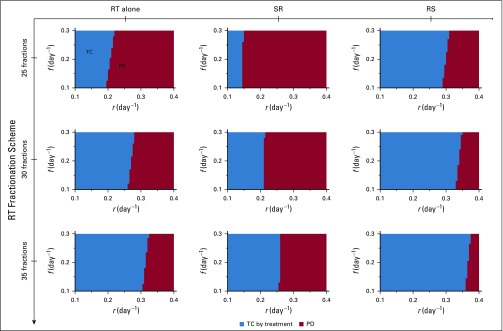
Model-predicted treatment outcomes of radiotherapy (RT) alone, RT after surgical resection (SR), and RT before surgical resection (RS) for tumors of 108 viable cancer cells pretreatment and increasing number of treatment fractions in a cohort of virtual patients with different combinations of tumor growth rate (r) and immune recruitment rate (f) in response to tumor burden. Radiation is delivered to total doses of 50, 60, and 70 Gy in 25, 30, and 35 daily fractions at 2 Gy per day, 5 days per week. Tumor control (TC) by treatment (blue) and progressive disease (PD; red) refer to tumor eradication and escape after treatment, respectively. For all simulations, we set RT-induced antitumor immunity to q = 4.5 × 10⁻¹ day−1.
FIG A2.
FIG A2.
Kaplan-Meier 20-year disease-free survival (DFS) curves for each of the considered cancer sites, with 95% CIs.
FIG A3.
FIG A3.
Results of analysis using multivariable Cox proportional hazard model performed after propensity score matching of the adjuvant and neoadjuvant radiotherapy (RT) cohorts for each cancer site separately. Hazard ratios (HRs; with 95% CIs, P values, and trend lines obtained using linear least squares weighted by the inverses of site-specific CI lengths) for (A) disease-free survival (DFS) and (B) overall survival (OS) after preoperative (neoadjuvant) radiation (RS) compared with postoperative adjuvant radiation (SR). HRs were adjusted for age, sex, year of diagnosis, histology, type of surgery, type of applied radiation, and tumor size. Equation describes the trend line, and coefficients were tested for significant difference from 0 using t test. (*) P < .05. (†) P < .001.
FIG A4.
FIG A4.
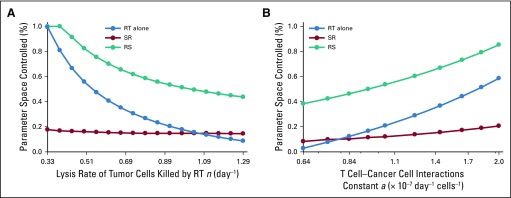
Proportion of parameter space controlled by radiotherapy (RT) alone, RT after surgical resection (SR), and RT before surgical resection (RS) for different values of (A) the lysis rate of tumor cells killed by RT (n) and (B) the T cell–cancer interactions constant (a; Equations 1 to 3). Radiation is delivered to a total dose of 50 Gy in 25 daily fractions at 2 Gy per day, 5 days per week. For all simulations, we set RT-induced antitumor immunity to q = 4.5 × 10⁻¹ day−1 and tumors of 108 viable cancer cells pretreatment.
FIG A5.
FIG A5.
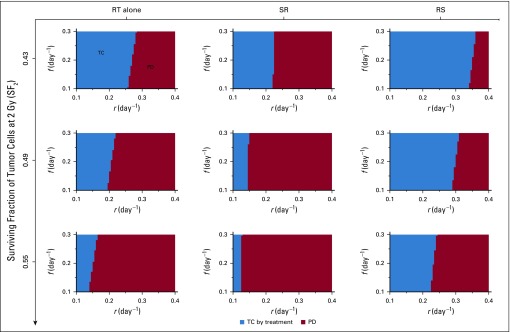
Model-predicted treatment outcomes of radiotherapy (RT) alone, RT after surgical resection (SR), and RT before surgical resection (RS) for tumors of 108 viable cancer cells pretreatment and increasing surviving fractions of tumor cells at 2 Gy (SF2) in a cohort of virtual patients with different combinations of tumor growth rate (r) and immune recruitment rate (f) in response to tumor burden. Radiation is delivered to a total dose of 50 Gy in 25 daily fractions at 2 Gy per day, 5 days per week. Tumor control (TC) by treatment (blue) and progressive disease (PD; red) refer to tumor eradication and escape after treatment, respectively. For all simulations, we set RT-induced antitumor immunity to q = 4.5 × 10⁻¹ day−1.
FIG A6.
FIG A6.
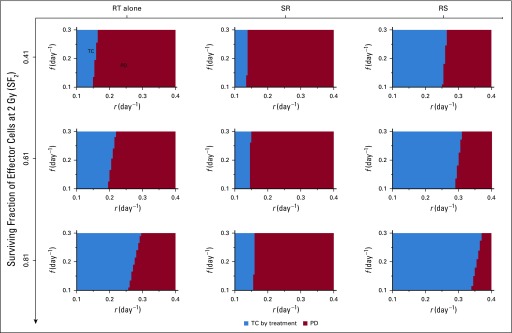
Model-predicted treatment outcomes of radiotherapy (RT) alone, RT after surgical resection (SR), and RT before surgical resection (RS) for tumors of 108 viable cancer cells pretreatment and increasing surviving fractions of effector cells at 2 Gy (SF2) in a cohort of virtual patients with different combinations of tumor growth rate (r) and immune recruitment rate (f) in response to tumor burden. Radiation is delivered to a total dose of 50 Gy in 25 daily fractions at 2 Gy per day, 5 days per week. Tumor control (TC) by treatment (blue) and progressive disease (PD; red) refer to tumor eradication and escape after treatment, respectively. For all simulations, we set RT-induced antitumor immunity to q = 4.5 × 10⁻¹ day−1.

References

    1. Fisher B, Anderson S, Bryant J, et al. Twenty-year follow-up of a randomized trial comparing total mastectomy, lumpectomy, and lumpectomy plus irradiation for the treatment of invasive breast cancer. N Engl J Med. 2002;347:1233–1241. - PubMed
    1. Kao J, Lavaf A, Teng MS, et al. Adjuvant radiotherapy and survival for patients with node-positive head and neck cancer: An analysis by primary site and nodal stage. Int J Radiat Oncol Biol Phys. 2008;71:362–370. - PubMed
    1. Creutzberg CL, van Putten WLJ, Wárlám-Rodenhuis CC, et al. Outcome of high-risk stage IC, grade 3, compared with stage I endometrial carcinoma patients: The Postoperative Radiation Therapy in Endometrial Carcinoma trial. J Clin Oncol. 2004;22:1234–1241. - PubMed
    1. Bui DL, Yu JB. Trends in adjuvant and neoadjuvant radiotherapy for cancer treatment from 1973 to 2011. Cancer J. 2015;21:147–149. - PubMed
    1. Frykholm GJ, Glimelius B, Påhlman L. Preoperative or postoperative irradiation in adenocarcinoma of the rectum: Final treatment results of a randomized trial and an evaluation of late secondary effects. Dis Colon Rectum. 1993;36:564–572. - PubMed

Publication types