Review
. 2019 Mar 22:10:587.
doi: 10.3389/fmicb.2019.00587. eCollection 2019.

Resistance Toward Chlorhexidine in Oral Bacteria - Is There Cause for Concern?

Affiliations
Review

Resistance Toward Chlorhexidine in Oral Bacteria - Is There Cause for Concern?

Fabian Cieplik et al. Front Microbiol. .

Abstract

The threat of antibiotic resistance has attracted strong interest during the last two decades, thus stimulating stewardship programs and research on alternative antimicrobial therapies. Conversely, much less attention has been given to the directly related problem of resistance toward antiseptics and biocides. While bacterial resistances toward triclosan or quaternary ammonium compounds have been considered in this context, the bis-biguanide chlorhexidine (CHX) has been put into focus only very recently when its use was associated with emergence of stable resistance to the last-resort antibiotic colistin. The antimicrobial effect of CHX is based on damaging the bacterial cytoplasmic membrane and subsequent leakage of cytoplasmic material. Consequently, mechanisms conferring resistance toward CHX include multidrug efflux pumps and cell membrane changes. For instance, in staphylococci it has been shown that plasmid-borne qac ("quaternary ammonium compound") genes encode Qac efflux proteins that recognize cationic antiseptics as substrates. In Pseudomonas stutzeri, changes in the outer membrane protein and lipopolysaccharide profiles have been implicated in CHX resistance. However, little is known about the risk of resistance toward CHX in oral bacteria and potential mechanisms conferring this resistance or even cross-resistances toward antibiotics. Interestingly, there is also little awareness about the risk of CHX resistance in the dental community even though CHX has been widely used in dental practice as the gold-standard antiseptic for more than 40 years and is also included in a wide range of oral care consumer products. This review provides an overview of general resistance mechanisms toward CHX and the evidence for CHX resistance in oral bacteria. Furthermore, this work aims to raise awareness among the dental community about the risk of resistance toward CHX and accompanying cross-resistance to antibiotics. We propose new research directions related to the effects of CHX on bacteria in oral biofilms.

Keywords: CHX; adaptation; antiseptic; chlorhexidine; efflux pump; persistence; resistance; tolerance.


Figures
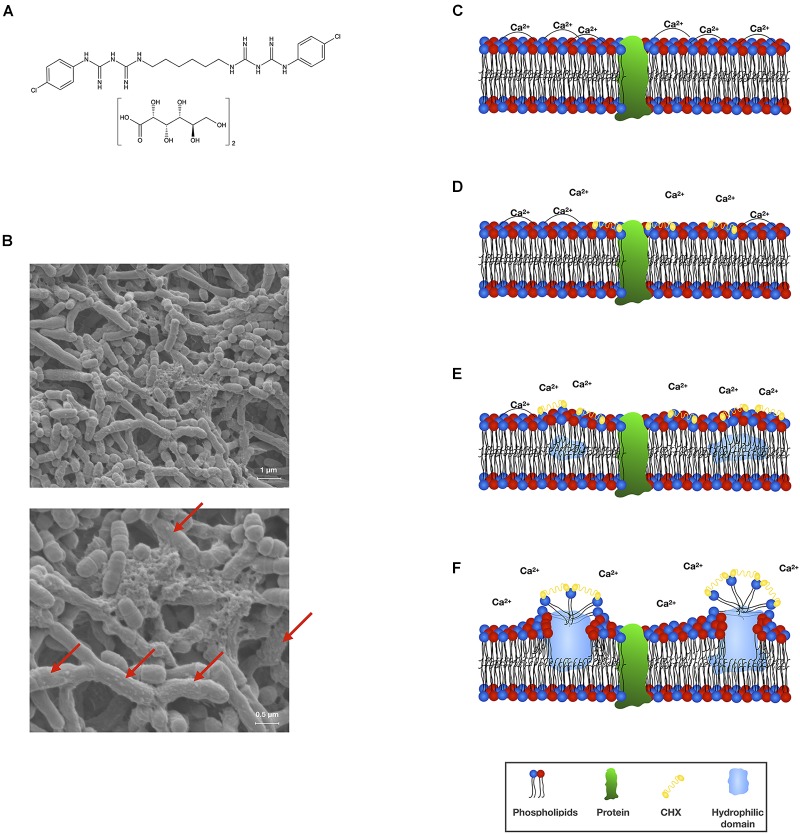
FIGURE 1
FIGURE 1
(A) Chemical structural formula of CHX digluconate. (B) Scanning electron microscopic (SEM) visualization of an in vitro polymicrobial biofilm comprising Actinomyces naeslundii, Actinomyces odontolyticus, and S. mutans (methodology as described in Cieplik et al., 2018b,c) following treatment with CHX (0.2%; 10 min). Vesicle-like structures on the surfaces of bacterial cells indicate membrane damage (indicated by red arrows). SEM images are reprinted from Cieplik et al. (2018b). (C–F) Scheme depicting the mode of action of CHX toward bacterial cytoplasmic membranes. The bacterial cytoplasmic membrane carries a net negative charge and is composed of a phospholipid bilayer with embedded proteins. The phospholipid bilayer is stabilized by divalent cations such as Ca2+ and forms a hydrophobic environment, which is essential to moderate the functionality of the embedded proteins (C). CHX (as a cationic agent) binds to the negatively charged bacterial cell surface and initially interacts with the cytoplasmic membrane. Thereby, CHX bridges between pairs of phospholipid headgroups and displaces the associated divalent cations (D). Progressive decrease in fluidity of the outer phospholipid layer with creation of hydrophilic domains within the bilayer affecting the osmoregulation and metabolic activity of the cytoplasmic membrane and its associated enzymes (E,F). This scheme was adopted and modified from Gilbert and Moore (2005).
FIGURE 2
FIGURE 2
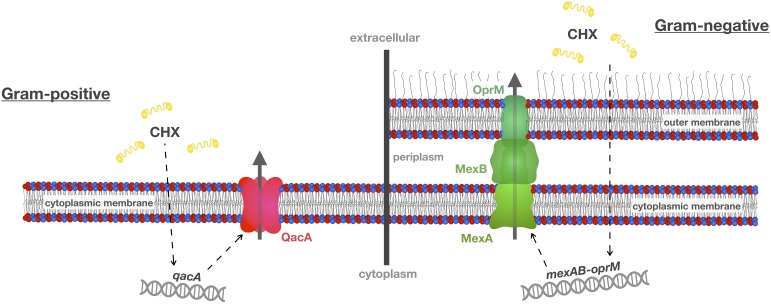
Efflux mechanisms conferring resistance toward CHX. A common resistance mechanism toward antibacterial agents such as CHX is up-regulation of multidrug efflux pumps. This scheme shows two well-known efflux systems, i.e., qacA in Gram-positive S. aureus and mexAB-oprM in Gram-negative P. aeruginosa. These efflux pumps may also be present in oral bacteria and recognize not only CHX as their substrate but also other antiseptics and antibiotics, and, thus, may contribute to cross-resistances between CHX and antibiotics. This scheme was adopted and modified from Venter et al. (2017).
FIGURE 3
FIGURE 3
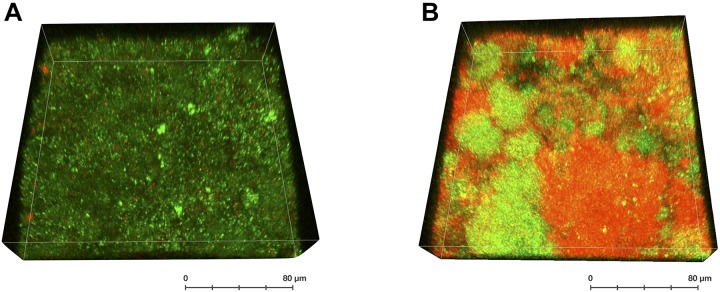
3D-reconstruction of a LIVE/DEAD-stained confocal image stack of a supragingival oral biofilm after treatment with CHX. The biofilm was formed in situ on a bovine enamel slab for 72 h (methodology as described in Al-Ahmad et al., 2015) and was either left untreated (A) or was treated with 0.2% CHX for 5 min (B). Bacteria with intact (green; considered “live”) or compromised bacterial membranes (red; considered “dead”) are depicted indicating “pockets of viable cells” within the biofilm.
FIGURE 4
FIGURE 4
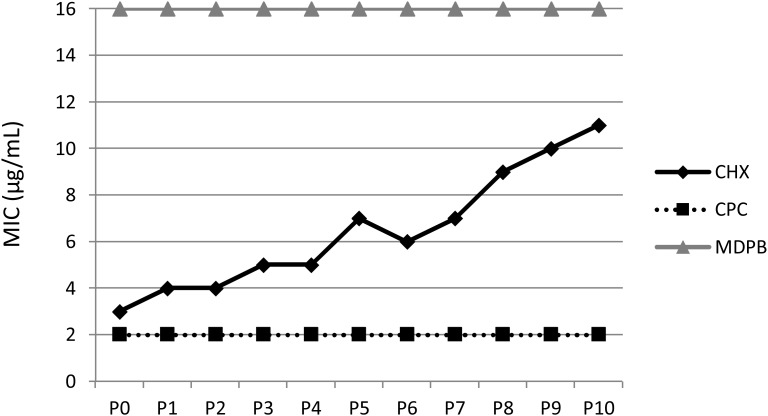
Multiple passaging of bacteria under CHX-treatment in vitro. MICs of CHX, cetylpyridinium chloride (CPC) and methacryloyloxydodecylpyridinium bromide (MDPB) repeatedly performed from passages 0–10 (P0–P10) against E. faecalis. This figure is reprinted from Kitagawa et al. (2016) with kind permission from the publisher.

References

    1. Abouassi T., Hannig C., Mahncke K., Karygianni L., Wolkewitz M., Hellwig E., et al. (2014). Does human saliva decrease the antimicrobial activity of chlorhexidine against oral bacteria? BMC Res. Notes 7:711. 10.1186/1756-0500-7-711 - DOI - PMC - PubMed
    1. Al-Ahmad A., Ameen H., Pelz K., Karygianni L., Wittmer A., Anderson A. C., et al. (2014). Antibiotic resistance and capacity for biofilm formation of different bacteria isolated from endodontic infections associated with root-filled teeth. J. Endod. 40 223–230. 10.1016/j.joen.2013.07.023 - DOI - PubMed
    1. Al-Ahmad A., Bucher M., Anderson A. C., Tennert C., Hellwig E., Wittmer A., et al. (2015). Antimicrobial photoinactivation using visible light plus water-filtered infrared-A (VIS + wIRA) alters in situ oral biofilms. PLoS One 10:e0132107. 10.1371/journal.pone.0132107 - DOI - PMC - PubMed
    1. Al-Ahmad A., Walankiewicz A., Hellwig E., Follo M., Tennert C., Wittmer A., et al. (2016). Photoinactivation using visible light plus water-filtered infrared-A (vis+wIRA) and chlorine e6 (Ce6) eradicates planktonic periodontal pathogens and subgingival biofilms. Front. Microbiol. 7:1900. 10.3389/fmicb.2016.01900 - DOI - PMC - PubMed
    1. Allerberger F., Gareis R., Jindrák V., Struelens M. J. (2009). Antibiotic stewardship implementation in the EU: the way forward. Expert Rev. Anti Infect. Ther. 7 1175–1183. 10.1586/eri.09.96 - DOI - PubMed