


Mortality attributable to seasonal influenza in Greece, 2013 to 2017: variation by type/subtype and age, and a possible harvesting effect
- PMID: 30968823
- PMCID: PMC6462785
- DOI: 10.2807/1560-7917.ES.2019.24.14.1800118
Mortality attributable to seasonal influenza in Greece, 2013 to 2017: variation by type/subtype and age, and a possible harvesting effect
Abstract
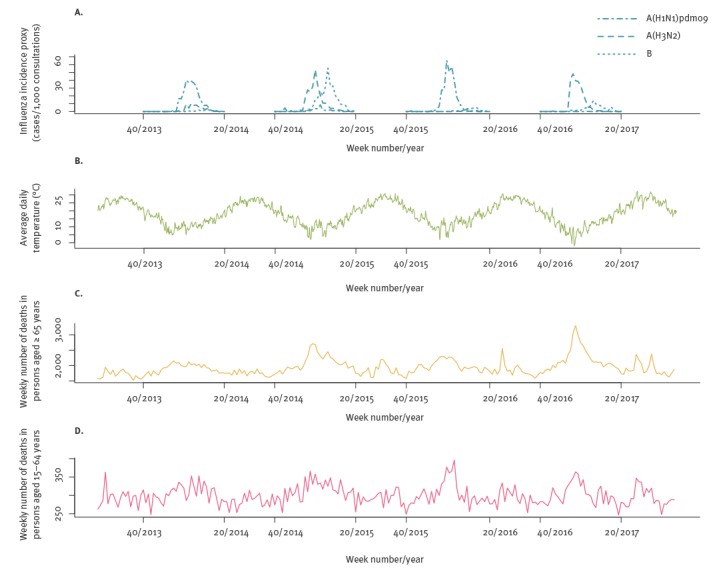
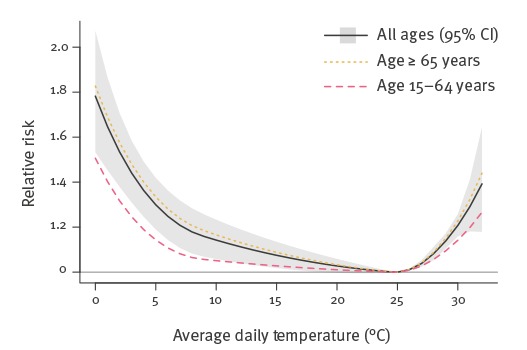
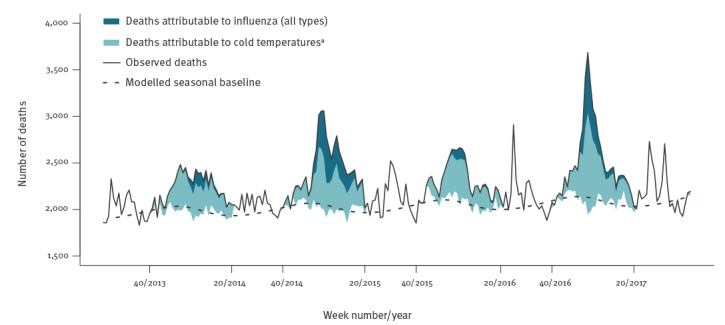
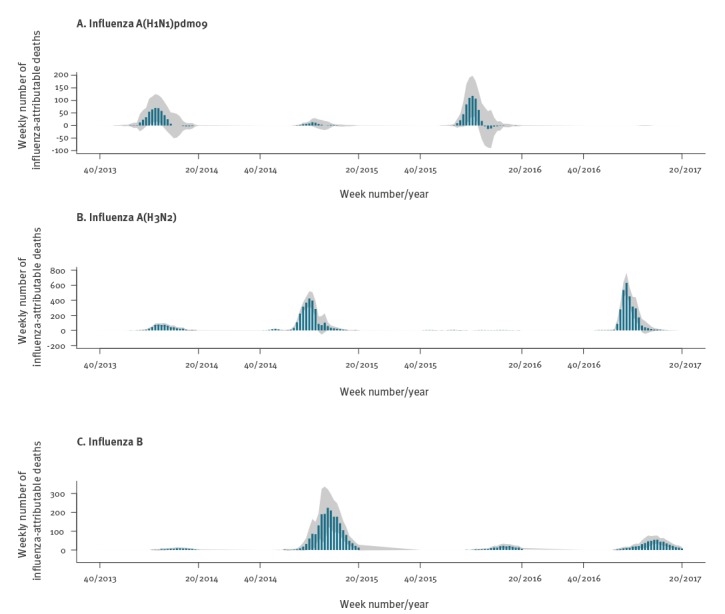
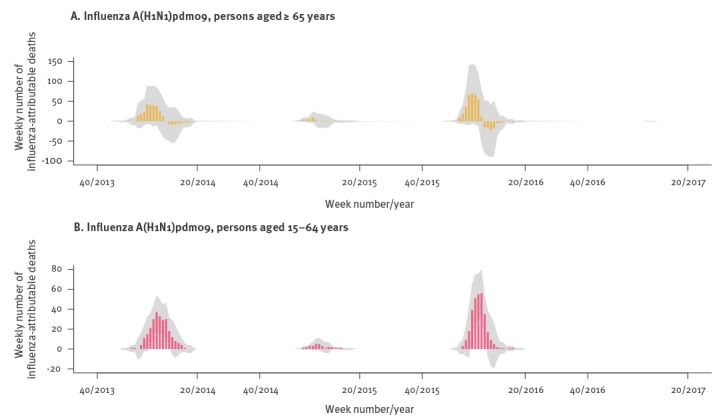
IntroductionEstimating the contribution of influenza to excess mortality in the population presents substantial methodological challenges.AimIn a modelling study we combined environmental, epidemiological and laboratory surveillance data to estimate influenza-attributable mortality in Greece, over four seasons (2013/14 to 2016/17), specifically addressing the lag dimension and the confounding effect of temperature.MethodsAssociations of influenza type/subtype-specific incidence proxies and of daily mean temperature with mortality were estimated with a distributed-lag nonlinear model with 30 days of maximum lag, separately by age group (all ages, 15-64 and ≥ 65 years old). Total and weekly deaths attributable to influenza and cold temperatures were calculated.ResultsOverall influenza-attributable mortality was 23.6 deaths per 100,000 population per year (95% confidence interval (CI): 17.8 to 29.2), and varied greatly between seasons, by influenza type/subtype and by age group, with the vast majority occurring in persons aged ≥ 65 years. Most deaths were attributable to A(H3N2), followed by influenza B. During periods of A(H1N1)pdm09 circulation, weekly attributable mortality to this subtype among people ≥ 65 years old increased rapidly at first, but then fell to zero and even negative, suggesting a mortality displacement (harvesting) effect. Mortality attributable to cold temperatures was much higher than that attributable to influenza.ConclusionsStudies of influenza-attributable mortality need to consider distributed-lag effects, stratify by age group and adjust both for circulating influenza virus types/subtypes and daily mean temperatures, in order to produce reliable estimates. Our approach addresses these issues, is readily applicable in the context of influenza surveillance, and can be useful for other countries.
Keywords: epidemiology; influenza; modelling; surveillance.
Conflict of interest statement
Figures
References
-
- Iuliano AD, Roguski KM, Chang HH, Muscatello DJ, Palekar R, Tempia S, et al. Global Seasonal Influenza-associated Mortality Collaborator Network Estimates of global seasonal influenza-associated respiratory mortality: a modelling study. Lancet. 2018;391(10127):1285-300. 10.1016/S0140-6736(17)33293-2 - DOI - PMC - PubMed
MeSH terms
LinkOut - more resources
Full Text Sources
Medical