. 2019 Jun 1;121(6):2088-2100.
doi: 10.1152/jn.00041.2019. Epub 2019 Apr 10.

Sequence learning is driven by improvements in motor planning

Affiliations

Sequence learning is driven by improvements in motor planning

Giacomo Ariani et al. J Neurophysiol. .

Abstract

The ability to perform complex sequences of movements quickly and accurately is critical for many motor skills. Although training improves performance in a large variety of motor sequence tasks, the precise mechanisms behind such improvements are poorly understood. Here we investigated the contribution of single-action selection, sequence preplanning, online planning, and motor execution to performance in a discrete sequence production task. Five visually presented numbers cued a sequence of five finger presses, which had to be executed as quickly and accurately as possible. To study how sequence planning influenced sequence production, we manipulated the amount of time that participants were given to prepare each sequence by using a forced-response paradigm. Over 4 days, participants were trained on 10 sequences and tested on 80 novel sequences. Our results revealed that participants became faster in selecting individual finger presses. They also preplanned three or four sequence items into the future, and the speed of preplanning improved for trained, but not for untrained, sequences. Because preplanning capacity remained limited, the remaining sequence elements had to be planned online during sequence execution, a process that also improved with sequence-specific training. Overall, our results support the view that motor sequence learning effects are best characterized by improvements in planning processes that occur both before and concurrently with motor execution. NEW & NOTEWORTHY Complex skills often require the production of sequential movements. Although practice improves performance, it remains unclear how these improvements are achieved. Our findings show that learning effects in a sequence production task can be attributed to an enhanced ability to plan upcoming movements. These results shed new light on planning processes in the context of movement sequences and have important implications for our understanding of the neural mechanisms that underlie skill acquisition.

Keywords: discrete sequence production; motor planning; sequence learning.


Conflict of interest statement

No conflicts of interest, financial or otherwise, are declared by the authors.

Figures
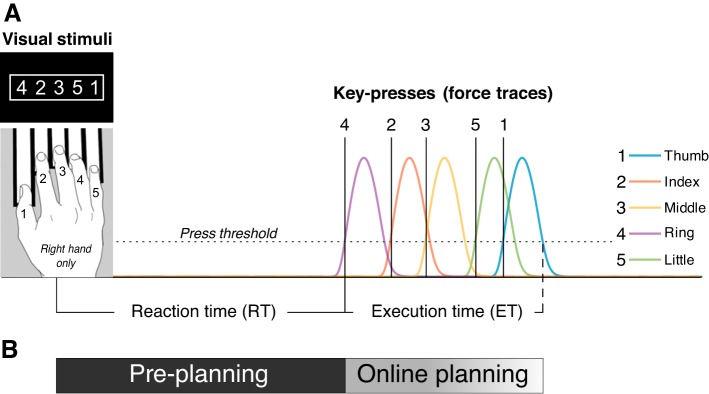
Fig. 1.
Fig. 1.
Discrete sequence production task. A: visual stimuli (e.g., numbers) instruct both which fingers to use and in what order (left to right). After a reaction time (RT), 5 key presses are executed (see force traces). B: preplanning takes place during the RT (i.e., before movement onset); online planning occurs in parallel with motor sequence execution (i.e., after movement onset).
Fig. 2.
Fig. 2.
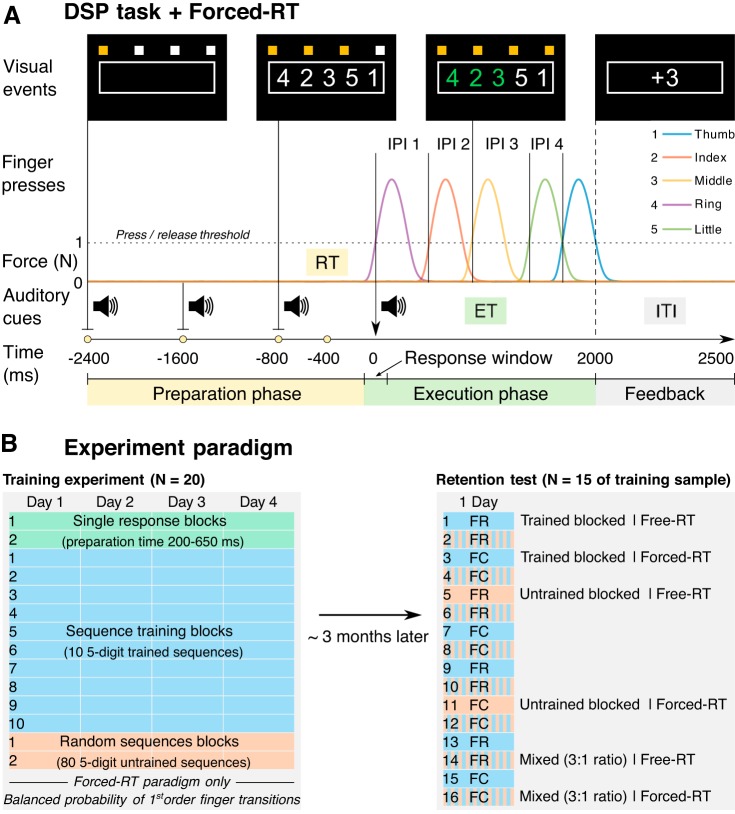
Experimental task and paradigm. A: a series of 4 audio-visual signals (800 ms apart) specifies the timing of movement initiation (vertical arrow) within the acceptable response window. Sequence cues appear at 1 of 4 time points (yellow dots) before the 4th signal (preparation phase). After completing the sequence (execution phase), participants receive points depending on their performance. Colored lines illustrate schematic force traces for the 5 finger presses in a sequence. The horizontal dotted line denotes the force threshold for a press/release. Vertical lines indicate press onsets (IPI 1 = 1st interpress interval). The vertical dashed line represents the release of the last press (end of the execution phase). DSP, discrete sequence production; RT, reaction time; ET, execution time; ITI, intertrial interval. B, left: the training experiment (n = 20, 15 women, 5 men) consisted of 4 days of training on single-response (green), sequence training (blue), and random-sequences (orange) blocks. Right: after ~3 mo we called the same participants back for a retention test (n = 15, 11 women, 4 men) with blocks of trials including trained (blue), untrained (orange), or mixed trained-untrained (striped) sequences. Mixed blocks contained 30 trained and 10 untrained sequences presented in random order. We also alternated the Forced-RT (FC) and Free-RT (FR) paradigms every 2 blocks. The initial paradigm was counterbalanced across participants.
Fig. 3.
Fig. 3.
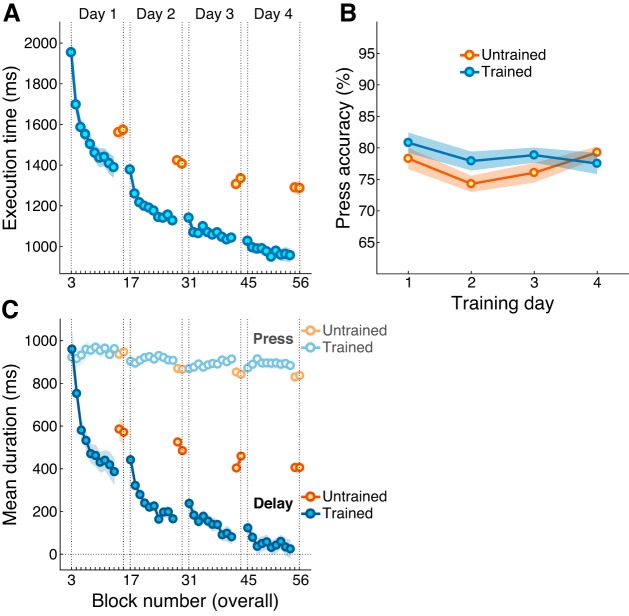
Sequence-general and sequence-specific learning. A: mean sequence execution time plotted as a function of block number separately for trained and untrained sequences. Vertical dotted lines demarcate the beginning and the end of each testing session (1 per day). Shaded areas indicate SE. B: mean sequence execution accuracy (among trials with correct timing) as a function of training day separately for trained and untrained sequences. Shaded areas indicate SE. C: mean press duration (light colors) and average delay between presses (dark colors) as a function of block number separately for trained and untrained sequences. Other conventions are the same as in A.
Fig. 4.
Fig. 4.
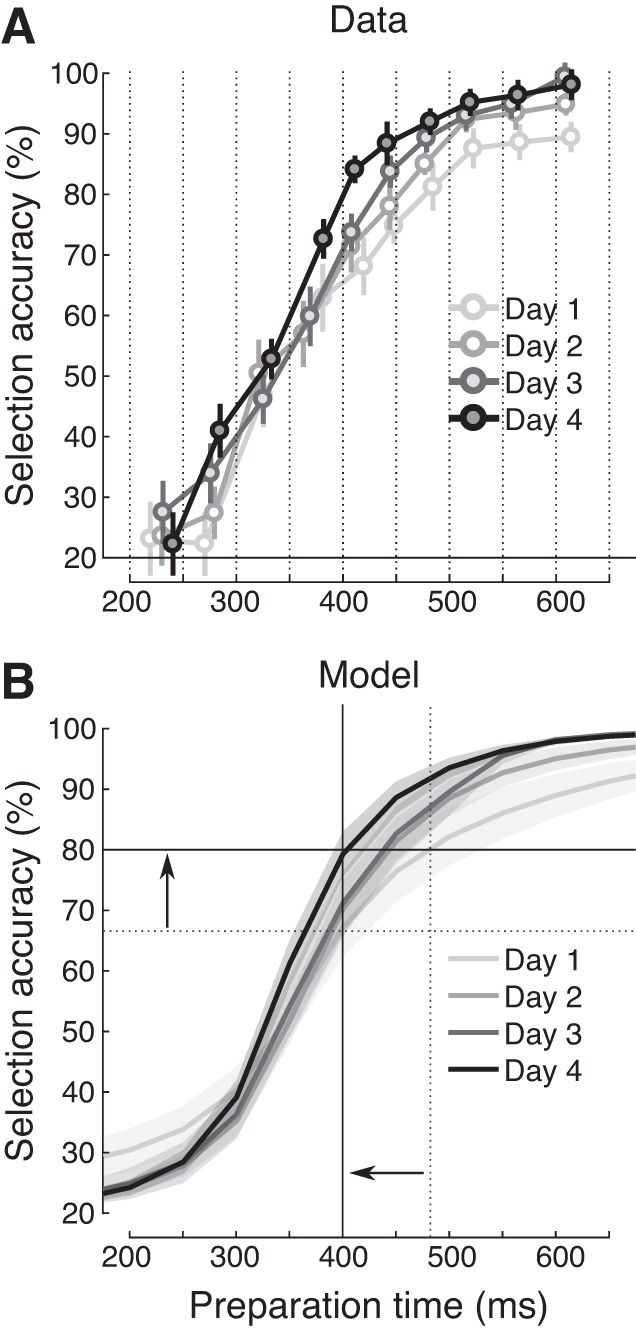
Selection of individual action elements improves with practice. A: mean single-finger selection accuracy plotted as a function of actual average reaction time (RT) separately for each testing day. Vertical dotted lines indicate the instructed preparation time as determined by Forced-RT. The horizontal solid line denotes chance level for selection accuracy (1 out of 5 fingers). Between-subject variability is plotted as error bars. B: logistic function model fits for data shown in A separately for each testing day. Solid lines and arrows serve as a visual aid to appreciate performance improvements in selection accuracy given a 400-ms preparation time (vertical solid line), and improvements in selection speed to reach 80% selection accuracy (horizontal solid line) from day 1 (dotted lines) to day 4. Shaded areas indicate SE.
Fig. 5.
Fig. 5.
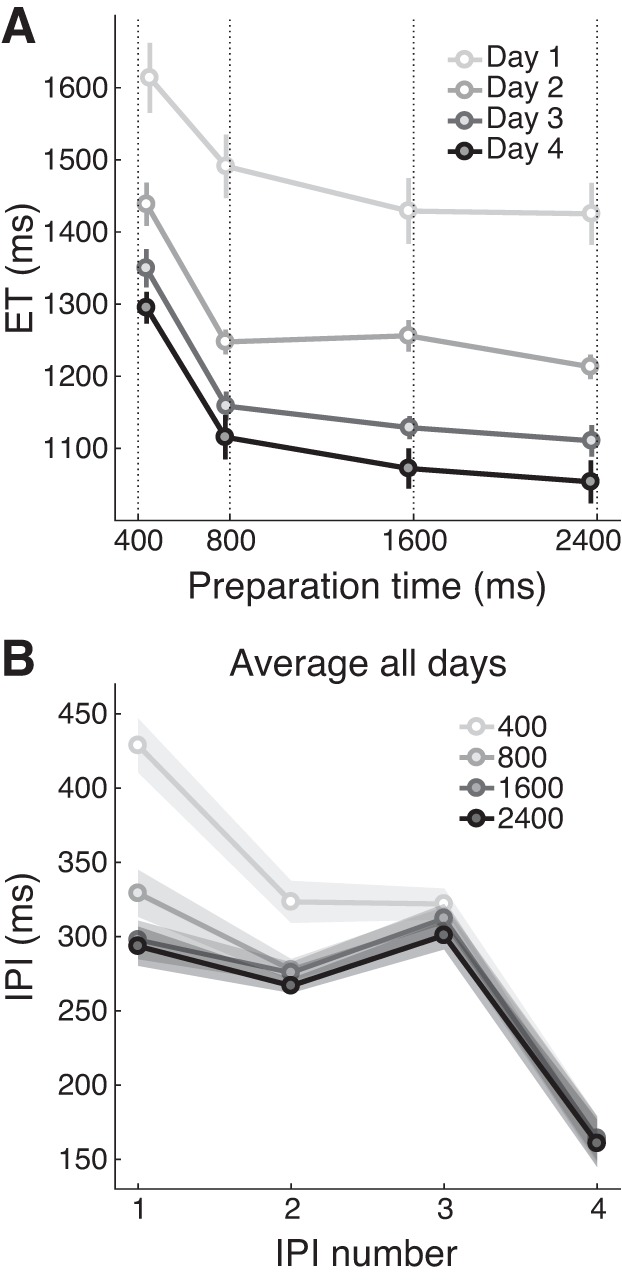
Preparation time affects the quality of sequence preplanning. A: mean execution time (ET) as a function of preparation time. Separate lines indicate results for each training day. Results are averaged across trained and untrained sequences, using the last 4 blocks for each training day. Error bars reflect SE. For each preparation time, the actual average reaction time (RT) is shown, with the instructed RT indicated by the dotted line. B: mean duration for each interpress interval (IPI), averaged across training days, with separate lines for each preparation time level. As in A, results are averaged over the last 4 blocks of each day, collapsing across trained and untrained sequences. Shaded areas indicate SE.
Fig. 6.
Fig. 6.
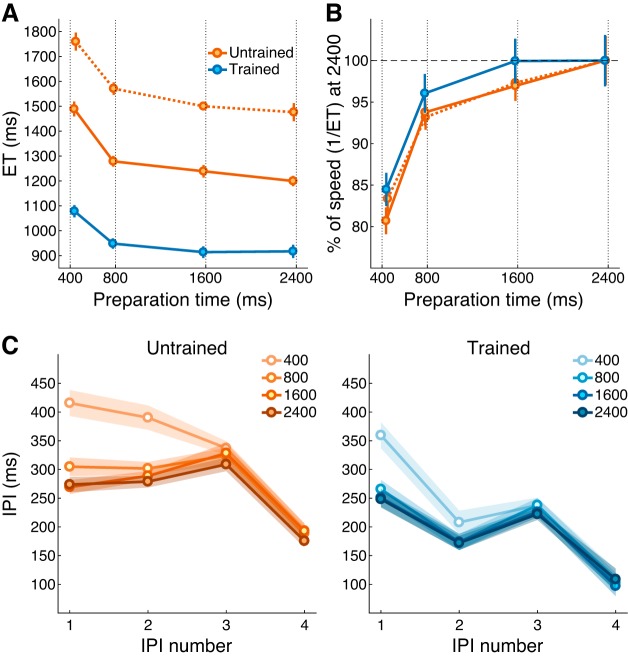
Training makes preplanning faster but not more complete. To assess sequence-general learning we compared performance for untrained sequences between day 1 and day 4. To assess sequence-specific learning, we compared trained and untrained sequences on day 4 (the last 4 blocks: 2 trained, 2 untrained). A: mean execution time (ET) as a function of preparation time, separately for untrained sequences on day 1 (orange dotted) and trained (blue) and untrained (orange solid) sequences on day 4. Other figure conventions are the same as in Fig. 5A. B: speed (1/ET), expressed as % of the individual speed reached at 2,400-ms preparation time, separately for untrained sequences on day 1 (orange dotted) and trained (blue) and untrained (orange solid) sequences on day 4. C: mean interpress interval (IPI) duration on day 4 separately for untrained (left) and trained (right) sequences and preparation time levels. Shaded areas indicate SE.
Fig. 7.
Fig. 7.
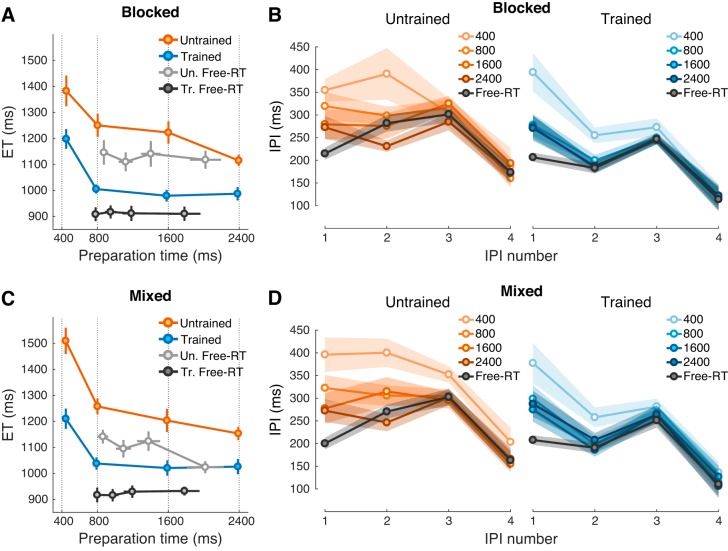
Performance improvements are stable across time and experiment paradigm (retention test). A: mean execution time (ET) as a function of preparation time levels with the factor sequence type Blocked separately for trained and untrained sequences in the Forced-reaction time (RT) condition and trained (Tr) and untrained (Un) sequences in the Free-RT condition. For visualization purposes, data from the Free-RT condition were subdivided into bins separated by actual RT quartiles (4 data points per subject, from left to right, respectively), but statistical analyses were performed on unsplit data (1 data point per subject). Other figure conventions are the same as in Fig. 5A. B: mean duration for each interpress interval (IPI) in Blocked blocks separately for untrained (left) and trained (right) sequences and preparation time (in ms). For sake of comparison, mean IPI durations for the Free-RT task are also plotted. Shaded areas indicate SE. C: same as A but with factor sequence type Mixed. D: same as B but for Mixed blocks of trials.
Fig. 8.
Fig. 8.
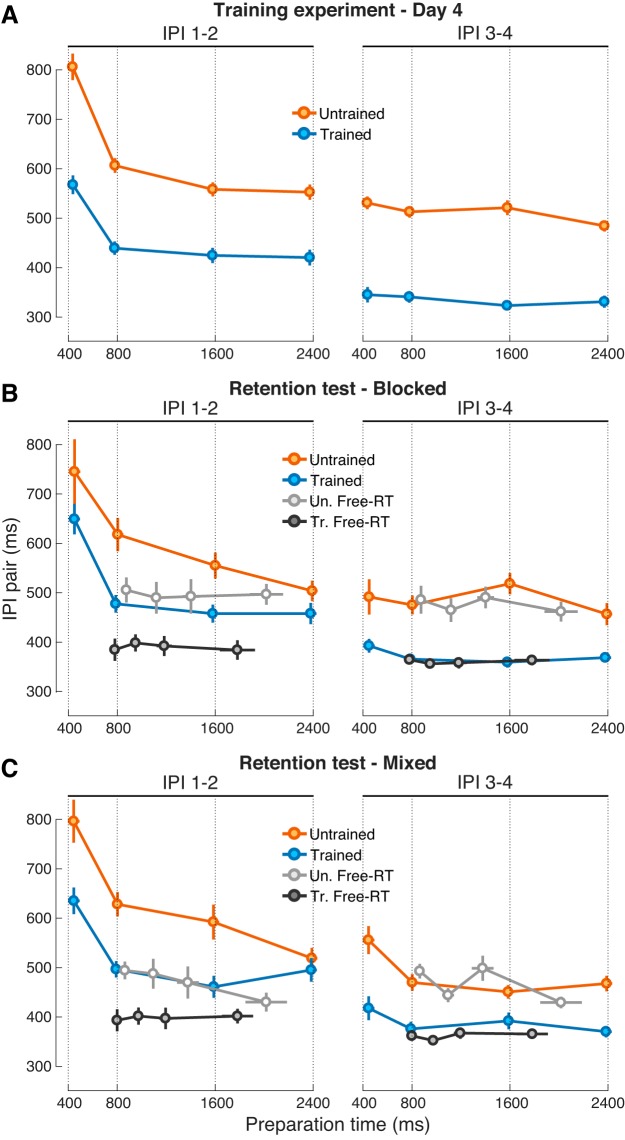
Improved online planning robustly underlies sequence-specific learning. Mean duration of interpress interval (IPI) pairs (IPIs 1 and 2, left; IPIs 3 and 4, right) as a function of preparation time (in ms) separately for trained and untrained sequences in the Forced-reaction time (RT) condition and trained (Tr) and untrained (Un) sequences in the Free-RT condition. Other figure conventions are the same as in Fig. 7A. A: training experiment, day 4, last 4 blocks (2 trained, 2 untrained). B: retention test, Blocked blocks. C: retention test, Mixed blocks.

References

    1. Abrahamse EL, Ruitenberg MFL, de Kleine E, Verwey WB. Control of automated behavior: insights from the discrete sequence production task. Front Hum Neurosci 7: 82, 2013. doi:10.3389/fnhum.2013.00082. - DOI - PMC - PubMed
    1. Averbeck BB, Chafee MV, Crowe DA, Georgopoulos AP. Parallel processing of serial movements in prefrontal cortex. Proc Natl Acad Sci USA 99: 13172–13177, 2002. doi:10.1073/pnas.162485599. - DOI - PMC - PubMed
    1. Bays PM, Husain M. Dynamic shifts of limited working memory resources in human vision. Science 321: 851–854, 2008. doi:10.1126/science.1158023. - DOI - PMC - PubMed
    1. Beukema P, Verstynen T. Predicting and binding: interacting algorithms supporting the consolidation of sequential motor skills. Curr Opin Behav Sci 20: 98–103, 2018. doi:10.1016/j.cobeha.2017.11.014. - DOI
    1. Cowan N. The magical mystery four: how is working memory capacity limited, and why? Curr Dir Psychol Sci 19: 51–57, 2010. doi:10.1177/0963721409359277. - DOI - PMC - PubMed

Publication types

LinkOut - more resources