Review
. 2019 Jun;15(26):e1900228.
doi: 10.1002/smll.201900228. Epub 2019 Apr 10.

Dynamic DNA Structures

Affiliations
Review

Dynamic DNA Structures

Yingwei Zhang et al. Small. 2019 Jun.

Abstract

Dynamic DNA structures, a type of DNA construct built using programmable DNA self-assembly, have the capability to reconfigure their conformations in response to environmental stimulation. A general strategy to design dynamic DNA structures is to integrate reconfigurable elements into conventional static DNA structures that may be assembled from a variety of methods including DNA origami and DNA tiles. Commonly used reconfigurable elements range from strand displacement reactions, special structural motifs, target-binding DNA aptamers, and base stacking components, to DNA conformational change domains, etc. Morphological changes of dynamic DNA structures may be visualized by imaging techniques or may be translated to other detectable readout signals (e.g., fluorescence). Owing to their programmable capability of recognizing environmental cues with high specificity, dynamic DNA structures embody the epitome of robust and versatile systems that hold great promise in sensing and imaging biological analytes, in delivering molecular cargos, and in building programmable systems that are able to conduct sophisticated tasks.

Keywords: DNA walkers and circuits; dynamic DNA structures; nanorobotic transportation of molecular cargos; self-assembly; sensing and imaging.


Conflict of interest statement

Conflict of Interest

The authors declare no conflict of interest.

Figures
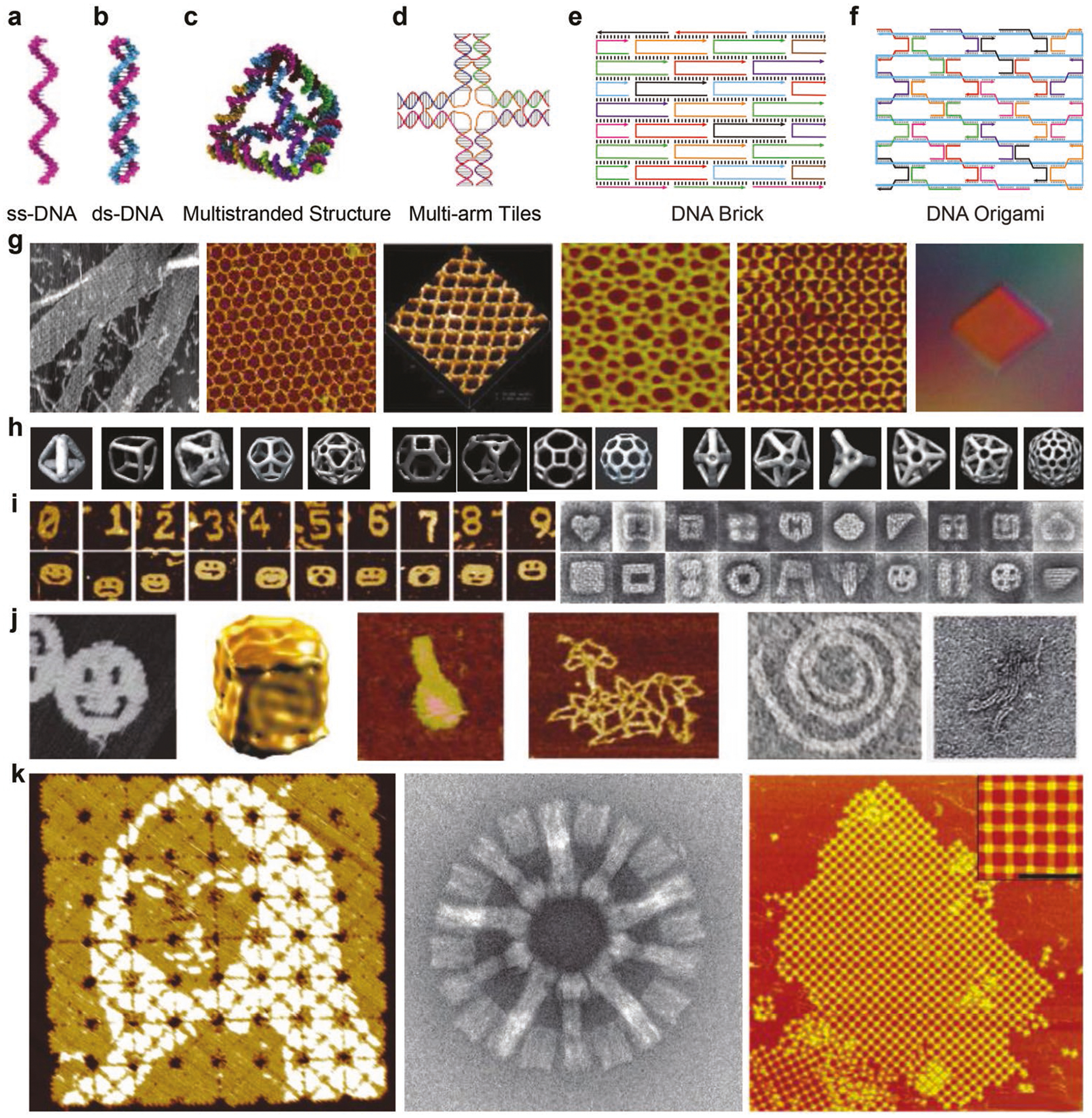
Figure 1.
Figure 1.
Assembly strategies and representative DNA structures. a–f) Assembly strategies for constructing DNA structures including single-stranded DNA, double-stranded DNA duplex, multistranded DNA structures, multiarm tiles, DNA bricks, and DNA origami. g) Infinite-sized 2D lattices and 3D crystal assembled multiarm DNA tiles. Reproduced with permission.[,–13] Copyright 1998, Springer Nature; 2005, ACS; 2003, AAAS; 2008, NAS; 2006, ACS; 2009, Springer Nature. h) 3D polyhedral structures assembled from multiarm DNA tiles. Reproduced with permission.[–17] Copyright 2008, Springer Nature; 2014, Wiley-VCH.; 2016, ACS; 2009, ACS. i) 2D and 3D objects assembled from DNA bricks. Reproduced with permission.[6,7] Copyright 2012, Springer Nature; 2012, AAAS. j) 2D and 3D objects assembled from DNA origami. Reproduced with permission.[,–22] Copyright 2006, Springer Nature; 2009, Springer Nature; 2011, AAAS; 2015, Springer Nature; 2009, AAAS; 2011, Springer Nature and k) enlarged DNA origami structures via hierarchical assembly of DNA origami units. Reproduced with permission.[–25] Copyright 2017, Springer Nature; 2017, Springer Nature; 2011, Wiley-VCH.
Figure 2.
Figure 2.
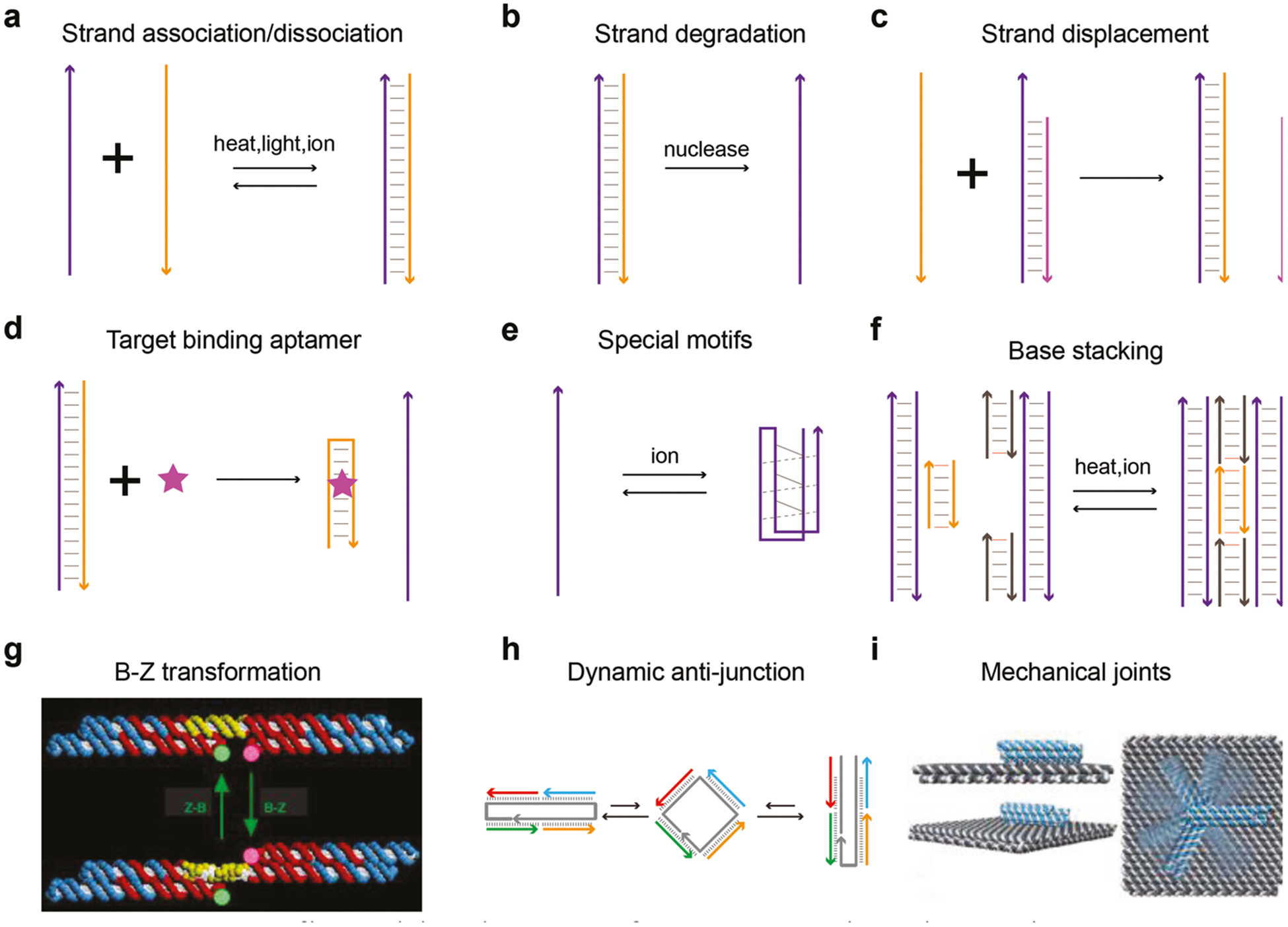
Reconfigurable elements for constructing dynamic DNA structures. a) DNA strands associate or dissociate upon environmental stimulation. b) Degradation of DNA strands. c) Toehold mediated strand displacement. d) Target binding DNA aptamers induced strand displacement. e) Special DNA motifs that change secondary structures in response to environmental cues. f) DNA blunt-end mediated base stacking. g) DNA duplex transits between B-form and Z-form. Reproduced with permission.[35] Copyright 1999, Springer Nature. h) Dynamic antijunction unit. Reproduced with permission.[36] Copyright 2017, AAAS and i) flexible mechanical joint that rotates by electric force. Reproduced with permission.[37] Copyright 2018, AAAS.
Figure 3.
Figure 3.
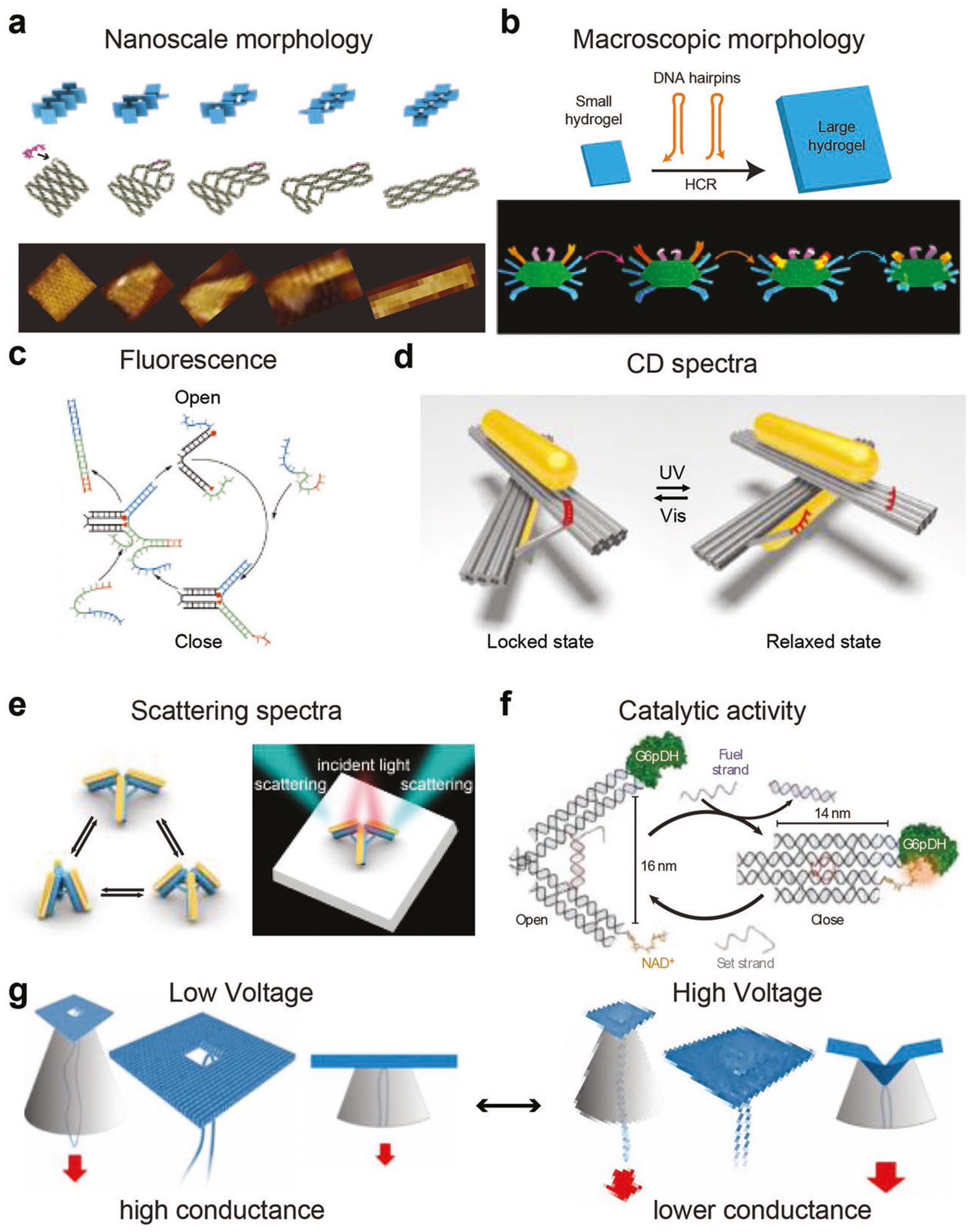
Readout signals of dynamic DNA structures. a) Nanoscale morphology change of dynamic DNA structures composing of antijunctions. Reproduced with permission.[36] Copyright 2017, AAAS. b) DNA hybridization chain reaction induced macroscopic morphology change in polyacrylamide hydrogels. Reproduced with permission.[40] Copyright 2017, AAAS. c) Open and close of a DNA tweezer regulates FRET efficiency. Reproduced with permission.[30] Copyright 2000, Springer Nature. d) A chiral gold nanorod nanodevice with photo-tunable CD signal. Reproduced with permission.[26] Copyright 2016, Springer Nature. e) Dynamic gold nanorod tripod with tunable scattering property. Reproduced with permission.[42] Copyright 2017, ACS. f) The catalytic activity of an enzyme mediated by underlying dynamic DNA structure. Reproduced with permission.[43] Copyright 2013, Springer Nature and g) the conductance of DNA origami nanopore controlled by the voltage-dependent dynamic deformation of origami structure. Reproduced with permission.[46] Copyright 2014, ACS.
Figure 4.
Figure 4.
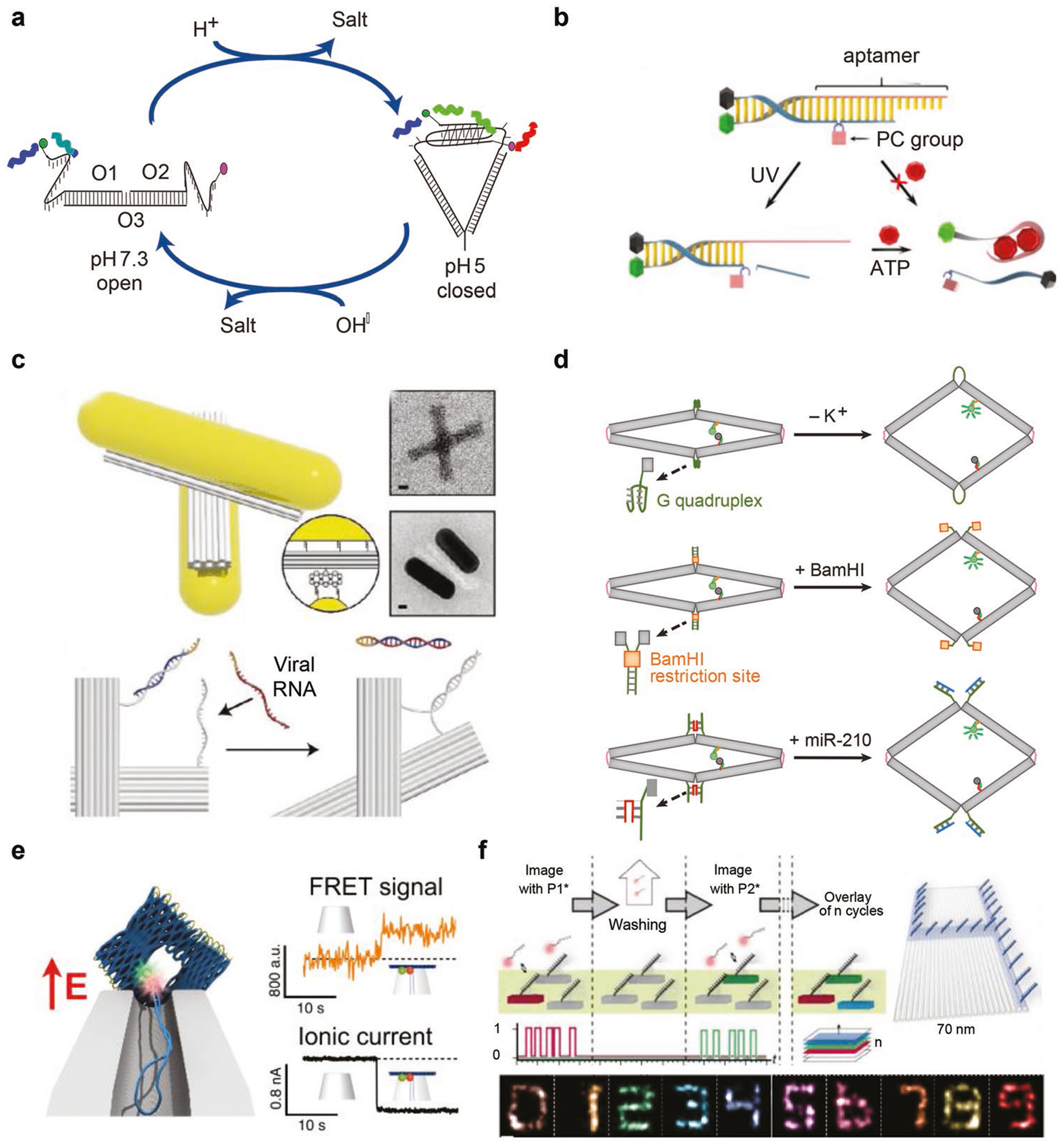
Dynamic DNA structures for biological sensing and imaging. a) A i-motif–based pH sensor that is capable of mapping the intracellular pH. Reproduced with permission.[47] Copyright 2009, Springer Nature. b) A light activatable, aptamer-based sensor for intracellular ATP sensing. Reproduced with permission.[50] Copyright 2018, ACS. c) A chiroptical metamolecule for viral RNA sensing in vitro. Reproduced with permission.[51] Copyright 2018, Wiley-VCH. d) Biosensing of ions, proteins, or nucleic acids via allosteric activation of nanoactuator. Reproduced with permission.[52] Copyright 2016, Springer Nature. e) Optical voltage sensing device based on DNA origami nanopore with responsive deformation upon eletrical stimulation. Reproduced with permission.[53] Copyright 2018, ACS and f) transient binding of fluorophore DNA (DNA-PAINT) for optical imaging at sub-10 nm resolution. Reproduced with permission.[54] Copyright 2014, Springer Nature.
Figure 5.
Figure 5.
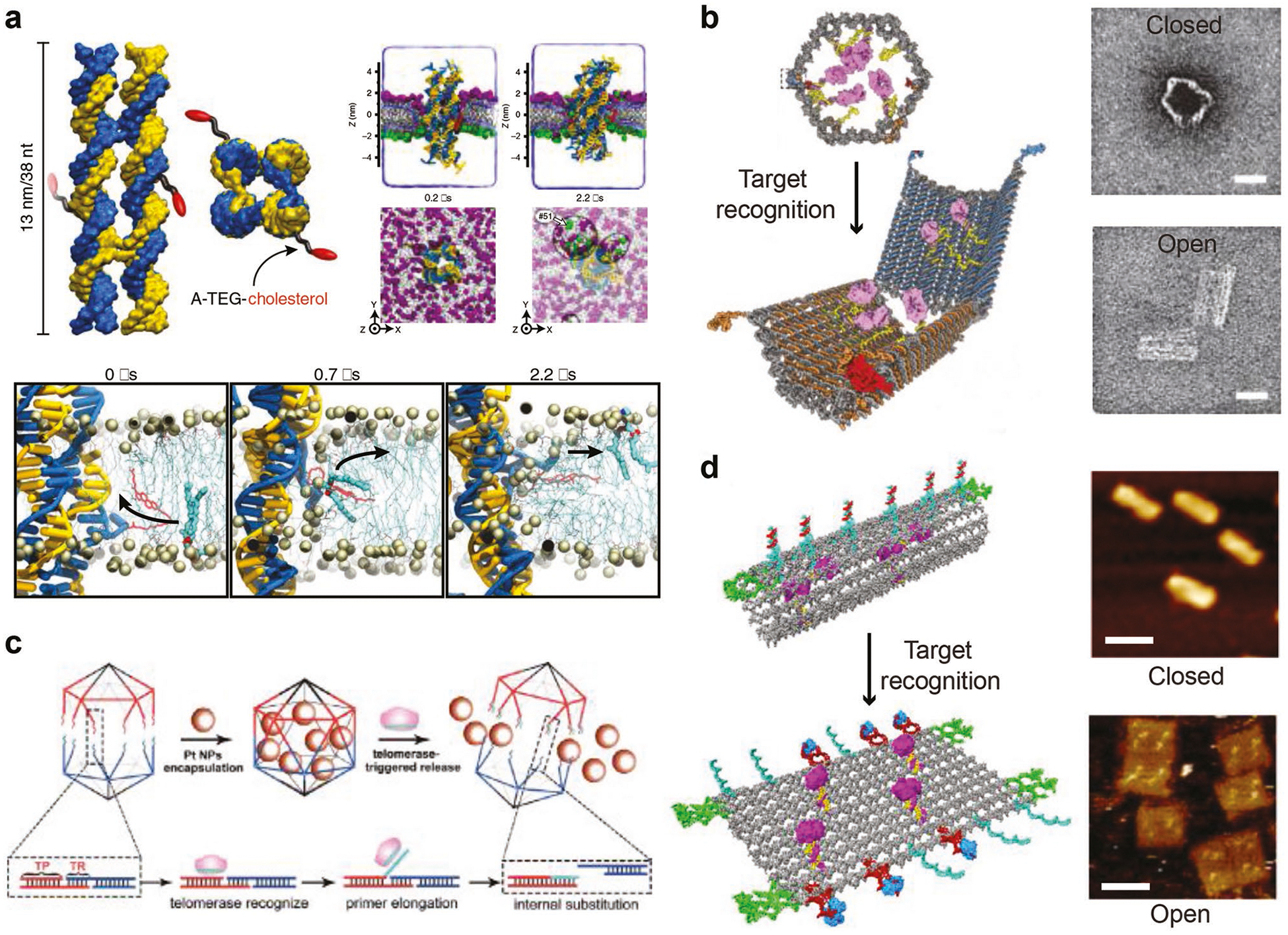
Dynamic DNA structures for molecular cargo transportation. a) A DNA nanostructure with cholesterol tags that scrambles lipid molecules between interior and outerior membranes at high speed. Reproduced with permission.[55] Copyright 2018, Springer Nature. b) A DNA origami barrel that opens and releases molecular payloads upon recognizing receptors on cell membrane. Reproduced with permission.[59] Copyright 2012, AAAS. c) A DNA icosahedron that releases Pt nanoparticles once triggered by telomerase in vitro and in vivo. Reproduced with permission.[60] Copyright 2018, Wiley-VCH. d) A tubular DNA origami robot that opens and releases thrombin in vivo upon stimulation by a molecular cancer biomarker nucleolin. Reproduced with permission.[61] Copyright 2018, Springer Nature.
Figure 6.
Figure 6.
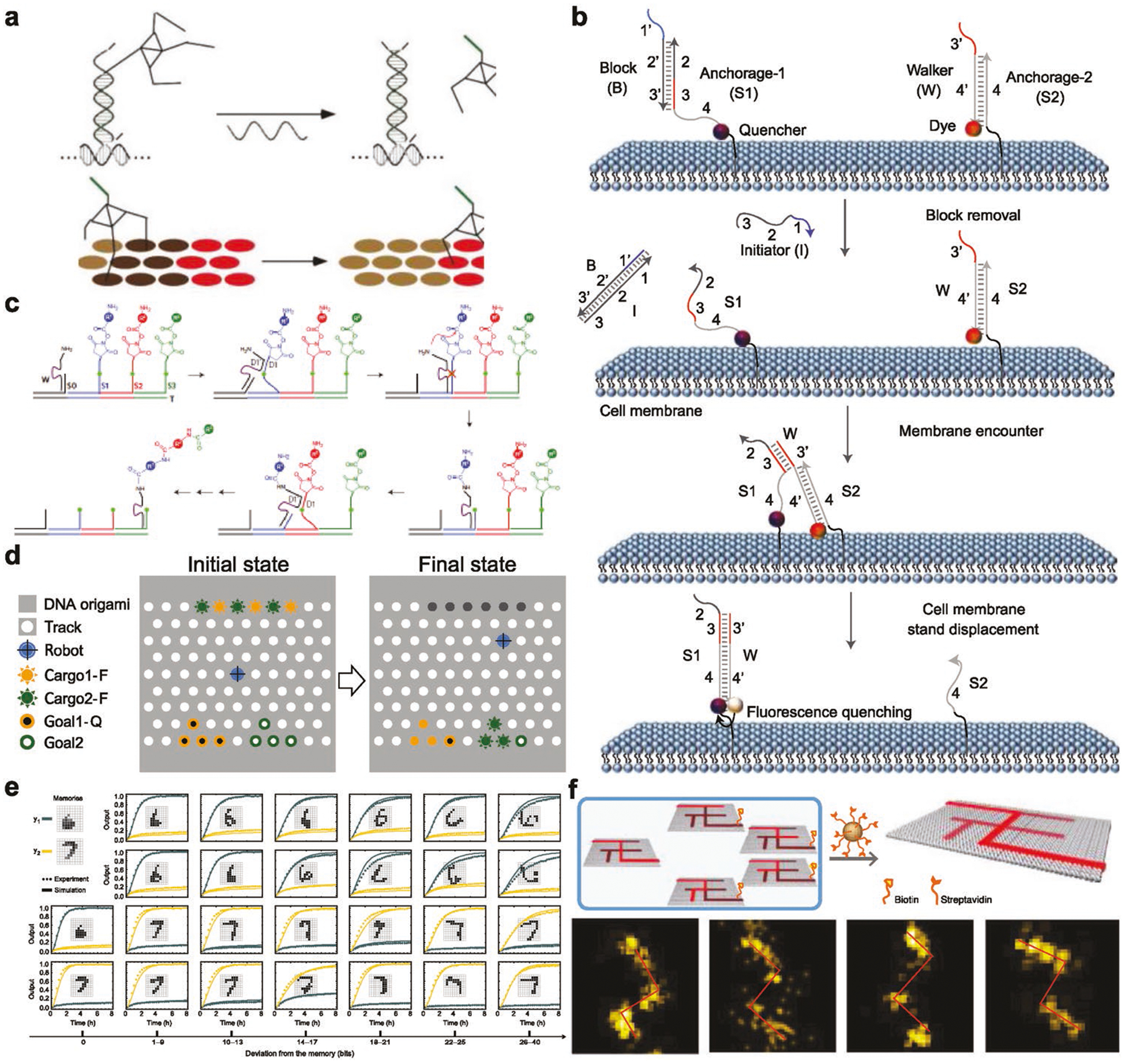
Programmable DNA walkers and circuits. a) A DNA walker that walks along a prescriptive landscape. Reproduced with permission.[62] Copyright 2010, Springer Nature. b) DNA probes for monitoring dynamic and transient molecular encounters on live cell membranes. Reproduced with permission.[63] Copyright 2017, Springer Nature. c) DNA walker enables precise and step-wise chemical synthesis. Reproduced with permission.[64] Copyright 2010, Springer Nature. d) A cargo-sorting robot that pick up and transport a prescribed cargo to a designated site on a DNA origami field. Reproduced with permission.[65] Copyright 2017, AAAS. e) DNA circuits that are trained to recognize molecular patterns of high accuracy. Reproduced with permission.[66] Copyright 2018, Springer Nature and f) a DNA navigator that is capable of maze solving. Reproduced with permission.[67] Copyright 2019, Springer Nature.

References

    1. Watson JD, Crick FH, Nature 1953, 171, 737. - PubMed
    1. Seeman NC, J. Theor. Biol 1982, 99, 237. - PubMed
    1. Hong F, Zhang F, Liu Y, Yan H, Chem. Rev 2017, 117, 12584. - PubMed
    1. Goodman RP, Berry RM, Turberfield AJ, Chem. Commun 2004, 0, 1372. - PubMed
    1. Yan H, Park SH, Finkelstein G, Reif JH, LaBean TH, Science 2003, 301, 1882. - PubMed

Publication types

LinkOut - more resources