. 2019 Apr 9;11(4):803.
doi: 10.3390/nu11040803.

Rosmarinic and Sinapic Acids May Increase the Content of Reduced Glutathione in the Lenses of Estrogen-Deficient Rats

Affiliations

Rosmarinic and Sinapic Acids May Increase the Content of Reduced Glutathione in the Lenses of Estrogen-Deficient Rats

Maria Zych et al. Nutrients. .

Abstract

Oxidative stress is believed to be associated with both postmenopausal disorders and cataract development. Previously, we have demonstrated that rosmarinic and sinapic acids, which are diet-derived antioxidative phenolic acids, counteracted some disorders induced by estrogen deficiency. Other studies have shown that some phenolic acids may reduce cataract development in various animal models. However, there is no data on the effect of phenolic acids on oxidative stress markers in the lenses of estrogen-deficient rats. The study aimed to investigate whether administration of rosmarinic acid and sinapic acid affects the antioxidative abilities and oxidative damage parameters in the lenses of estrogen-deficient rats. The study was conducted on three-month-old female Wistar rats. The ovariectomized rats were orally treated with rosmarinic acid at doses of 10 and 50 mg/kg or sinapic acid at doses of 5 and 25 mg/kg, for 4 weeks. The content of reduced glutathione (GSH), oxidized glutathione and amyloid β1-42, as well as products of protein and lipid oxidation, were assessed. Moreover, the activities of superoxide dismutase, catalase, and some glutathione-related enzymes in the lenses were determined. Rosmarinic and sinapic acids in both doses resulted in an increase in the GSH content and glutathione reductase activity. They also improved parameters connected with protein oxidation. Since GSH plays an important role in maintaining the lens transparency, the increase in GSH content in lenses after the use of rosmarinic and sinapic acids seems to be beneficial. Therefore, both the investigated dietary compounds may be helpful in preventing cataract.

Keywords: estrogen-deficient rats; lenses; oxidative stress; reduced glutathione; rosmarinic acid; sinapic acid.


Conflict of interest statement

The authors declare no conflict of interest.

Figures
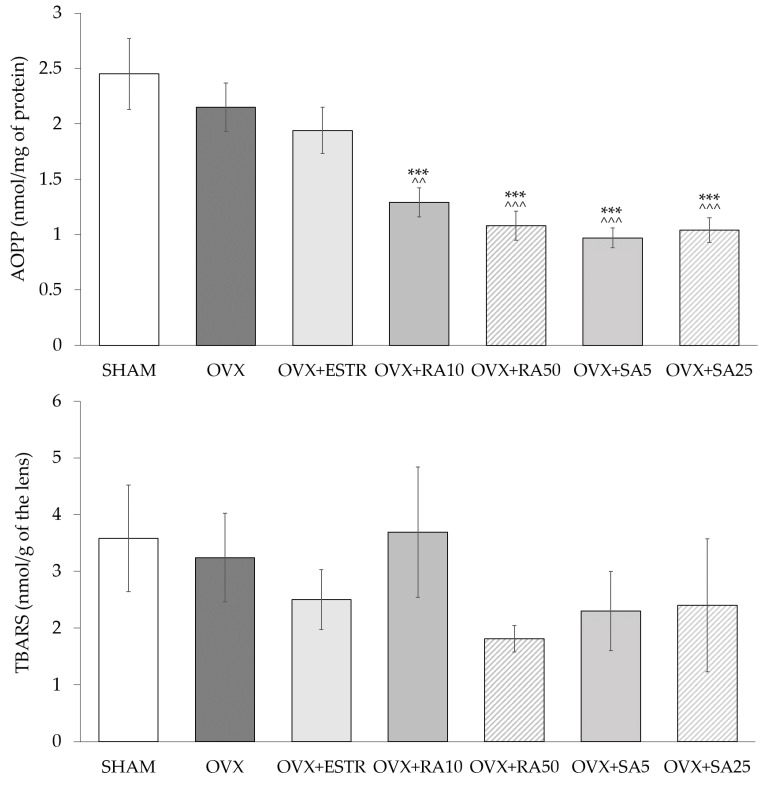
Figure 1
Figure 1
Effect of rosmarinic acid and sinapic acid on the AOPP and TBARS content in the lenses of ovariectomized rats. Rosmarinic acid at doses of 10 mg/kg (OVX + RA10) and 50 mg/kg (OVX + RA50), sinapic acid at doses of 5 mg/kg (OVX + SA5) and 25 mg/kg (OVX + SA25) or estradiol at a dose 0.2 mg/kg (OVX + ESTR) were administered orally to ovariectomized rats, once daily for 28 days. SHAM: sham-operated control rats; OVX: ovariectomized control rats; TBARS: thiobarbituric acid reactive substances; AOPP: advanced oxidation protein products. Results are presented as the mean ± SEM. One-way ANOVA followed by Duncan’s test were used for evaluation of the significance of the results. *** p < 0.001: significant differences with regard to the SHAM control rats. ^^ p < 0.01, ^^^ p < 0.001—significant differences with regard to the OVX control rats. No statistically significant differences in results for TBARS were demonstrated by ANOVA.
Figure 2
Figure 2
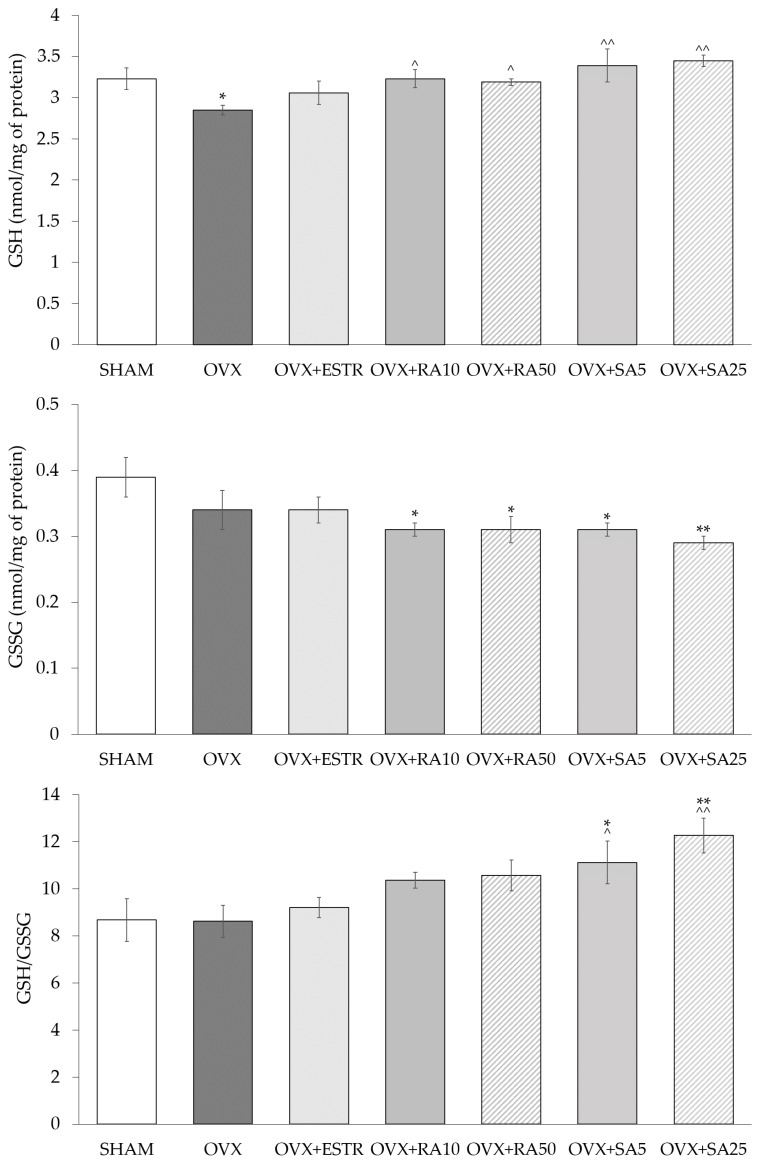
Effect of rosmarinic acid and sinapic acid on the GSH and GSSG content and on the GSH/GSSG ratio in the lenses of ovariectomized rats. Rosmarinic acid at doses of 10 mg/kg (OVX + RA10) and 50 mg/kg (OVX + RA50), sinapic acid at doses of 5 mg/kg (OVX + SA5) and 25 mg/kg (OVX + SA25) or estradiol at a dose 0.2 mg/kg (OVX+ESTR) were administered orally to ovariectomized rats, once daily for 28 days. SHAM: sham-operated control rats; OVX: ovariectomized control rats; GSH: reduced glutathione; GSSG: oxidized glutathione. Results are presented as the mean ± SEM. One-way ANOVA followed by Duncan’s test were used for evaluation of the significance of the results. * p ≤ 0.05, ** p < 0.01: significant differences with regard to the SHAM control rats. ^ p ≤ 0.05, ^^ p < 0.01: significant differences with regard to the OVX control rats.
Figure 3
Figure 3
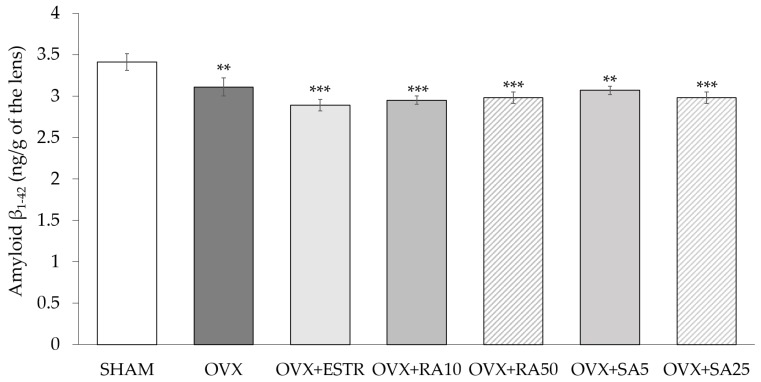
Effect of rosmarinic acid and sinapic acid on the amyloid β1-42 content and on the GSH/GSSG ratio in the lenses of ovariectomized rats. Rosmarinic acid at doses of 10 mg/kg (OVX + RA10) and 50 mg/kg (OVX + RA50), sinapic acid at doses of 5 mg/kg (OVX + SA5) and 25 mg/kg (OVX + SA25) or estradiol at a dose 0.2 mg/kg (OVX+ESTR) were administered orally to ovariectomized rats, once daily for 28 days. SHAM: sham-operated control rats; OVX: ovariectomized control rats. Results are presented as the mean ± SEM. One-way ANOVA followed by Duncan’s test were used for evaluation of the significance of the results. ** p < 0.01, *** p < 0.001: significant differences with regard to the SHAM control rats.

References

    1. Klein B.E.K., Klein R., Linton K.L.P. Prevalence of age-related lens opacities in a population. The Beaver Dam Eye Study. Ophthalmology. 1992;99:546–552. doi: 10.1016/S0161-6420(92)31934-7. - DOI - PubMed
    1. Zhang J.S., Xu L., Wang Y.X., You Q.S., Da Wang J., Jonas J.B. Five-year incidence of age-related cataract and cataract surgery in the adult population of Greater Beijing. The Beijing Eye Study. Ophthalmology. 2011;118:711–718. doi: 10.1016/j.ophtha.2010.08.021. - DOI - PubMed
    1. Lai K., Cui J., Ni S., Zhang Y., He J., Yao K. The effects of postmenopausal hormone use on cataract: A meta-analysis. PLoS ONE. 2013;8:e78647. doi: 10.1371/journal.pone.0078647. - DOI - PMC - PubMed
    1. Celojevic D., Petersen A., Karlsson J.-O., Behndig A., Zetterberg M. Effects of 17β-estradiol on proliferation, cell viability and intracellular redox status in native human lens epithelial cells. Mol. Vis. 2011;17:1987–1996. - PMC - PubMed
    1. Gottipati S., Cammarata P.R. Mitochondrial superoxide dismutase activation with 17 β-estradiol-treated human lens epithelial cells. Mol. Vis. 2008;14:898–905. - PMC - PubMed