


Targeting MIAT reduces apoptosis of cardiomyocytes after ischemia/reperfusion injury
- PMID: 30971184
- PMCID: PMC6527071
- DOI: 10.1080/21655979.2019.1605812
Targeting MIAT reduces apoptosis of cardiomyocytes after ischemia/reperfusion injury
Abstract
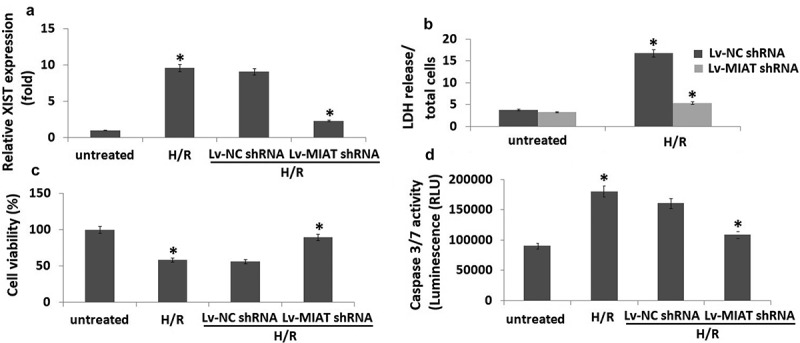
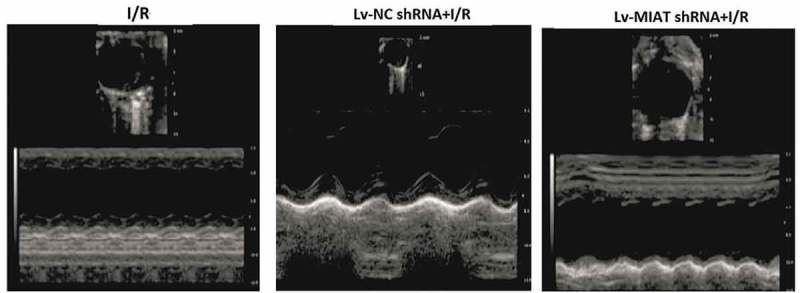
This study aims to investigate the role of targeting lncRNA myocardial infarction-associated transcript (MIAT) in protection against hypoxia/reoxygenation (H/R) injury in H9c2 cells in vitro and myocardial ischemia/reperfusion (I/R) injury in vivo by regulating expression of NF-kB and p53 upregulated modulator of apoptosis (PUMA). H9C2 cells were infected with lentivirus expressing the short-hairpin RNA direct against human MIAT gene (Lv-MIAT shRNA) or lentivirus expressing scrambled control (Lv-NC shRNA) or PUMA siRNA or p65 siRNA or their control siRNA respectively. Then the H9c2 cells were infected with Lv-shRNA to 2 hours of hypoxia (H) and 24 hour of reoxygenation (R). 100 ul of Lv-MIAT shRNA (1 × 10⁸ PFU) or Lv-NC shRNA was transfected into mouse hearts, then the hearts were subjected to I/R (1h/72 h). We discovered targeting MIAT remarkably enhanced H9c2 cell viability, decreased H/R-induced cell apoptosis and LDH leakage and significantly decreased I/R-induced myocardial infarct size, reduced myocardial apoptosis and enhanced the heart function. Targeting MIAT downregulated p65 nuclear translocation, NF-κB activity and anti-apoptotic protein cleaved-caspase-3, Bax, and upregulated anti-apoptotic protein Bcl-2 induced by H/R or I/R. Our study suggests that targeting MIAT may protect against H9c2 cardiomyoblasts H/R injury or myocardial I/R injury via inhibition of cell apoptosis, mediated by NF-κB and PUMA signal pathway.
Keywords: Hypoxia/reoxygenation; apoptosis; ischaemia-reperfusion; lncRNA myocardial infarction-associated transcript; nuclear factor kappa B; p53 upregulated modulator of apoptosis.
Figures



References
-
- D J H, Yellon DM.. Ischaemic conditioning and reperfusion injury. Nat Rev Cardiol. 2016;13:193–209. - PubMed
-
- Hausenloy DJ. Novel targets and future strategies for acute cardioprotection: position paper of the European society of cardiology working group on cellular biology of the heart. Cardiovasc Res. 2017;113:564–585. - PubMed
MeSH terms
Substances
LinkOut - more resources
Full Text Sources
Research Materials
Miscellaneous
