


Assessment and effect of a gap between new-onset epilepsy diagnosis and treatment in the US
- PMID: 30971487
- PMCID: PMC6537131
- DOI: 10.1212/WNL.0000000000007448
Assessment and effect of a gap between new-onset epilepsy diagnosis and treatment in the US
Abstract
Objective: To estimate the treatment gap between a new epilepsy diagnosis and antiepileptic drug (AED) initiation in the United States.
Methods: Retrospective claims-based cohort study using Truven Health MarketScan databases (commercial and supplemental Medicare, calendar years 2010-2015; Medicaid, 2010-2014) and a validation study using PharMetrics Plus Database linked to LRx claims database (2009-2014). Persons met epilepsy diagnostic criteria, had an index date (first epilepsy diagnosis) with a preceding 2-year baseline (1 year for persons aged 1 to <2 years; none for persons <1 year), and continuous medical and pharmacy enrollment without epilepsy/seizure diagnosis or AED prescription during baseline. Outcomes included percentage of untreated persons (no AED prescription) up to 3 years' follow-up and comparative outcomes (incidence rate ratio: untreated persons/treated persons), including medical events and health care resource utilization.
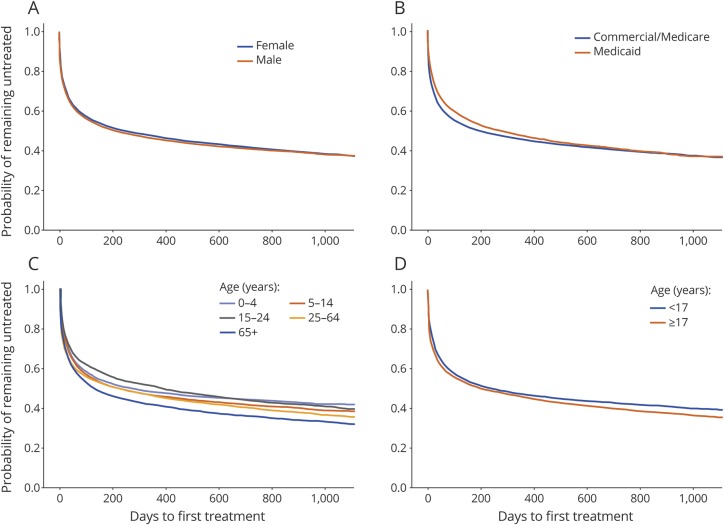
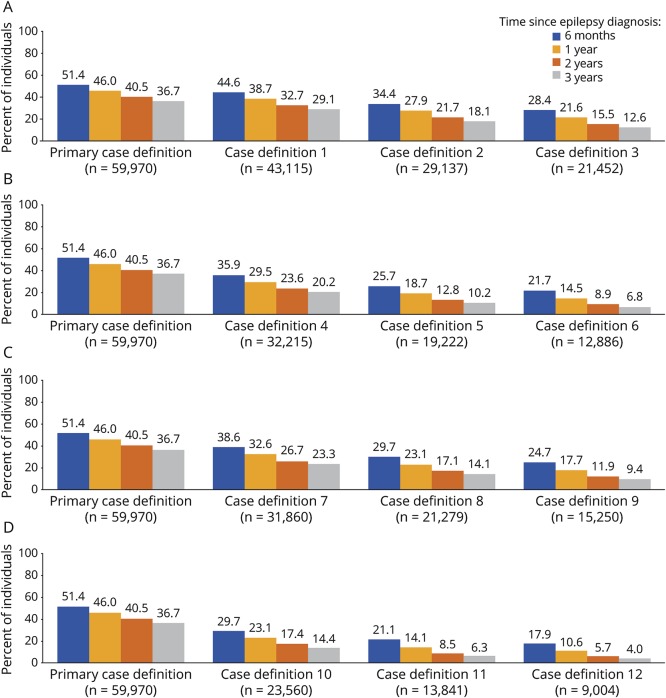
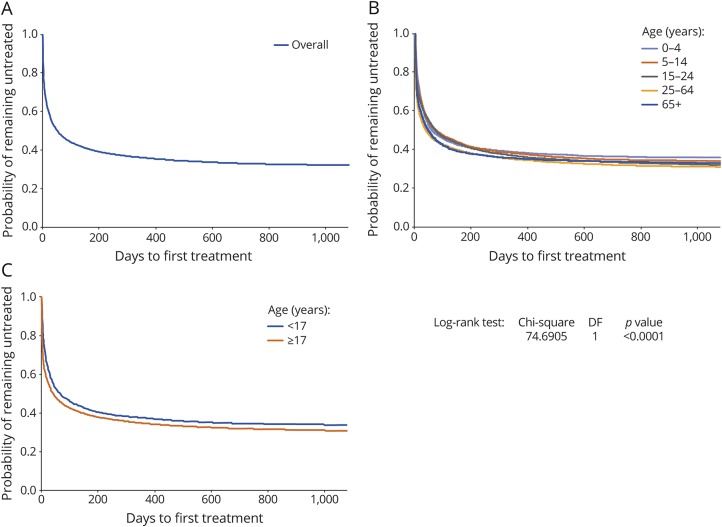
Results: In the primary study, 59,970 persons met selection (or inclusion) criteria; 36.7% of persons with newly diagnosed epilepsy remained untreated up to 3 years after diagnosis. In the validation study (N = 30,890), 31.8% of persons remained untreated up to 3 years after diagnosis. Lack of AED treatment was associated with an adjusted incidence rate ratio (95% confidence interval) of 1.2 (1.2-1.3) for medical events, 2.3 (2.2-2.3) for hospitalizations, and 2.8 (2.7-2.9) for emergency department visits.
Conclusions: One-third of newly diagnosed persons remain untreated up to 3 years after epilepsy diagnosis. The increased risk of medical events and health care utilization highlights the consequences of delayed treatment after epilepsy diagnosis, which might be preventable.
Copyright © 2019 The Author(s). Published by Wolters Kluwer Health, Inc. on behalf of the American Academy of Neurology.
Figures
Comment in
-
Undertreatment of newly diagnosed epilepsy in the US: Mind the gap!Neurology. 2019 May 7;92(19):879-880. doi: 10.1212/WNL.0000000000007445. Epub 2019 Apr 10. Neurology. 2019. PMID: 30971486 No abstract available.
-
Reader response: Assessment and effect of a gap between new-onset epilepsy diagnosis and treatment in the US.Neurology. 2020 Mar 17;94(11):502. doi: 10.1212/WNL.0000000000009102. Neurology. 2020. PMID: 32179644 No abstract available.
-
Author response: Assessment and effect of a gap between new-onset epilepsy diagnosis and treatment in the US.Neurology. 2020 Mar 17;94(11):503. doi: 10.1212/WNL.0000000000009104. Neurology. 2020. PMID: 32179645 No abstract available.
References
-
- de Boer HM, Mula M, Sander JW. The global burden and stigma of epilepsy. Epilepsy Behav 2008;12:540–546. - PubMed
-
- National Institute for Health and Care Excellence. Epilepsies: diagnosis and management—clinical guideline [CG137] [online]. Available at: nice.org.uk/guidance/cg137. Accessed February 20, 2018. - PubMed
Publication types
MeSH terms
Substances
LinkOut - more resources
Full Text Sources
Medical
Miscellaneous
