


Mechanistic insights into environmental and genetic risk factors for systemic lupus erythematosus
- PMID: 30972159
- PMCID: PMC6456562
Mechanistic insights into environmental and genetic risk factors for systemic lupus erythematosus
Abstract
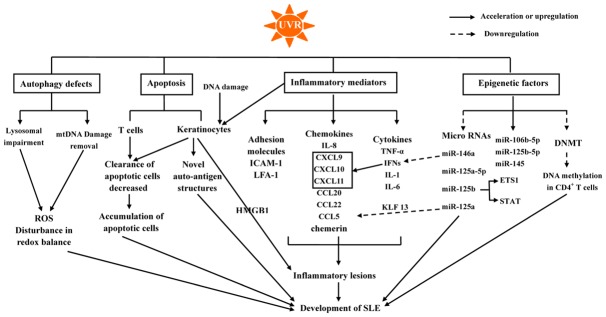
Systemic lupus erythematosus (SLE) is an autoimmune disease involving multiple organ systems with diverse presentation, primarily affecting women of reproductive age. Various genetic and environmental risk factors are involved in the pathogenesis of SLE, and many SLE susceptibility genes have been identified recently; however, gene therapy is not a viable clinical option at this time. Thus, environmental risks factors, particularly regional characteristics that can be controlled, need to be further investigated. Here, we systematically explored these risk factors, including ultraviolet radiation, seasonal distribution, geographical distribution, and climate factors, and also summarized the mechanisms related to these risk factors. Probable mechanisms were explicated in at least four aspects including inflammatory mediators, apoptosis and autophagy in keratinocytes, epigenetic factors, and gene-environment interactions. This information is expected to provide practical insights into these risk factors in order to benefit patients with SLE and facilitate the development of potential therapeutic strategies.
Keywords: Risk factors; climate factors; geographical distribution; season distribution; systemic lupus erythematosus; ultraviolet radiation.
Conflict of interest statement
None.
Figures
References
-
- Deapen D, Escalante A, Weinrib L, Horwitz D, Bachman B, Roy-Burman P, Walker A, Mack TM. A revised estimate of twin concordance in systemic lupus erythematosus. Arthritis Rheum. 1992;35:311–318. - PubMed
-
- Lehmann P, Hölzle E, Kind P, Goerz G, Plewig G. Experimental reproduction of skin lesions in lupus erythematosus by UVA and UVB radiation. J Am Acad Dermatol. 1990;22:181–187. - PubMed
-
- Meller S, Winterberg F, Gilliet M, Müller A, Lauceviciute I, Rieker J, Neumann NJ, Kubitza R, Gombert M, Bünemann E. Ultraviolet radiation-induced injury, chemokines, and leukocyte recruitment: an amplification cycle triggering cutaneous lupus erythematosus. Arthritis Rheum. 2005;52:1504–1516. - PubMed
-
- Kirchhof MG, Dutz JP. The immunopathology of cutaneous lupus erythematosus. Rheum Dis Clin North Am. 2014;40:455–474. - PubMed
-
- Kuhn A, Wenzel J, Weyd H. Photosensitivity, apoptosis, and cytokines in the pathogenesis of lupus erythematosus: a critical review. Clin Rev Allergy Immunol. 2014;47:148–162. - PubMed
Publication types
LinkOut - more resources
Full Text Sources