


Long-term evaluation of home-based pulmonary rehabilitation in patients with fibrotic idiopathic interstitial pneumonias
- PMID: 30972352
- PMCID: PMC6452059
- DOI: 10.1183/23120541.00045-2019
Long-term evaluation of home-based pulmonary rehabilitation in patients with fibrotic idiopathic interstitial pneumonias
Abstract
Background: Few studies have examined the benefits of pulmonary rehabilitation in patients with fibrotic idiopathic pulmonary pneumonia (f-IIP). Here, we report the results of an observational study in routine clinical practice of home-based pulmonary rehabilitation for f-IIP patients.
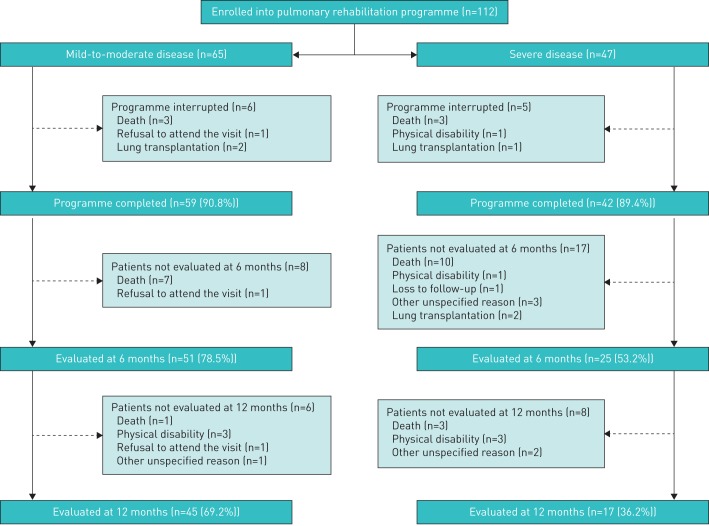
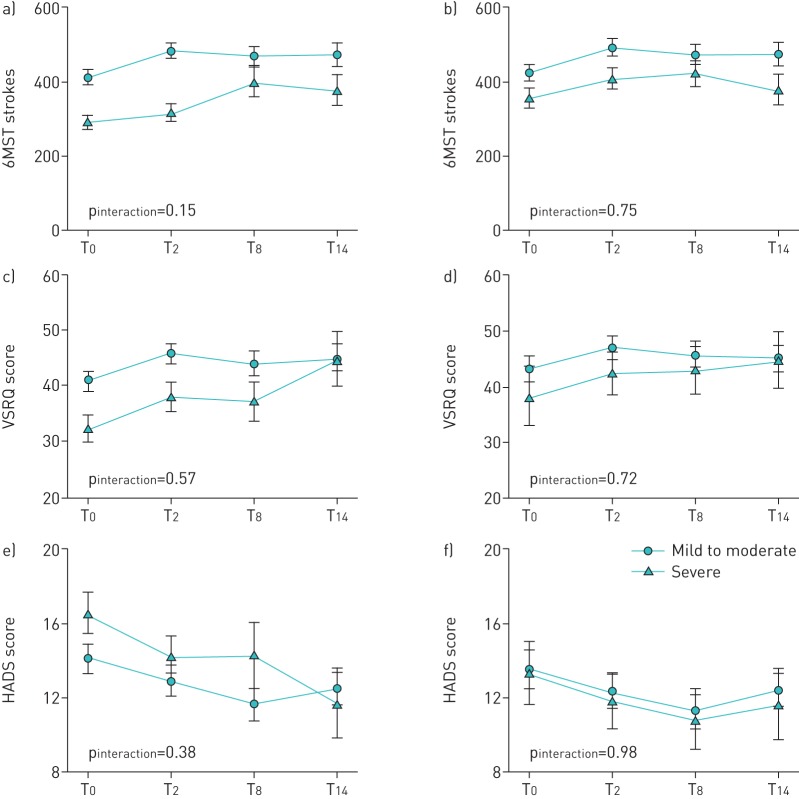
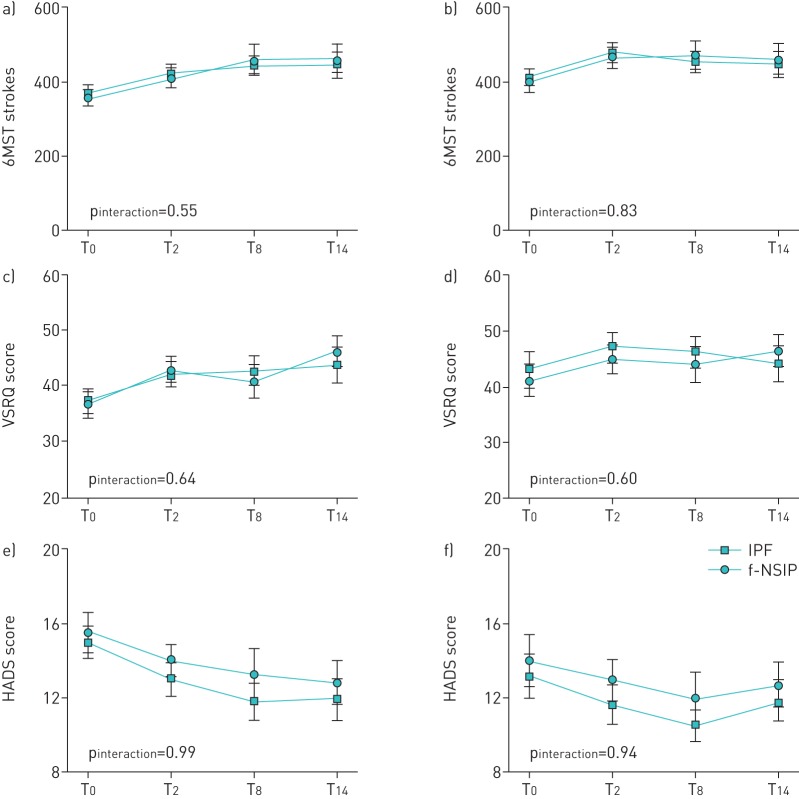
Methods: A total of 112 consecutive patients (61 with idiopathic pulmonary fibrosis and 51 with fibrotic nonspecific interstitial pneumonitis) were enrolled, of whom 65 had mild-to-moderate disease (forced vital capacity (FVC) ≥50% predicted and diffusing capacity of the lung for carbon monoxide (D LCO) ≥30% predicted) and 47 had severe disease (FVC <50% predicted and/or D LCO <30% predicted). The 2-month pulmonary rehabilitation programme consisted of a once-weekly visit with retraining, therapeutic education and psychosocial support. Patients were provided with an individualised action plan and were followed-up bimonthly for 12 months. Exercise tolerance (6-min stepper test (6MST)), mood (Hospital Anxiety and Depression Scale (HADS)) and quality of life (QoL) (Visual Simplified Respiratory Questionnaire (VSRQ)) were assessed before (T0), immediately after (T2), 6 months after (T8) and 12 months after (T14) the end of the pulmonary rehabilitation programme.
Results: 6MST strokes, HADS Anxiety score and VSRQ score were each significantly improved at T2 (n=101), T8 (n=76) and T14 (n=62) compared with T0 values. The improvements in outcomes were not influenced by disease severity or subtype. Patients who completed the study had significantly better baseline FVC and D LCO values than those who did not.
Conclusions: Home-based pulmonary rehabilitation provides long-term benefits in exercise tolerance, anxiety and QoL for patients with f-IIP. Pulmonary rehabilitation should be prescribed systematically as part of the therapeutic arsenal for these patients.
Conflict of interest statement
Conflict of interest: B. Wallaert reports personal fees from Roche and Boehringer Ingelheim, outside the submitted work. Conflict of interest: L. Duthoit has nothing to disclose. Conflict of interest: E. Drumez has nothing to disclose. Conflict of interest: H. Behal has nothing to disclose. Conflict of interest: L. Wemeau reports personal fees from Roche and Boehringer Ingelheim, outside the submitted work. Conflict of interest: C. Chenivesse has nothing to disclose. Conflict of interest: J-M. Grosbois reports that FormAction Santé received financial support from Adair, France Oxygène, Homeperf, LVL Medical, Orkyn, Santélys, Santeo, SOS Oxygène, Sysmed, VitalAire and ARS Hauts de France, during the conduct of the study.
Figures
References
-
- De Vries J, Kessels BL, Drent M. Quality of life of idiopathic pulmonary fibrosis patients. Eur Respir J 2001; 17: 954–961. - PubMed
-
- Spruit MA, Singh SJ, Garvey C, et al. An official American Thoracic Society/European Respiratory Society statement: key concepts and advances in pulmonary rehabilitation. Am J Respir Crit Care Med 2013; 188: e13–e64. - PubMed
-
- Gomes-Neto M, Silva CM, Ezequiel D, et al. Impact of pulmonary rehabilitation on exercise tolerance and quality of life in patients with idiopathic pulmonary fibrosis: a systematic review and meta-analysis. J Cardiopulm Rehabil Prev 2018; 38: 273–278. - PubMed
-
- Dowman L, Hill CJ, Holland AE. Pulmonary rehabilitation for interstitial lung disease. Cochrane Database Syst Rev 2014; 10: CD006322. - PubMed
LinkOut - more resources
Full Text Sources
Research Materials