Self-efficacy, beliefs, and goals: Moderation of declining physical activity during adolescence
- PMID: 30973746
- PMCID: PMC6522322
- DOI: 10.1037/hea0000734
Self-efficacy, beliefs, and goals: Moderation of declining physical activity during adolescence
Abstract
Objective: To examine whether the decline in physical activity observed from childhood through adolescence is explained by moderating effects of self-efficacy on concurrent changes in children's goals and beliefs about their physical activity environments.
Method: Latent growth modeling was used in longitudinal tests in a cohort of 79 boys and 108 girls assessed in 5th, 6th, 7th, 9th, and 11th grades.
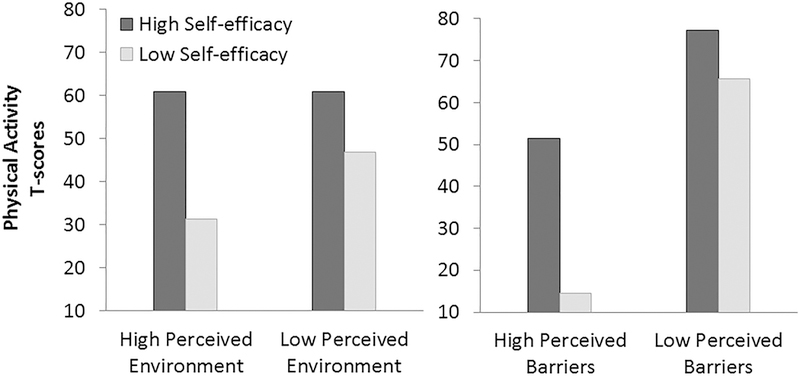
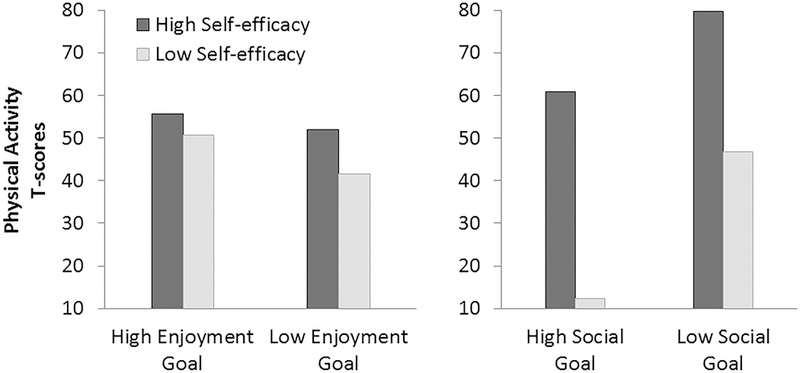
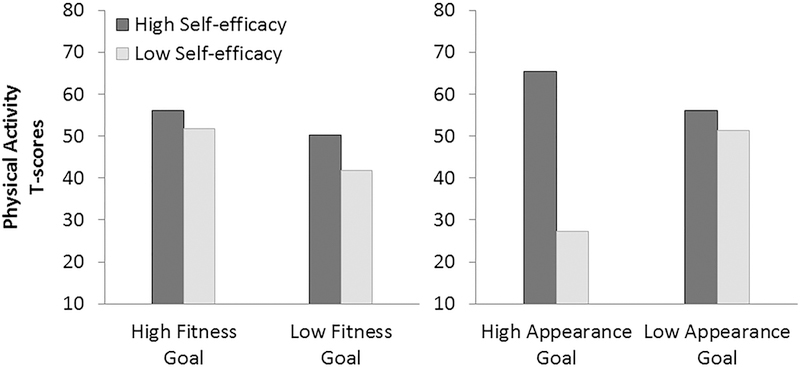
Results: Physical activity measured objectively by an accelerometer declined most in students who had bigger declines in self-efficacy and (1) maintained higher perceptions of barriers to physical activity, (2) had bigger declines in enjoyment and fitness goals, or (3) had smaller declines in appearance and social goals.
Conclusions: Trials of physical activity interventions based on social-cognitive theory should consider that the influence of changing goals on physical activity may differ according to whether students maintain high efficacy beliefs about overcoming barriers to physical activity coincident with perceptions of their physical activity environment. (PsycINFO Database Record (c) 2019 APA, all rights reserved).
Figures
References
-
- Aiken LS, West SG. (1991). Multiple Regression: Testing and Interpreting Interactions. Thousand Oaks, CA: Sage Publications.
-
- American Community Survey (2010). 2006–2010 American Community Survey Selected Population Tables: Poverty Status in the Past 12 Months by Sex and Age. Washington, DC: US Census Bureau.
-
- Bandura A (2004). Health promotion by social cognitive means. Health Education and Behavior, 31, 143–164. - PubMed
-
- Bandura A (1997). Self-efficacy: The exercise of controlL New York, NY: W.H. Freeman and Company.