Review
. 2019 Dec:60:168-178.
doi: 10.1016/j.copbio.2019.02.020. Epub 2019 Apr 8.

Future prospects for noncanonical amino acids in biological therapeutics

Affiliations
Review

Future prospects for noncanonical amino acids in biological therapeutics

Arlinda Rezhdo et al. Curr Opin Biotechnol. 2019 Dec.

Abstract

There is growing evidence that noncanonical amino acids (ncAAs) can be utilized in the creation of biological therapeutics ranging from protein conjugates to cell-based therapies. However, when does genetically encoding ncAAs yield biologics with unique properties compared to other approaches? In this review, we attempt to answer this question in the broader context of therapeutic development, emphasizing advances within the past two years. In several areas, ncAAs add valuable routes to therapeutically relevant entities, but application-specific needs ultimately determine whether ncAA-mediated or alternative solutions are preferred. Looking forward, using ncAAs to perform 'protein medicinal chemistry,' in which atomic-level changes to proteins dramatically enhance therapeutic properties, is a promising emerging area. Further upgrades to the performance of ncAA incorporation technologies will be essential to realizing the full potential of ncAAs in biological therapeutics.


Figures

Figure 1.
Figure 1.
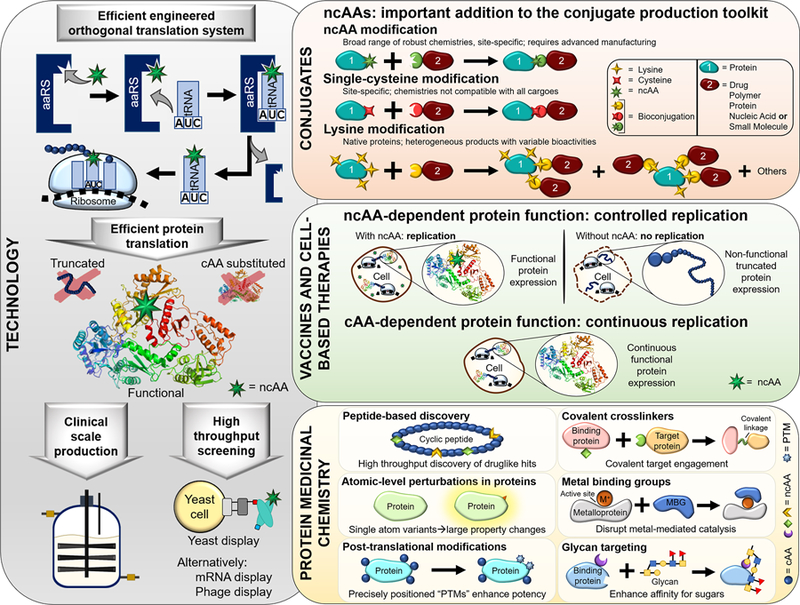
Overview of topics covered in this review. Technology: underlying successful applications of ncAAs in therapeutic settings are high efficiency, high fidelity platforms for genetically encoding ncAAs in proteins. The performance of orthogonal translation systems (OTSs), comprised of aminoacyl-tRNA synthetase (aaRS)/suppressor tRNA pairs, remains a limiting factor in many platforms. Conjugates: ncAA-mediated conjugations are important additions to the conjugate production toolkit. Vaccines and cell-based therapies: ncAA-dependent protein function allows for precise control over viral and cell replication. Protein medicinal chemistry: utilizing ncAAs to precisely alter protein structure and function provides many opportunities for discovering new classes of therapeutics. Protein structure taken from PDB ID 1DLO. Glycan structure taken from reference [61].
Figure 2.
Figure 2.
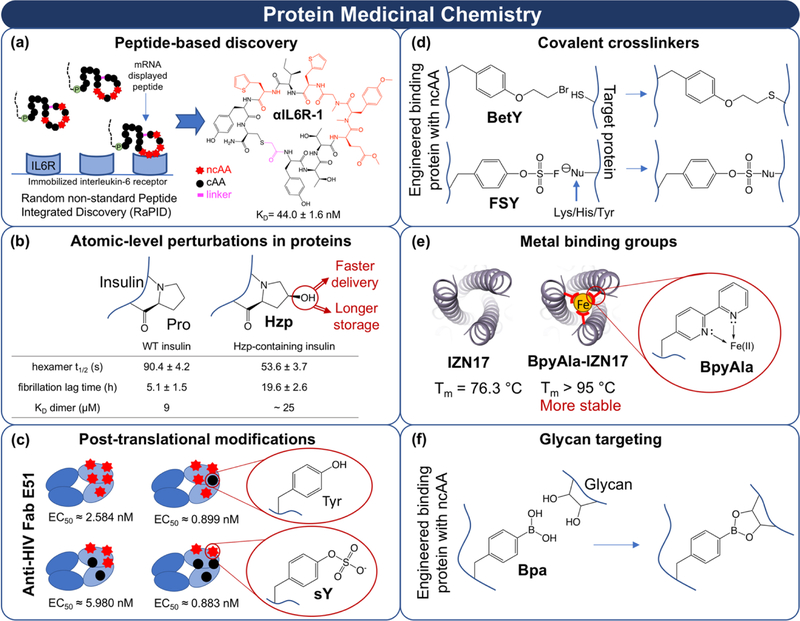
Early examples of protein medicinal chemistry. (a) NcAA-containing macrocyclic peptide synthesis and screening. The portion of the genetic code encoding hydrophilic cAAs was reassigned to a set of hydrophobic ncAAs to make encoded peptides more druglike. A macrocyclic library generated with this altered genetic code was screened against the interleukin-6 receptor (IL6R) in mRNA display format. Identified hits exhibited hydrophobicities that would be extremely challenging to achieve utilizing only canonical amino acids [53**]. (b) A single-atom substitution at position 28 in the insulin B-chain significantly shortened the dissociation time of monomeric insulin (hexamer t1/2) while prolonging its shelf life (fibrillation lag time). Hzp: (4S)-hydroxyproline [49**]. (c) Precise control of posttranslational modifications using ncAA incorporation. Uniformly sulfated antibodies were produced by genetically encoding sulfotyrosine (sY) in response to a stop codon. By evaluating all possible sulfation patterns in an antibody region important for binding, combinations leading to the highest potencies were identified [58*]. (d) Two representative examples of ncAA-based, proximity-activated covalent crosslinkers that function in mammalian cell culture [68*,69*]. BetY: O-(2-bromoethyl)tyrosine; FSY: fluorosulfate-L-tyrosine. (e) The trimeric coiled-coil structure of the N-peptide of HIV surface protein gp41 (IZN17) can be stabilized by encoding a metal chelating ncAA within its structure. BpyAla: (2,2’-Bipyridin-5-yl)alanine [73*]. PDB: 2R3C. (f) The boronic acid group in 4-borono-L-phenylalanine (Bpa) is capable of forming a covalent bond with the diol structures found in many glycans.

References

    1. Chin JW: Expanding and reprogramming the genetic code. Nature 2017, 550:53–60. - PubMed
    1. Wang L: Engineering the Genetic Code in Cells and Animals: Biological Considerations and Impacts. Acc Chem Res 2017, 50:2767–2775. - PMC - PubMed
    1. Ledbetter MP, Romesberg FE: Editorial overview: Expanding the genetic alphabet and code. Curr Opin Chem Biol 2018, 46:A1–A2. - PubMed
    1. Kang M, Lu Y, Chen S, Tian F: Harnessing the power of an expanded genetic code toward next-generation biopharmaceuticals. Curr Opin Chem Biol 2018, 46:123–129. - PubMed
    1. Huang Y, Liu T: Therapeutic applications of genetic code expansion. Synth Syst Biotechnol 2018, 3:150–158. - PMC - PubMed

Publication types