


Similar Risk of Re-Revision in Patients after One- or Two-Stage Surgical Revision of Infected Total Hip Arthroplasty: An Analysis of Revisions in the Swedish Hip Arthroplasty Register 1979⁻2015
- PMID: 30974876
- PMCID: PMC6518190
- DOI: 10.3390/jcm8040485
Similar Risk of Re-Revision in Patients after One- or Two-Stage Surgical Revision of Infected Total Hip Arthroplasty: An Analysis of Revisions in the Swedish Hip Arthroplasty Register 1979⁻2015
Abstract
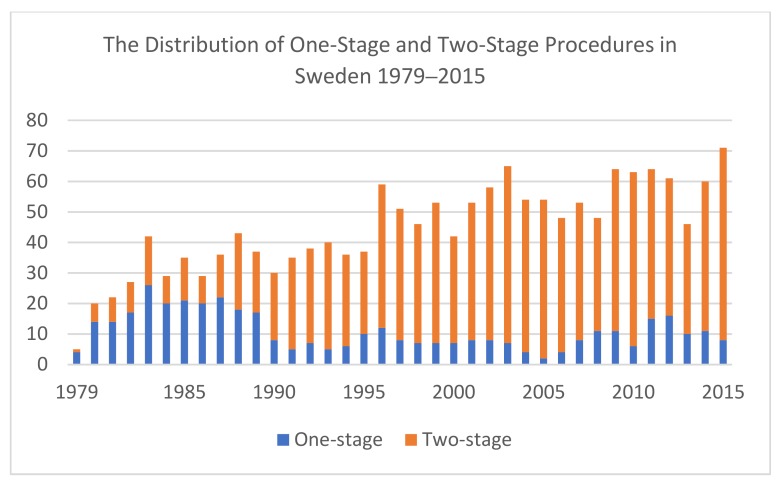
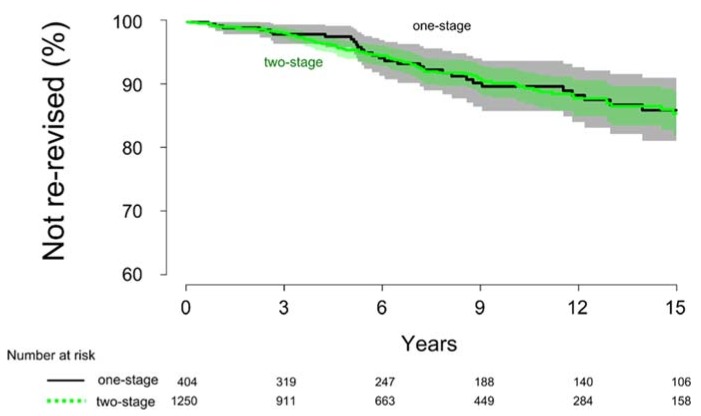
Late chronic infection is a devastating complication after total hip arthroplasty (THA) and is often treated with surgery. The one-stage surgical procedure is believed to be the more advantageous from a patient and cost perspective, but there is no consensus on whether the one- or two-stage procedure is the better option. We analysed the risk for re-revision in infected primary THAs repaired with either the one- or two-stage method. Data was obtained from the Swedish Hip Arthroplasty Register and the study groups were patients who had undergone a one-stage (n = 404) or two-stage (n = 1250) revision due to infection. Risk of re-revision was analysed using Kaplan-Meier analysis with log-rank test and Cox regression analysis. The cumulative survival rate was similar in the two groups at 15 years after surgery (p = 0.1). Adjusting for covariates, the risk for re-revision due to all causes did not differ between patients who were operated on with the one- or two-stage procedure (Hazard Ratio (HR) = 0.9, 95% Confidence Interval (C.I.) = 0.7-1.2, p = 0.5). The risk for re-revision due to infection (HR = 0.7, 95% C.I. = 0.4-1.1, p = 0.2) and aseptic loosening (HR = 1.2, 95% C.I. = 0.8-1.8, p = 0.5) was similar. This study could not determine whether the one-stage method was inferior in cases when the performing surgeons chose to use the one-stage method.
Keywords: hip arthroplasty; infection; revision surgery.
Conflict of interest statement
The authors declare no conflict of interest. The funders had no role in the design of the study; in the collection, analyses, or interpretation of data; in the writing of the manuscript, or in the decision to publish the results.
Figures


References
-
- Garellick G., Kärrholm J., Lindahl H., Malchau H., Rogmark C., Rolfson O. The Swedish Hip Arthroplasty Register, Annual Report 2013. [(accessed on 27 July 2015)]; Available online: https://registercentrum.blob.core.windows.net/shpr/r/Annual-report-2013-....
Grants and funding
LinkOut - more resources
Full Text Sources
