Review
. 2019 Apr 10;8(4):339.
doi: 10.3390/cells8040339.

Histone Methylation and Memory of Environmental Stress

Affiliations
Review

Histone Methylation and Memory of Environmental Stress

Paola Fabrizio et al. Cells. .

Abstract

Cellular adaptation to environmental stress relies on a wide range of tightly controlled regulatory mechanisms, including transcription. Changes in chromatin structure and organization accompany the transcriptional response to stress, and in some cases, can impart memory of stress exposure to subsequent generations through mechanisms of epigenetic inheritance. In the budding yeast Saccharomyces cerevisiae, histone post-translational modifications, and in particular histone methylation, have been shown to confer transcriptional memory of exposure to environmental stress conditions through mitotic divisions. Recent evidence from Caenorhabditis elegans also implicates histone methylation in transgenerational inheritance of stress responses, suggesting a more widely conserved role in epigenetic memory.

Keywords: chromatin; epigenetic inheritance; histone methylation; stress; transcriptional memory.


Conflict of interest statement

The authors declare no conflict of interest.

Figures
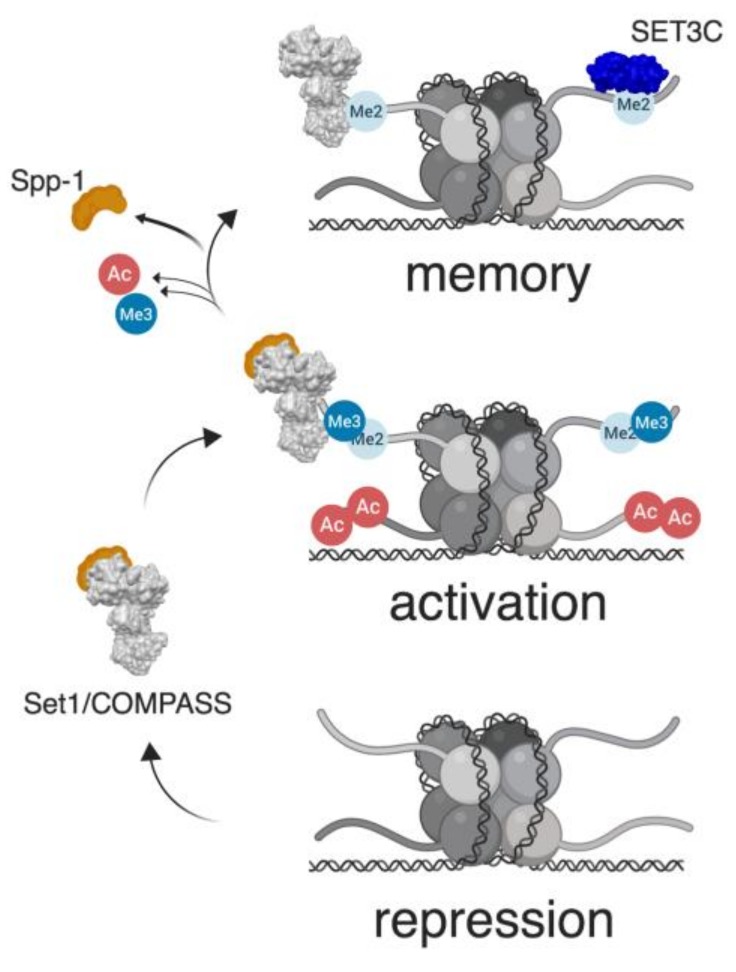
Figure 1
Figure 1
Model for S. cerevisiae INO1 transcriptional memory. When INO1 transcription is repressed (lower panel), nucleosomes associated with the INO1 promoter are hypoacetylated and hypomethylated. Upon activation (middle panel), INO1 relocalizes to the nuclear periphery, promoter nucleosomes are acetylated, and Set1/COMPASS di- and tri-methylates H3K4. When memory is induced (upper panel), INO1 remains at the nuclear periphery, nucleosomes are deacetylated, and a remodeled version of Set1/COMPASS (lacking the Spp1 component required for H3K4 tri-methylation) leads to the accumulation of H3K4me2, which is maintained through its interaction with the SET3C histone deacetylase complex.
Figure 2
Figure 2
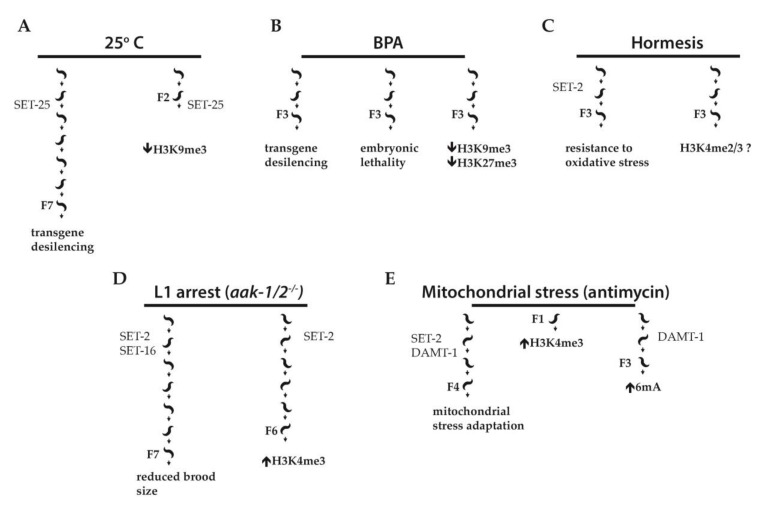
Examples of stress-induced transgenerational inheritance in C. elegans. (A) Worms exposed to high temperature (25 °C) for a single generation show desilencing of a multicopy pdaf-21p::GFP transgene for seven generations, dependent on the histone methyltransferase SET-25. F2 embryos derived from ancestors developed at 25 °C show decreased levels of H3K9me3 on the multicopy array as compared to controls developed at 16 °C. (B) A germline heterochromatic transgene array is desilenced by Bisphenol A (BPA). F3 progeny of treated worms show transgene desilencing, embryonic lethality, and a global reduction in H3K9me3 and H3K27me3. (C) Hormesis triggered by low doses of heavy metals, hyperosmosis, or fasting during embryonic development promotes resistance to oxidative stress in adult worms. The hormetic effect is transmitted to the F3 generation and, at least in the F1 generation, its presence requires the activity of SET-2. (D) In worms lacking AMPK activity (aak-1/2−/−), prolonged starvation-induced L1 arrest results in reduced brood size for up to seven generations. H3K4me3 levels are increased in PGCs of post L1 diapause aak-1/2−/− animals for up to at least six generations. SET-2 and the MLL related H3K4 methyltransferase SET-16 both contribute to the reduced brood size phenotype while SET-2 is also implicated in the post L1 diapause accumulation of H3K4me3 in aak-1/2−/− mutants. (E) Exposure of worms to the electron transport chain inhibitor antimycin induces developmental delay; antimycin treatment of parental worms protects future generations (up to F4) from developmental delay (mitochondrial stress adaptation). Loss of N6-methyldeoxyadenine methyltransferase DAMT-1 prevents 6mA accumulation. Both SET-2 and DAMT-1 are required for mitochondrial stress adaptation.

References

    1. Black J.C., Van Rechem C., Whetstine J.R. Histone lysine methylation dynamics: Establishment, regulation, and biological impact. Mol. Cell. 2012;48:491–507. - PMC - PubMed
    1. Ahringer J., Gasser S.M. Repressive chromatin in Caenorhabditis elegans: Establishment, composition, and function. Genetics. 2018;208:491–511. - PMC - PubMed
    1. Suganuma T., Workman J.L. Signals and combinatorial functions of histone modifications. Annu. Rev. Biochem. 2011;80:473–499. - PubMed
    1. Xue Y., Acar M. Mechanisms for the epigenetic inheritance of stress response in single cells. Curr. Genet. 2018;64:1221–1228. doi: 10.1007/s00294-018-0849-1. - DOI - PMC - PubMed
    1. Ahmed S., Brickner D.G., Light W.H., Cajigas I., McDonough M., Froyshteter A.B., Volpe T., Brickner J.H. DNA zip codes control an ancient mechanism for gene targeting to the nuclear periphery. Nat. Cell Biol. 2010;12:111–118. - PMC - PubMed

Publication types

LinkOut - more resources