Comparative Study
. 2019 Apr 11;9(1):5905.
doi: 10.1038/s41598-019-42508-z.

Comparative study of peritoneal dialysis versus hemodialysis on the clinical outcomes in Korea: a population-based approach

Affiliations
Comparative Study

Comparative study of peritoneal dialysis versus hemodialysis on the clinical outcomes in Korea: a population-based approach

Sung Woo Lee et al. Sci Rep. .

Abstract

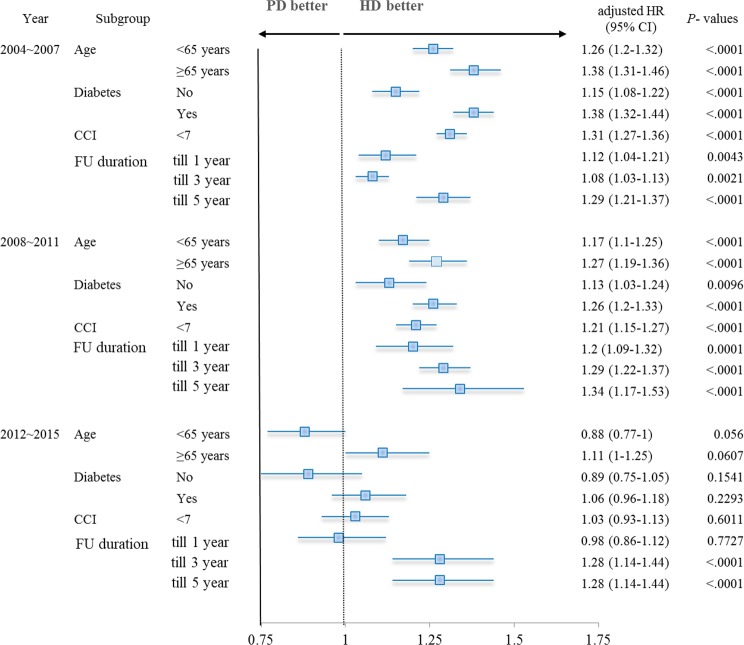
There has been paucity of data regarding the secular trend of adverse outcomes in peritoneal dialysis (PD) as compared with hemodialysis (HD) in Korea. 96,596 patients who started dialysis between 2004-2015 in Korea were identified using the National Health Insurance Service database. The adjusted hazard ratio (HR) (95% confidence interval, CI) of PD over HD for mortality was 1.31 (1.27-1.36; P < 0.001) in the period of 2004-2007 and 1.21 (1.16-1.27; P < 0.001) in the period of 2008-2011. However, the hazard of PD over HD for mortality turned out to be insignificant in the period of 2012-2015. Similar trend was noted for nonfatal cardiovascular events (CVEs). In subgroup analysis, the hazard of PD over HD for mortality was evident, regardless of the status of age, diabetes, and comorbidity burden in 2004-2011. In 2012-2015, however, the hazard of PD over HD for mortality was insignificant when follow up was censored at one year, which became significant when follow up follow up was censored at three or five year. In conclusion, the mortality of PD over HD in Korea has been significantly improved, a finding that was paralleled by the improved nonfatal CVEs.


Conflict of interest statement

The authors declare no competing interests.

Figures
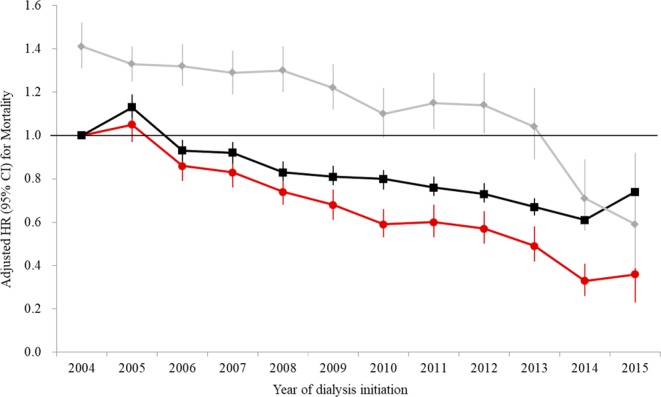
Figure 1
Figure 1
Secular trend of mortality according to dialysis modality and the respective hazard of PD over HD. The black line indicates mortality trends of HD, while the red line indicates that of PD according to the year of dialysis initiation. The gray line indicates the respective hazard ratio of PD over HD. Adjusted HRs and 95% CIs were calculated by multivariate Cox proportional hazard regression analysis, entering age, sex, insurance type, income status, and CCI value as covariates. HR, hazard ratio; CI, confidence interval; HD, hemodialysis; PD, peritoneal dialysis.
Figure 2
Figure 2
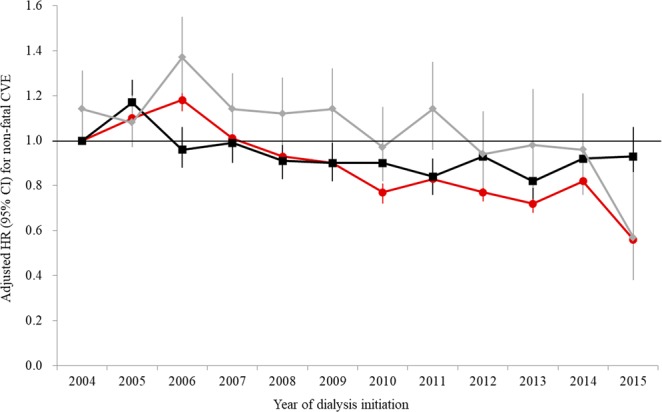
Secular trend of nonfatal CVE according to dialysis modality and the respective hazard of PD over HD. The black line indicates nonfatal CVE trends of HD, and the red line indicates that of PD according to the year of dialysis initiation. The gray line indicates the respective hazard ratio of PD over HD. Adjusted HRs and 95% CIs were calculated by multivariate Cox proportional hazard regression analysis, entering age, sex, insurance type, income status, and CCI value as covariates. HR, hazard ratio; CI, confidence interval; HD, hemodialysis; PD, peritoneal dialysis; CVE, cardiovascular event.
Figure 3
Figure 3
Subgroup analysis of the association between dialysis modality and patient mortality. Adjusted HRs and CIs were calculated by multivariate Cox proportional hazard regression analysis, entering age, sex, insurance type, income status, and CCI as covariates. HR, hazard ratio; CI, confidence interval; HD, hemodialysis; PD, peritoneal dialysis; Charlson Comorbidity Index, CCI; FU, follow up.

References

    1. Jin DC, et al. Lessons from 30 years’ data of Korean end-stage renal disease registry, 1985–2015. Kidney Res Clin Pract. 2015;34:132–139. doi: 10.1016/j.krcp.2015.08.004. - DOI - PMC - PubMed
    1. Khawar O, Kalantar-Zadeh K, Lo WK, Johnson D, Mehrotra R. Is the declining use of long-term peritoneal dialysis justified by outcome data? Clin J Am Soc Nephrol. 2007;2:1317–1328. doi: 10.2215/CJN.02550607. - DOI - PubMed
    1. Jin DC. Major changes and improvements of dialysis therapy in Korea: review of end-stage renal disease registry. Korean J Intern Med. 2015;30:17–22. doi: 10.3904/kjim.2015.30.1.17. - DOI - PMC - PubMed
    1. Kim HJ, et al. The pattern of choosing dialysis modality and related mortality outcomes in Korea: a national population-based study. Korean J Intern Med. 2017;32:699–710. doi: 10.3904/kjim.2017.141. - DOI - PMC - PubMed
    1. Ghaffari A, et al. PD First: peritoneal dialysis as the default transition to dialysis therapy. Semin Dial. 2013;26:706–713. doi: 10.1111/sdi.12125. - DOI - PubMed

Publication types