


Poor access to acute care resources to treat major trauma in low- and middle-income settings: A self-reported survey of acute care providers
- PMID: 30976499
- PMCID: PMC6440920
- DOI: 10.1016/j.afjem.2019.01.004
Poor access to acute care resources to treat major trauma in low- and middle-income settings: A self-reported survey of acute care providers
Abstract
Introduction: Injury and violence are neglected global health concerns, despite being largely predictable and therefor preventable. We conducted a small study to indirectly describe and compare the perception of availability of resources to manage major trauma in high-income, and low- and middle-income countries using evidence-based guidance (as per the 2016 National Institute of Clinical Excellence guidelines), as self-reported by delegates attending the 2016 International Conference on Emergency Medicine held in South Africa.
Methods: A survey was distributed to delegates at the International Conference on Emergency Medicine 2016. The survey instrument captured responses from participants working in both pre- and in-hospital settings. Responses were grouped according to income group (either high-income, or low- and middle-income) based on the respondent's nationality (using the World Bank definition for income group). A Fisher's Exact test was conducted to compare responses between different income groups.
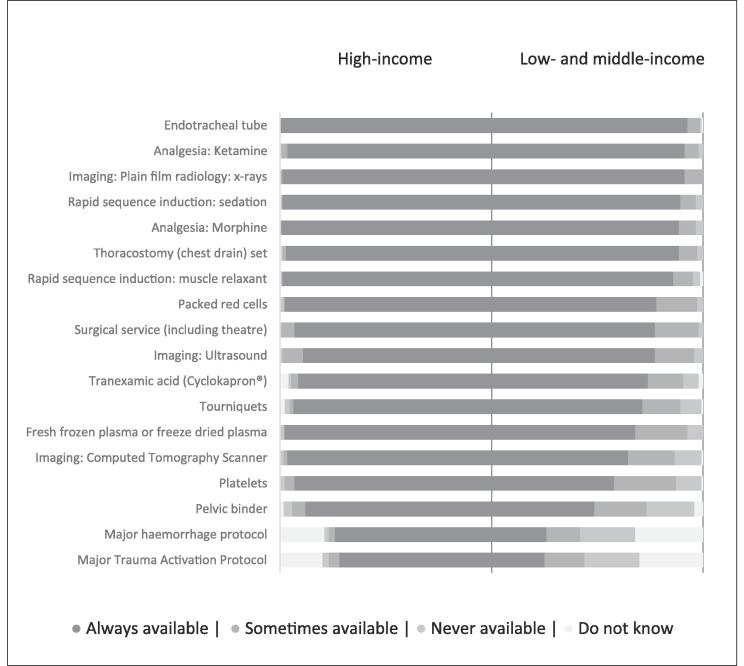
Results: The survey was distributed to 980 delegates, and 392 (40%) responded. A total of 206 (53%) respondents were from high-income countries and 186 (47%) were from low- to middle-income countries. Respondents described significantly less access to resources and services for low- and middle-income countries to adequately care for major trauma patients both pre- and in-hospital when compared to high-income countries. Shortages ranged from consumables to analgesia, imaging to specialist services, and pre-hospital to in-hospital care.
Conclusion: Major trauma care requires a chain of successful, evidence-based events for outcomes to benefit. This small study suggests that many of the links of this chain are either missing or broken within low- and middle-income countries. These settings simply do not benefit from the currently available evidence-base in major trauma care. It is important that this evidence-base also be evaluated within low- and middle-income countries. The capacity of low- and middle-income country emergency care systems also needs better describing.
Keywords: Developed countries; Emergency medicine; Global health; Income; Self-report; Specialization.
Figures

References
-
- The World Health Organization. The global burden of disease 2004. [cited 2015 Dec 27]. Available from: http://www.who.int/healthinfo/global_burden_disease/GBD_report_2004updat....
-
- Peden M, McGee K, Krug E. Injury: a leading cause of the global burden of disease. [cited 2015 Dec 27]. Available from: http://www.who.int/violence_injury_prevention/publications/other_injury/....
-
- Mock C., Quansah R., Krishnan R. Strengthening the prevention and care of injuries worldwide. Lancet. 2004;363(9427):2172–2179. - PubMed
LinkOut - more resources
Full Text Sources
