


Normal Body Temperature: A Systematic Review
- PMID: 30976605
- PMCID: PMC6456186
- DOI: 10.1093/ofid/ofz032
Normal Body Temperature: A Systematic Review
Abstract
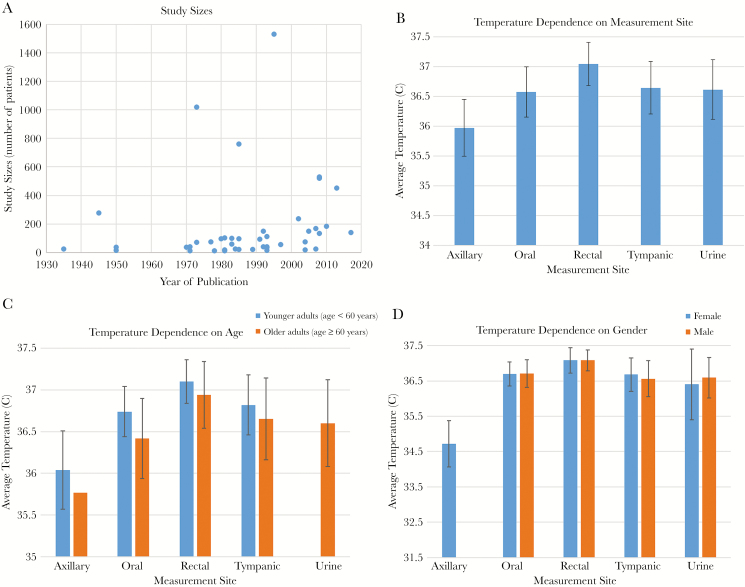
PubMed was searched from 1935 to December 2017 with a variety of search phrases among article titles. The references of the identified manuscripts were then manually searched. The inclusion criteria were as follows: (1) the paper presented data on measured normal body temperature of healthy human subjects ages 18 and older, (2) a prospective design was used, and (3) the paper was written in or translated into the English language. Thirty-six articles met the inclusion criteria. This comprised 9227 measurement sites from 7636 subjects. The calculated ranges (mean ± 2 standard deviations) were 36.32-37.76 (rectal), 35.76-37.52 (tympanic), 35.61-37.61 (urine), 35.73-37.41 (oral), and 35.01-36.93 (axillary). Older adults (age ≥60) had lower temperature than younger adults (age <60) by 0.23°C, on average. There was only insignificant gender difference. Compared with the currently established reference point for normothermia of 36.8°C, our means are slightly lower but the difference likely has no physiological importance. We conclude that the most important patient factors remain site of measurement and patient's age.
Keywords: body temperature; fever; hypothermia; normothermia.
Figures
References
-
- Kluger MJ, Kozak W, Conn CA, et al. . Role of fever in disease. Ann N Y Acad Sci 1998; 856:224–33. - PubMed
-
- Boeck B.[ Diagnose im alten mesopotamien. Ueberlegungen zu graenzen und moeglichkeiten der interpretation keilschriftlicher diagnostischer texte.] Orientalistische Literaturzeitung 2009; 104:382–98.
-
- Geller MJ. West meets East: early Greek and Babylonian diagnosis. In: Horstmanshoff FJ, Stol M, eds. Magic and Rationality in Acient Near Eastern and Graeco-Roman Medicine. Leiden-Boston: Brill; 2004. - PubMed
-
- Heessel N.[Babylonisch-assyrische Diagnostik.] Muenster: Ugarit Verlag; 2000.
-
- Heessel N. Reading and interpreting medical cuneiform texts-methods and problems. Le Journal des Medecines Cuneiformed 2004; 3:6–7.
Publication types
LinkOut - more resources
Full Text Sources
Other Literature Sources
Miscellaneous
