


Relationship Between Nonalcoholic Fatty Liver Disease Susceptibility Genes and Coronary Artery Disease
- PMID: 30976747
- PMCID: PMC6442707
- DOI: 10.1002/hep4.1319
Relationship Between Nonalcoholic Fatty Liver Disease Susceptibility Genes and Coronary Artery Disease
Abstract
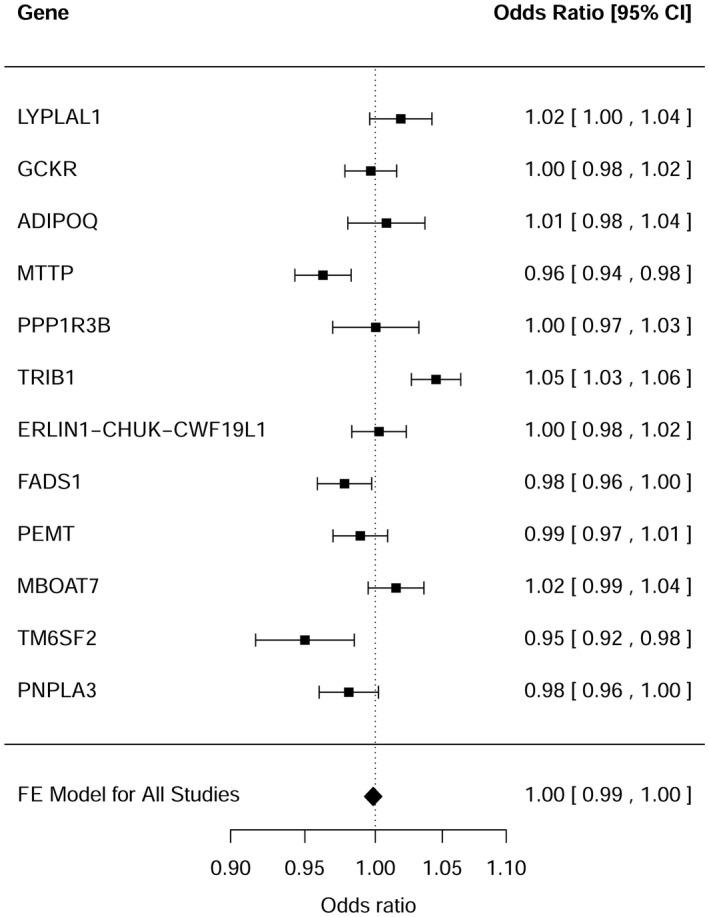
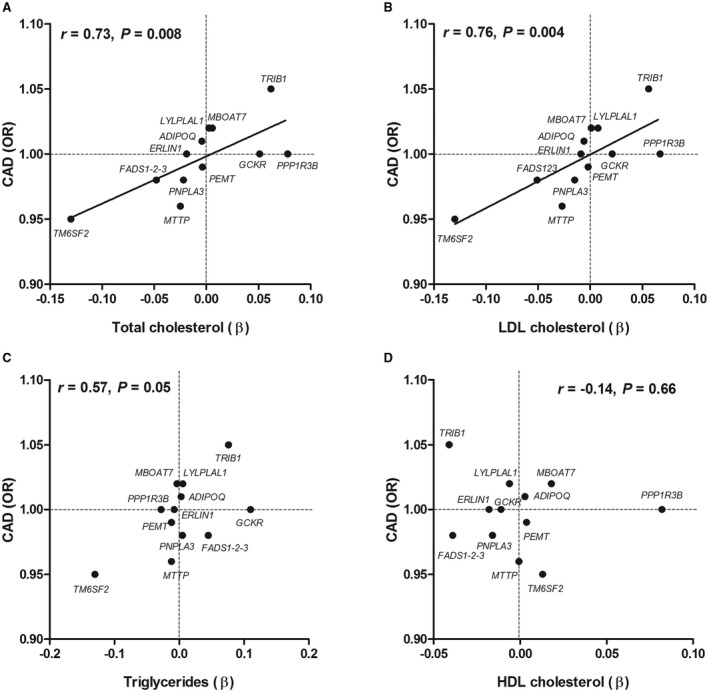
Coronary artery disease (CAD) is the principal cause of death in patients with nonalcoholic fatty liver disease (NAFLD). The aim of the present study was to investigate whether NAFLD is causally involved in the pathogenesis of CAD. For this, previously reported NAFLD susceptibility genes were clustered and tested for an association with CAD in the Coronary Artery Disease Genome-Wide Replication and Meta-Analysis plus the Coronary Artery Disease Genetics (CARDIoGRAMplusC4D) Consortium data set. The role of plasma lipids as a potential mediator was explored by using data from the Global Lipids Genetics Consortium. Statistical analyses revealed that the combination of 12 NAFLD genes was not associated with CAD in 60,801 CAD cases and 123,504 controls (odds ratio [OR] per NAFLD risk allele, 1.0; 95% confidence interval [CI], 0.99-1.00). In a subsequent sensitivity analysis, a positive relationship was observed after exclusion of gene variants that are implicated in NAFLD through impaired very low-density lipoprotein secretion (i.e., microsomal triglyceride transfer protein [MTTP], patatin-like phospholipase domain containing 3 [PNPLA3], phosphatidylethanolamine N-methyltransferase [PEMT], and transmembrane 6 superfamily member 2 [TM6SF2]) (OR, 1.01; 95% CI, 1.00-1.02). Clustering of the excluded genes showed a significant negative relationship with CAD (OR, 0.97; 95% CI, 0.96-0.99). A substantial proportion of the observed heterogeneity between the individual NAFLD genes in relation to CAD could be explained by plasma lipids, as reflected by a strong relationship between plasma lipids and CAD risk conferred by the NAFLD susceptibility genes (r = 0.76; P = 0.004 for low-density lipoprotein cholesterol). Conclusion: NAFLD susceptibility genes do not cause CAD per se. The relationship between these genes and CAD appears to depend to a large extent on plasma lipids. These observations strongly suggest taking plasma lipids into account when designing a new drug to target NAFLD.
Figures
References
-
- Charlton MR, Burns JM, Pedersen RA, Watt KD, Heimbach JK, Dierkhising RA. Frequency and outcomes of liver transplantation for nonalcoholic steatohepatitis in the United States. Gastroenterology 2011;141:1249‐1253. - PubMed
-
- Ong JP, Pitts A, Younossi ZM. Increased overall mortality and liver‐related mortality in non‐alcoholic fatty liver disease. J Hepatol 2008;49:608‐612. - PubMed
-
- Targher G, Byrne CD, Lonardo A, Zoppini G, Barbui C. Non‐alcoholic fatty liver disease and risk of incident cardiovascular disease: a meta‐analysis. J Hepatol 2016;65:589‐600. - PubMed
-
- Adams LA, Anstee QM, Tilg H, Targher G. Non‐alcoholic fatty liver disease and its relationship with cardiovascular disease and other extrahepatic diseases. Gut 2017;66:1138‐1153. - PubMed
-
- Jansen H, Samani NJ, Schunkert H. Mendelian randomization studies in coronary artery disease. Eur Heart J 2014;35:1917‐1924. - PubMed
LinkOut - more resources
Full Text Sources
Research Materials
Miscellaneous
