. 2019 Sep 1;111(9):996-999.
doi: 10.1093/jnci/djz041.

Identification of Candidates for Longer Lung Cancer Screening Intervals Following a Negative Low-Dose Computed Tomography Result

Identification of Candidates for Longer Lung Cancer Screening Intervals Following a Negative Low-Dose Computed Tomography Result

Hilary A Robbins et al. J Natl Cancer Inst. .

Abstract

Lengthening the annual low-dose computed tomography (CT) screening interval for individuals at lowest risk of lung cancer could reduce harms and improve efficiency. We analyzed 23 328 participants in the National Lung Screening Trial who had a negative CT screen (no ≥4-mm nodules) to develop an individualized model for lung cancer risk after a negative CT. The Lung Cancer Risk Assessment Tool + CT (LCRAT+CT) updates "prescreening risk" (calculated using traditional risk factors) with selected CT features. At the next annual screen following a negative CT, risk of cancer detection was reduced among the 70% of participants with neither CT-detected emphysema nor consolidation (median risk = 0.2%, interquartile range [IQR] = 0.1%-0.3%). However, risk increased for the 30% with CT emphysema (median risk = 0.5%, IQR = 0.3%-0.8%) and the 0.6% with consolidation (median = 1.6%, IQR = 1.0%-2.5%). As one example, a threshold of next-screen risk lower than 0.3% would lengthen the interval for 57.8% of screen-negatives, thus averting 49.8% of next-screen false-positives among screen-negatives but delaying diagnosis for 23.9% of cancers. Our results support that many, but not all, screen-negatives might reasonably lengthen their CT screening interval.


Figures

Figure 1.
Figure 1.
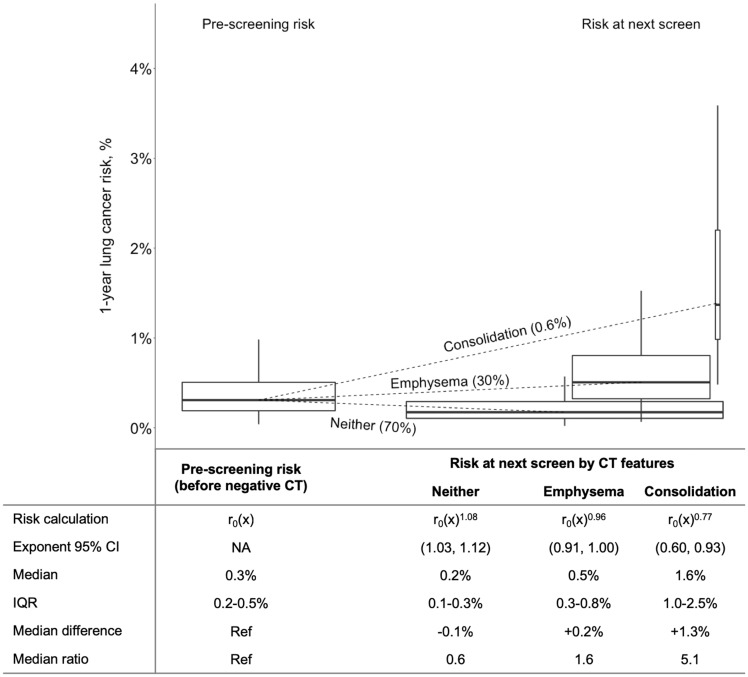
Effect of features noted on a negative computed tomography (CT) screen on risk of next-screen lung cancer detection among participants in the National Lung Screening Trial. For illustration, this figure was constructed using data from individuals who had a negative result at the first U.S. National Lung Screening Trial screen (T0) and were subsequently at risk for lung cancer at the second screen (T1) (n = 18 245). Among these individuals, 30% (n = 5484) had emphysema noted on their negative CT, 0.6% (n = 106) had consolidation, and 70% (12 691) had neither (n = 36 when both emphysema and consolidation were included in both risk distributions). Prescreening risk [r0(x)] was calculated using the Lung Cancer Risk Assessment Tool (18). Outliers are not included in the figure but are included in the calculations in the table. Within each group of boxplots, boxplot widths are scaled by the percentage of the population represented, boxplot heights represent the interquartile range (IQR), and the vertical lines (whiskers) represent the range of data excluding outliers. CI, confidence interval; Ref, reference.
Figure 2.
Figure 2.
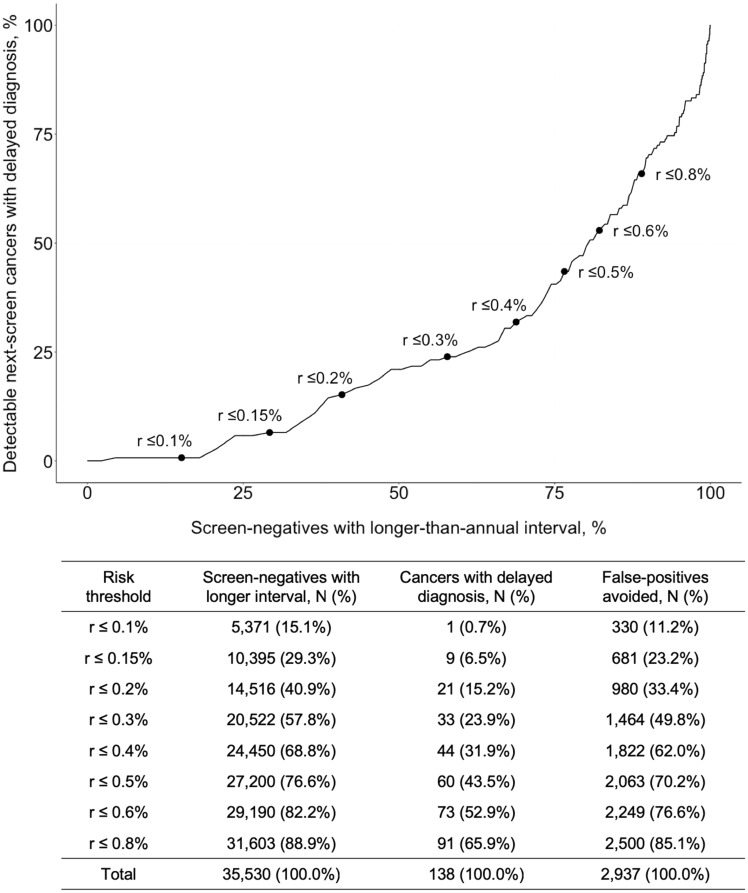
Potential effect of Lung Cancer Risk Assessment Tool with computed tomography (LCRAT+CT) risk thresholds for longer screening intervals among screen-negative participants in the National Lung Screening Trial. Points and labels indicate potential next-screen risk thresholds for lengthening CT screening intervals beyond one year. For example, if the interval were lengthened for those with a predicted next-screen risk 0.3% or less, then the interval would be lengthened for 57.8% of screen-negatives. Among them, 33 cancers were detected at the next screen and would therefore have their diagnosis delayed (ie, 33 of 138 or 23.9% of all next-screen cancers in screen-negatives). Screen-negatives at both T0 and T1 (and corresponding cancers at T1 and T2) were included in this analysis, such that individuals with a negative result at both screens may be included twice. The denominator for percentages is the total number of screen-negatives, the number of next-screen cancers among screen-negatives, and the number of false-positives at the next screen among screen-negatives, respectively.

Comment in

References

    1. Aberle DR, Adams AM, Berg CD, et al. National Lung Screening Trial Research Team. Reduced lung-cancer mortality with low-dose computed tomographic screening. N Engl J Med. 2011;3655:395–409. - PMC - PubMed
    1. Bach PB, Mirkin JN, Oliver TK, et al. Benefits and harms of CT screening for lung cancer: a systematic review. JAMA. 2012;30722:2418–2429. - PMC - PubMed
    1. Bach PB. Raising the bar for the U.S. Preventive Services Task Force. Ann Intern Med. 2014;1605:365–366. - PubMed
    1. Kinsinger LS, Anderson C, Kim J, et al. Implementation of lung cancer screening in the Veterans Health Administration. JAMA Intern Med. 2017;1773:399–406. - PubMed
    1. de Koning HJ, Meza R, Plevritis SK, et al. Benefits and harms of computed tomography lung cancer screening strategies: a comparative modeling study for the U.S. Preventive Services Task Force. Ann Intern Med. 2014;1605:311–320. - PMC - PubMed

Publication types