. 2019 Jun 4;47(10):4940-4947.
doi: 10.1093/nar/gkz276.

Hybrid-type and two-tetrad antiparallel telomere DNA G-quadruplex structures in living human cells

Affiliations

Hybrid-type and two-tetrad antiparallel telomere DNA G-quadruplex structures in living human cells

Hong-Liang Bao et al. Nucleic Acids Res. .

Abstract

Although the telomeric sequence has been reported to form various G-quadruplex topologies in vitro and in Xenopus laevis oocytes, in living human cells, the topology of telomeric DNA G-quadruplex remains a challenge. To investigate the human telomeric DNA G-quadruplex in a more realistic human cell environment, in the present study, we demonstrated that the telomeric DNA sequence can form two hybrid-type and two-tetrad antiparallel G-quadruplex structures by in-cell 19F NMR in living human cells (HELA CELLS). This result provides valuable information for understanding the structures of human telomeric DNA in living human cells and for the design of new drugs that target telomeric DNA.


Figures

Figure 1.
Figure 1.
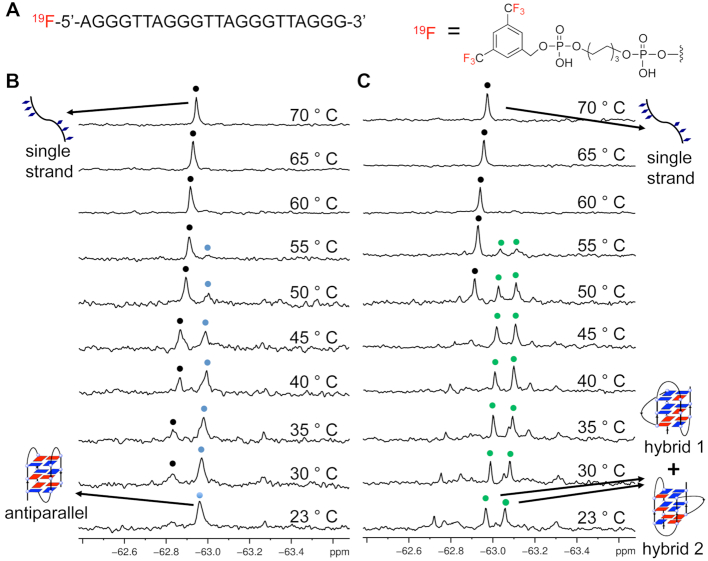
19F NMR spectra of 19F-labeled 22-mer ODN 1 d[AGGG(TTAGGG)3] in Na+ and K+ solutions. (A) Chemical structure of 19F-labeled DNA bearing 19F group at the 5′ terminal. (B)19F NMR of 19F-labeled DNA at different temperatures in Na+ solution. (C) 19F NMR of 19F-labeled DNA at different temperatures in K+ solution. Blue and black spots indicated antiparallel G-quadruplex and single strand, respectively. Green indicated hybrid-1 and hybrid-2 G-quadruplexes conformations. Temperatures indicated on the right. Condition: 0.1 mM DNA in (B) 300 mM NaCl and 20 mM Na-PO4 buffer (pH 7.0) or (C) 100 mM KCl and 20 mM K-PO4 buffer (pH 7.0). The sample is kept for 10 min of each temperature for 19F NMR detection.
Figure 2.
Figure 2.
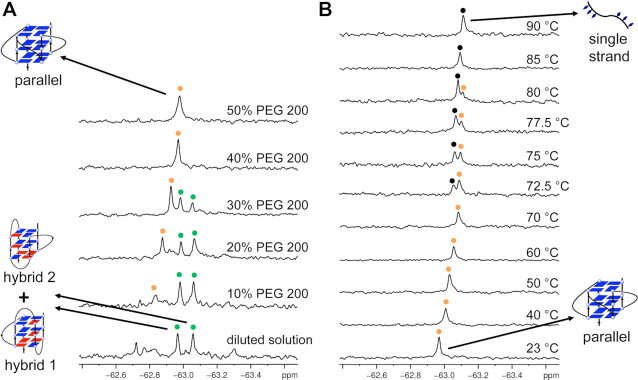
19F NMR spectra of 19F-labeled ODN 1 in PEG 200. (A) 19F NMR of 19F-labeled 22-mer DNA at different concentration of PEG 200 in K+ solution. (B) 19F NMR of 19F-labeled ODN 1 at different temperatures in 40% PEG 200. Green indicated hybrid-1 and hybrid-2 G-quadruplexes conformations. Orange and black spots indicated parallel G-quadruplex and single strand, respectively. PEG 200 ratio and temperatures indicated on the right. Condition: 0.1 mM DNA in 100 mM KCl and 20 mM K-PO4 buffer (pH 7.0). The sample is kept for 10 min of each temperature for 19F NMR detection.
Figure 3.
Figure 3.
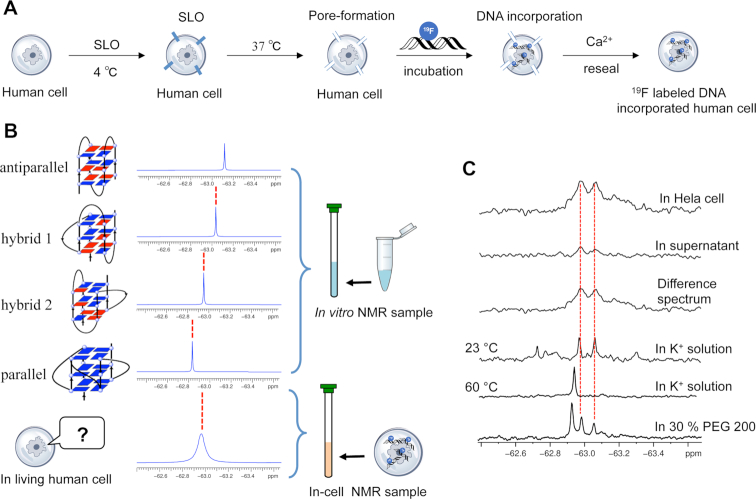
In-cell 19F NMR of 19F labeled ODN 1. (A) Schematic overview of the SLO treatment cell system for transfection DNA into HeLa cells. (B) Comparison with the position of reference in vitro spectrum provides a reliable determination of intracellular 19F-labeled DNA. (C) Comparison of 19F NMR spectra of ODN 1 in K+ solution, in HeLa cell, in supernatant, difference spectrum between HeLa cell and supernatant, in K+ solution (23 and 60°C) and in 30% PEG 200.

References

    1. Xu Y. Chemistry in human telomere biology: structure, function and targeting of telomere DNA/RNA. Chem. Soc. Rev. 2011; 40:2719–2740. - PubMed
    1. Blackburn E.H., Epel E.S., Lin J.. Human telomere biology: a contributory and interactive factor in aging, disease risks, and protection. Science. 2015; 350:1193–1198. - PubMed
    1. O'Sullivan R.J., Karlseder J.. Telomeres: protecting chromosomes against genome instability. Nat. Rev. Mol. Cell Biol. 2010; 11:171–181. - PMC - PubMed
    1. Neidle S., Parkinson G.N.. The structure of telomeric DNA. Curr. Opin. Struct. Biol. 2003; 13:275–283. - PubMed
    1. Hansel-Hertsch R., Di Antonio M., Balasubramanian S.. DNA G-quadruplexes in the human genome: detection, functions and therapeutic potential. Nat. Rev. Mol. Cell Biol. 2017; 18:279–284. - PubMed

Publication types