


Pharmacokinetic and exploratory exposure-response analysis of pertuzumab in patients with operable HER2-positive early breast cancer in the APHINITY study
- PMID: 30976844
- PMCID: PMC6499763
- DOI: 10.1007/s00280-019-03826-1
Pharmacokinetic and exploratory exposure-response analysis of pertuzumab in patients with operable HER2-positive early breast cancer in the APHINITY study
Abstract
Purpose: To characterize the pharmacokinetics (PK) of, and perform an exploratory exposure-response (E-R) analysis for, pertuzumab in patients with HER2-positive early breast cancer (EBC) within the APHINITY study (NCT01358877, BIG 4-11/BO25126/TOC4939G).
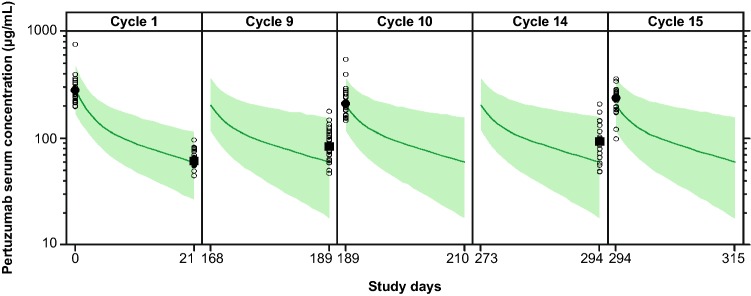
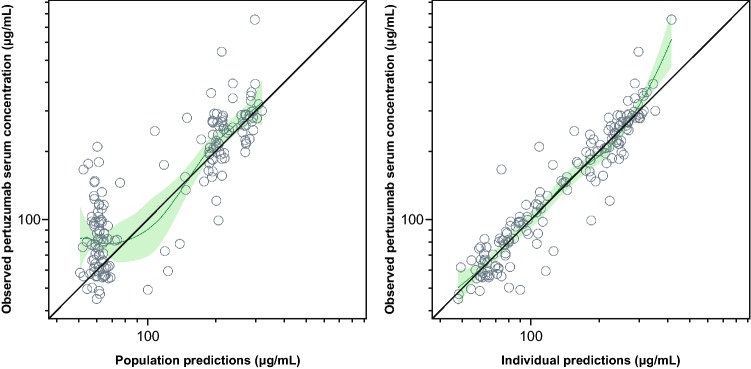
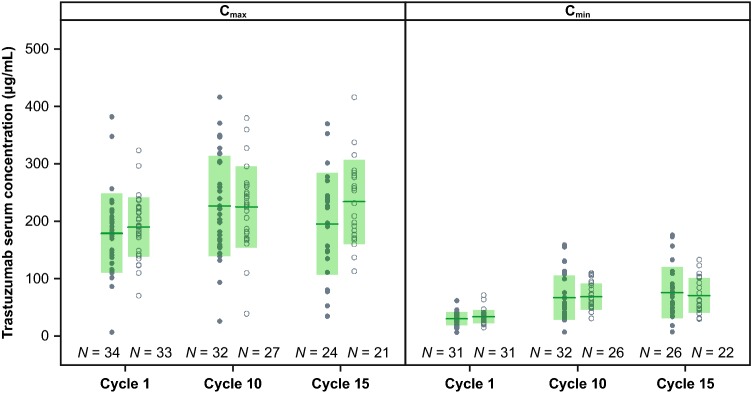
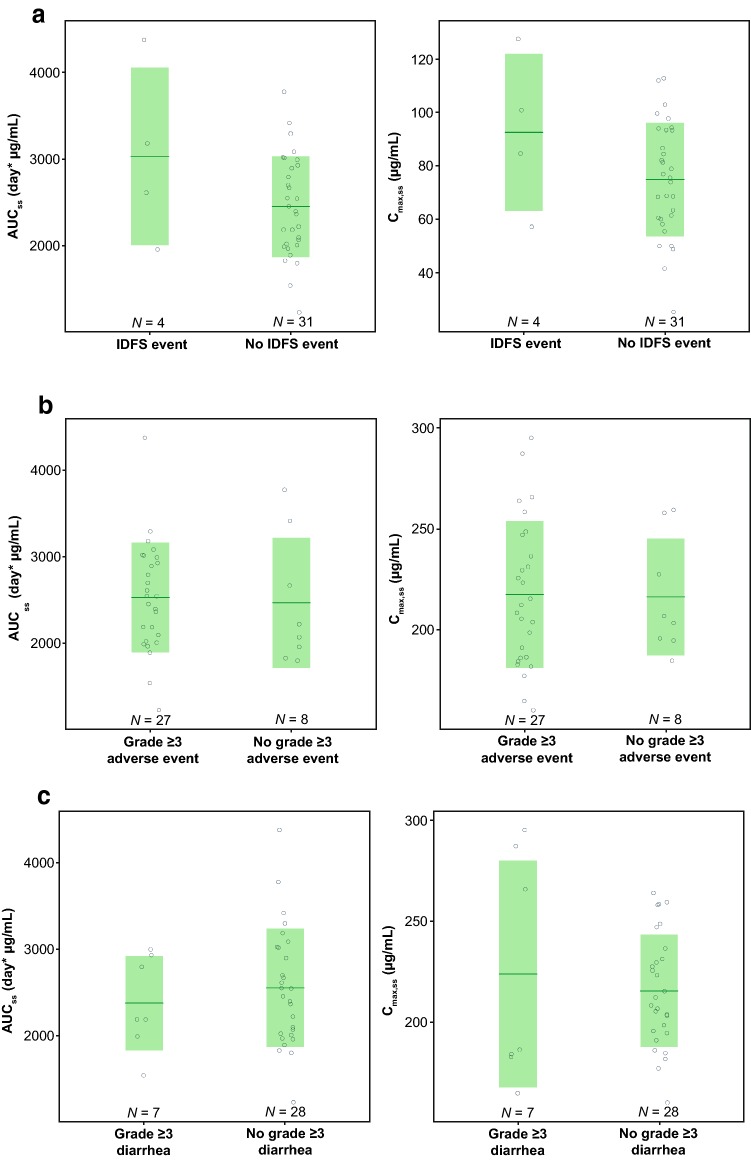
Methods: A previously developed pertuzumab two-compartment linear population pharmacokinetic (popPK) model was subjected to external validation to examine appropriateness for describing pertuzumab concentrations from the APHINITY study. Pharmacokinetic drug-drug interactions (DDIs) between pertuzumab, trastuzumab, and chemotherapy were assessed by comparing observed serum or plasma Cmax, Cmin, and AUClast geometric mean ratios with 90% CIs. Predictions of pertuzumab Cmax,ss, Cmin,ss, and AUCss were derived from individual parameter estimates and used in an exploratory E-R analysis.
Results: Using data from 72 patients, based on goodness-of-fit, the popPK model was deemed appropriate for predictions of individual exposures for subsequent comparisons to historical data, assessment of DDIs, and E-R analyses. No evidence of DDIs for pertuzumab on trastuzumab, trastuzumab on pertuzumab, or pertuzumab on chemotherapy PK was observed. Analyses of differences in exposure between patients with and without invasive disease-free survival events did not indicate improved efficacy with increased exposure. Overall Grade ≥ 3 diarrhea prevalence was higher with pertuzumab versus placebo, but was not greater with increasing pertuzumab exposure. No apparent E-R relationship was suggested with respect to other grade ≥ 3 AEs.
Conclusion: Overall, the limited available data from this exploratory study suggest that no dose adjustments are needed for pertuzumab when administered in combination with trastuzumab and an EBC chemotherapy regimen.
Keywords: Drug–drug interactions; Exposure–response; Pertuzumab; Pharmacokinetics.
Conflict of interest statement
All authors received support for third-party writing assistance for this manuscript, provided by F. Hoffmann-La Roche Ltd. W.P.K. and A.G. are paid employees of Genentech, Inc., significant stockholders for Roche Holding Ltd, and inventors on a pertuzumab-related patent filing. M.K., B.W., I.N., S.M., and S.G. are paid employees of Genentech, Inc. and significant stockholders for Roche Holding Ltd. L.L. is a paid employee of, and has a significant ownership in, qPharmetra LLC. A.K. is a paid employee of Roche Products Limited and a significant stockholder for Roche Holding Ltd. R.Ma. was a paid employee of Roche Products Limited at the time of the study. D.F. received funding to run the conduct clinical trials from F. Hoffmann-La Roche Ltd/Genentech, Inc., AstraZeneca, Novartis, Servier, Tesaro, Pfizer, and GlaxoSmithKline, paid to her institution, and research grants from the charitable organizations BCRF, Foundation Cancer Luxembourg, and the Belgian National Lottery, paid to her institution. R.Mc. received funding to assist in the running of the APHINITY study from F. Hoffmann-La Roche Ltd, paid to his institution. G.J. has received honoraria from Novartis, Roche, Lilly, Pfizer, Amgen, and Bristol-Myers Squibb; holds a consulting/advisory role for Novartis, Celgene, Roche, Amgen, Pfizer, Bristol-Myers Squibb, Lilly, Puma Biotechnology, AstraZeneca, Daiichi Sankyo, and AbbVie; and has received research funding from Novartis and Roche. C.T. has received honoraria from Daiichi Sankyo, Roche, Pfizer, and Eisai, and travel expenses from MSD and Daiichi Sankyo. J.Ba. holds leadership positions in Varian Medical Systems, Bristol-Myers Squibb, Foghorn, Grail, Aura, and Infinity; consulting/advisory roles for Grail, PMV Pharma, ApoGen, Juno Therapeutics, Roche/Genentech, Lilly, Novartis, and Northern Biologics; stock or other ownership in PMV Pharma, Grail, Tango, Venthera, Juno, Varian, Foghorn, Aura, Infinity, ApoGen; and has received honoraria, travel, accommodations, and expenses from Roche/Genentech, Novartis, Lilly. G.v.M. has received research funding from Pfizer, Amgen, Celgene, AstraZeneca, Myriad Genetics, AbbVie, Vifor, and Roche, to his institution. J. Bi. has received clinical study funding from Roche as PI of the study; travel expenses to medical meetings from AstraZeneca and Roche; and holds consulting roles (advisory boards) with AbbVie, AstraZeneca, Genomic Health, Libbs, Pfizer, and Roche. C.F. declares no other conflict of interest.
Figures
References
-
- Adams CW, Allison DE, Flagella K, Presta L, Clarke J, Dybdal N, McKeever K, Sliwkowski MX. Humanization of a recombinant monoclonal antibody to produce a therapeutic HER dimerization inhibitor, pertuzumab. Cancer Immunol Immunother. 2006;55:717–727. doi: 10.1007/s00262-005-0058-x. - DOI - PMC - PubMed
Publication types
MeSH terms
Substances
Associated data
LinkOut - more resources
Full Text Sources
Medical
Research Materials
Miscellaneous
