Changes in Relative Importance of the 5-Level Triage System, Korean Triage and Acuity Scale, for the Disposition of Emergency Patients Induced by Forced Reduction in Its Level Number: a Multi-Center Registry-based Retrospective Cohort Study
- PMID: 30977315
- PMCID: PMC6460112
- DOI: 10.3346/jkms.2019.34.e114
Changes in Relative Importance of the 5-Level Triage System, Korean Triage and Acuity Scale, for the Disposition of Emergency Patients Induced by Forced Reduction in Its Level Number: a Multi-Center Registry-based Retrospective Cohort Study
Abstract
Background: The 5-level triage tool, the Korean Triage and Acuity Scale (KTAS), was developed based on the Canadian Triage and Acuity Scale and has been used for triage in all emergency medical institutions in Korea since 2016. This study evaluated the association between the decrease in level number and the change in its relative importance for disposition in the emergency department (ED).
Methods: Using the registry of the National Emergency Department Information System (NEDIS) ver. 3.1, data regarding consecutive emergency patients from March 2017 to October 2017 were reviewed retrospectively. Reconfiguring KTAS levels, a total of 15 multinomial logistic regression models (KTAS_0 to KTAS_14), including the KTAS, its variants, and covariates were constructed to determine significant factors affecting ED disposition. The relative importance of each model was obtained using a dominance analysis.
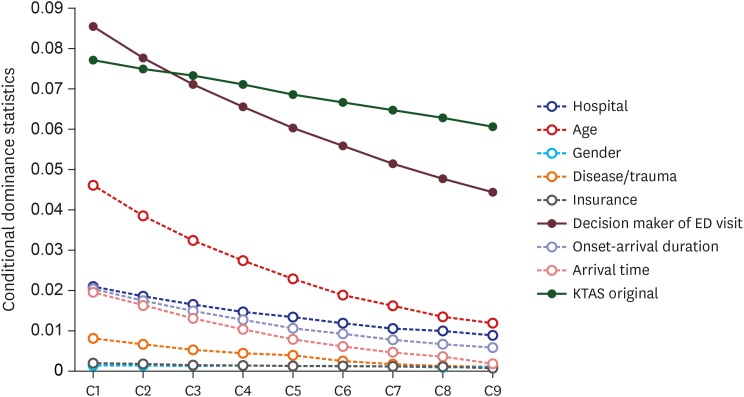
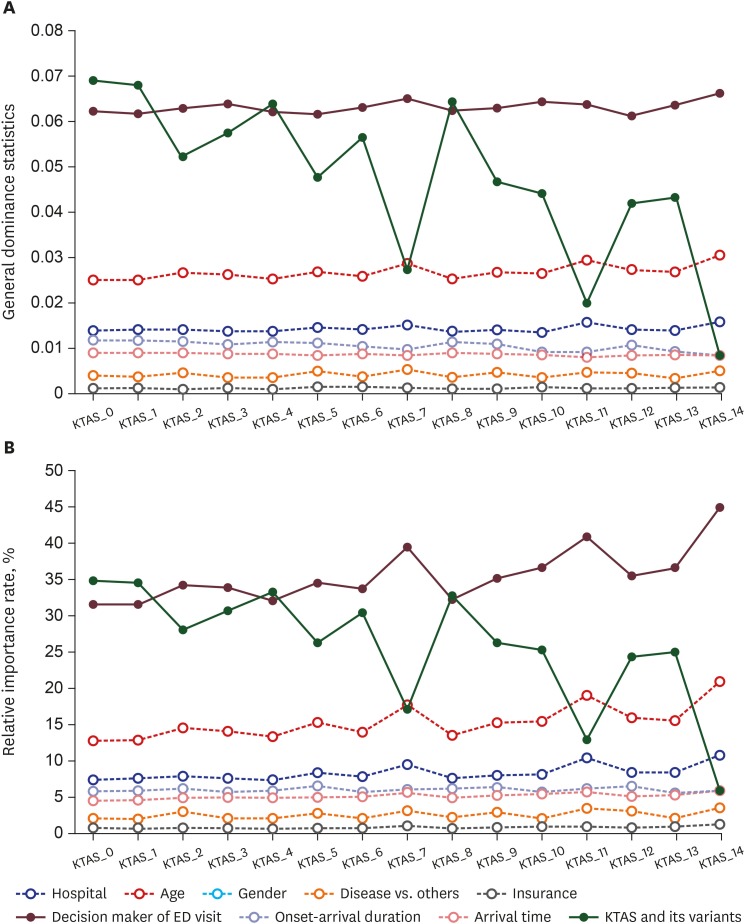
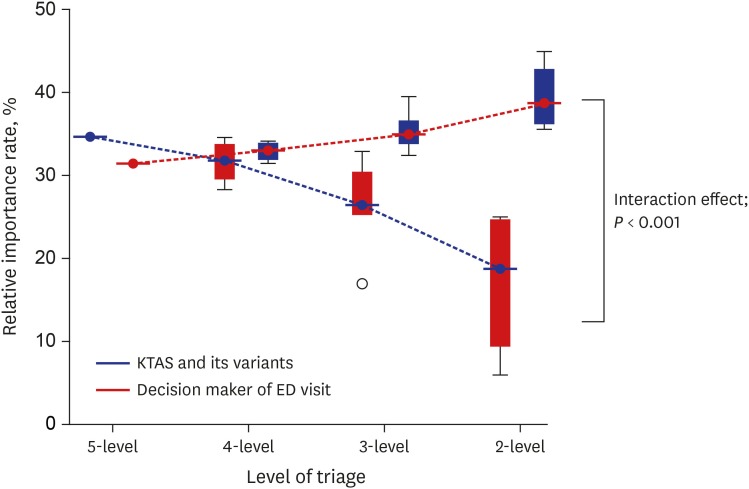
Results: A total of 79,771 patients were included in the analysis. In the model KTAS_0, the KTAS and 8 covariates were found to be significantly related to ED disposition. The KTAS and the decision maker of each ED visit, whether it was the physician or others, had the largest relative importance, 34.8% and 31.4%, respectively (P < 0.001). In other models of KTAS variants, including 4-level, 3-level and 2-level, the rates of the KTAS decreased to 31.8% (interquartile range [IQR], 28.9-34.2), 26.4% (IQR, 23.2-31.0), and 18.7% (IQR, 7.5-24.9), respectively (P = 0.016). On the other hand, the rates for covariates tended to be larger for smaller triage levels and so there was a significant interaction effect between the KTAS and the covariates according to the triage level (P < 0.001).
Conclusion: The 5-level triage tool, the KTAS, had the largest relative importance among the predictors affecting ED disposition only at its original level. Therefore, it is recommended that no attempt should be made to reduce the number of levels in the triage tool.
Keywords: Emergencies; Logistic Models; Registries; Triage.
© 2019 The Korean Academy of Medical Sciences.
Conflict of interest statement
The authors have no potential conflicts of interest to disclose.
Figures

Comment in
-
Let Clinicians Classify Emergency Patients.J Korean Med Sci. 2019 Apr 15;34(14):e115. doi: 10.3346/jkms.2019.34.e115. J Korean Med Sci. 2019. PMID: 30977316 Free PMC article. No abstract available.
References
-
- Iserson KV, Moskop JC. Triage in medicine, part I: Concept, history, and types. Ann Emerg Med. 2007;49(3):275–281. - PubMed
-
- Travers DA, Waller AE, Bowling JM, Flowers D, Tintinalli J. Five-level triage system more effective than three-level in tertiary emergency department. J Emerg Nurs. 2002;28(5):395–400. - PubMed
-
- Shelton R. The Emergency Severity Index 5-level triage system. Dimens Crit Care Nurs. 2009;28(1):9–12. - PubMed
-
- Schellein O, Ludwig-Pistor F, Bremerich DH. Manchester triage system. Process optimization in the interdisciplinary emergency department. Anaesthesist. 2009;58(2):163–170. - PubMed
MeSH terms
LinkOut - more resources
Full Text Sources