


Longitudinal associations between smoking and affect among cancer patients using varenicline to quit smoking
- PMID: 30978583
- PMCID: PMC6545135
- DOI: 10.1016/j.addbeh.2019.04.003
Longitudinal associations between smoking and affect among cancer patients using varenicline to quit smoking
Abstract
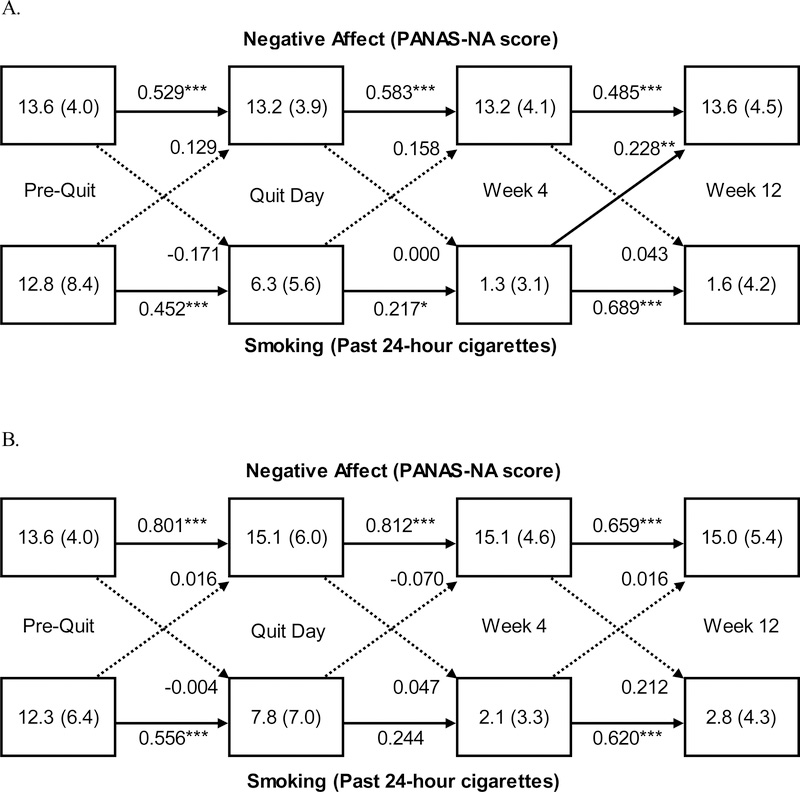
During a quit attempt, high negative affect predicts relapse to smoking. In this study, we evaluated bidirectional longitudinal associations between smoking and negative affect among cancer patients treated with varenicline. Participants (N = 119, 50% female, Mage = 59 years) were smokers (≥5 cigarettes/week) who were diagnosed with cancer and were recruited for a 24-week trial of extended duration varenicline plus behavioral counseling; data for this secondary analyses were drawn from the 12-week open-label phase of the trial. Smoking was assessed via self-reported number of cigarettes in the past 24 h. Negative affect was assessed using the Positive and Negative Affect Scale (PANAS). Data were collected at pre-quit (week 0), target quit day (week 1), week 4, and week 12. We evaluated cross-lagged panel models for negative affect and smoking using PROC CALIS in SAS. Models were run separately for participants who were adherent (≥80% of medication taken) or nonadherent to varenicline. Among adherent participants (n = 96), smoking accounted for up to 22% of variance in subsequent negative affect throughout treatment. Cross-lagged associations were not observed between smoking and negative affect among non-adherent participants (n = 23). Negative affect did not predict subsequent smoking among either adherent or nonadherent participants. These results suggest that varenicline may attenuate abstinence-induced negative affect among cancer patients treated for nicotine dependence.
Keywords: Adherence; Affect; Cancer; Randomized controlled trial; Smoking cessation.
Copyright © 2019 Elsevier Ltd. All rights reserved.
Conflict of interest statement
Figures
References
-
- Anthenelli RM, Benowitz NL, West R, St Aubin L, McRae T, Lawrence D, Ascher J, Russ C, Krishen A, et al. (2016). Neuropsychiatric safety and efficacy of varenicline, bupropion, and nicotine patch in smokers with and without psychiatric disorders (EAGLES): a double-blind, randomised, placebo-controlled clinical trial. The Lancet, 387:2507–20. doi: 10.1016/S0140-6736(16)30272-0 - DOI - PubMed
Publication types
MeSH terms
Substances
Grants and funding
LinkOut - more resources
Full Text Sources
Medical
Miscellaneous
