


A Systematically Assembled Signature of Genes to be Deep-Sequenced for Their Associations with the Blood Pressure Response to Exercise
- PMID: 30979034
- PMCID: PMC6523684
- DOI: 10.3390/genes10040295
A Systematically Assembled Signature of Genes to be Deep-Sequenced for Their Associations with the Blood Pressure Response to Exercise
Abstract
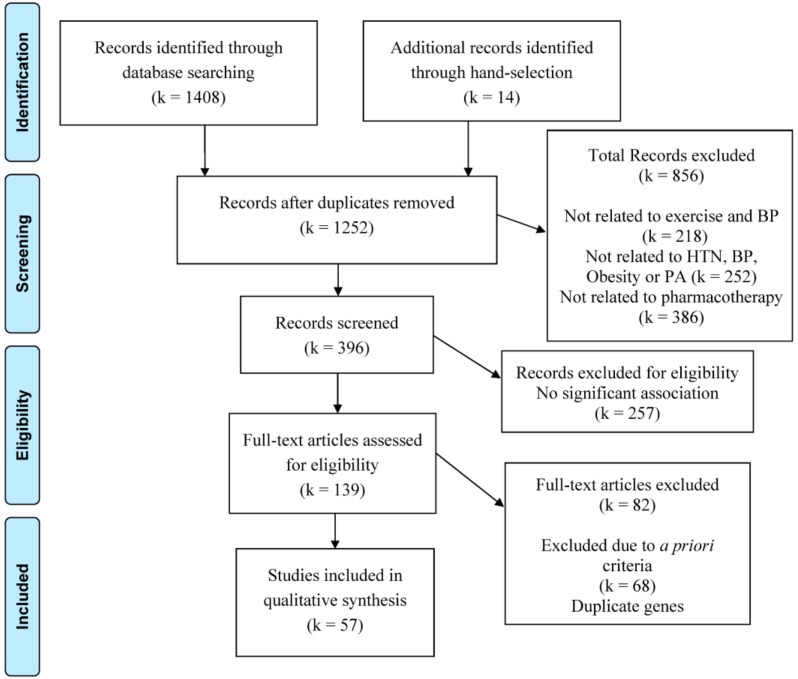
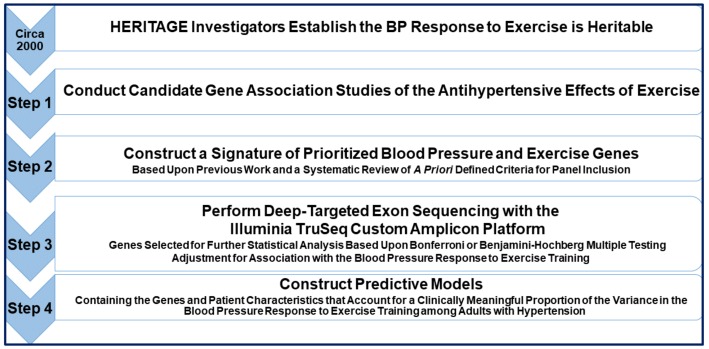
:Background: Exercise is one of the best nonpharmacologic therapies to treat hypertension. The blood pressure (BP) response to exercise is heritable. Yet, the genetic basis for the antihypertensive effects of exercise remains elusive. Methods: To assemble a prioritized gene signature, we performed a systematic review with a series of Boolean searches in PubMed (including Medline) from earliest coverage. The inclusion criteria were human genes in major BP regulatory pathways reported to be associated with: (1) the BP response to exercise; (2) hypertension in genome-wide association studies (GWAS); (3) the BP response to pharmacotherapy; (4a) physical activity and/or obesity in GWAS; and (4b) BP, physical activity, and/or obesity in non-GWAS. Included GWAS reports disclosed the statistically significant thresholds used for multiple testing. Results: The search yielded 1422 reports. Of these, 57 trials qualified from which we extracted 11 genes under criteria 1, 18 genes under criteria 2, 28 genes under criteria 3, 27 genes under criteria 4a, and 29 genes under criteria 4b. We also included 41 genes identified from our previous work. Conclusions: Deep-sequencing the exons of this systematically assembled signature of genes represents a cost and time efficient approach to investigate the genomic basis for the antihypertensive effects of exercise.
Keywords: antihypertensive therapy; healthy lifestyle; physical exercise.
Conflict of interest statement
The authors declare no conflict of interest.
Figures
References
-
- Benjamin E.J., Muntner P., Alonso A., Bittencourt M.S., Callaway C.W., Carson A.P., Chamberlain A.M., Chang A.R., Cheng S., Das S.R., et al. Heart Disease and Stroke Statistics-2019 Update: A Report from the American Heart Association. Circulation. 2019;139:e56–e528. doi: 10.1161/CIR.0000000000000659. - DOI - PubMed
-
- Whelton P.K., Carey R.M., Aronow W.S., Casey D.E., Jr., Collins K.J., Dennison Himmelfarb C., DePalma S.M., Gidding S., Jamerson K.A., Jones D.W., et al. 2017 ACC/AHA/AAPA/ABC/ACPM/AGS/APhA/ASH/ASPC/NMA/PCNA Guideline for the Prevention, Detection, Evaluation, and Management of High Blood Pressure in Adults: A Report of the American College of Cardiology/American Heart Association Task Force on Clinical Practice Guidelines. Hypertension. 2018;71:e127–e248. - PubMed
-
- Naci H., Salcher-Konrad M., Dias S., Blum M.R., Anova S., Nunan D., Ioannidis J. How Does Exercise Treatment Compare with Antihypertensive Medications? A Network Meta-Analysis of 391 RCTs Assessing Exercise and Medication Effects on Systolic Blood Pressure. Br. J. Sports Med. 2018 doi: 10.1136/bjsports-2018-099921. - DOI - PubMed
Publication types
MeSH terms
Substances
LinkOut - more resources
Full Text Sources
Medical
