. 2019 Apr 12;10(1):1706.
doi: 10.1038/s41467-019-09517-y.

High density DNA data storage library via dehydration with digital microfluidic retrieval

Affiliations

High density DNA data storage library via dehydration with digital microfluidic retrieval

Sharon Newman et al. Nat Commun. .

Abstract

DNA promises to be a high density data storage medium, but physical storage poses a challenge. To store large amounts of data, pools must be physically isolated so they can share the same addressing scheme. We propose the storage of dehydrated DNA spots on glass as an approach for scalable DNA data storage. The dried spots can then be retrieved by a water droplet using a digital microfluidic device. Here we show that this storage schema works with varying spot organization, spotted masses of DNA, and droplet retrieval dwell times. In all cases, the majority of the DNA was retrieved and successfully sequenced. We demonstrate that the spots can be densely arranged on a microfluidic device without significant contamination of the retrieval. We also demonstrate that 1 TB of data could be stored in a single spot of DNA and successfully retrieved using this method.


Conflict of interest statement

The authors declare no competing interests other than a provisional patent application (application number 62/812,521) filed on March 1, 2019 by the University of Washington covering the core ideas presented in this work; specifically, the use of dehydrated spots of DNA in a high density storage library with microfluidic retrieval. Inventors include L.C., K.S., A.P.S., S.N., M.W, B.H.N., and C.N.T.

Figures
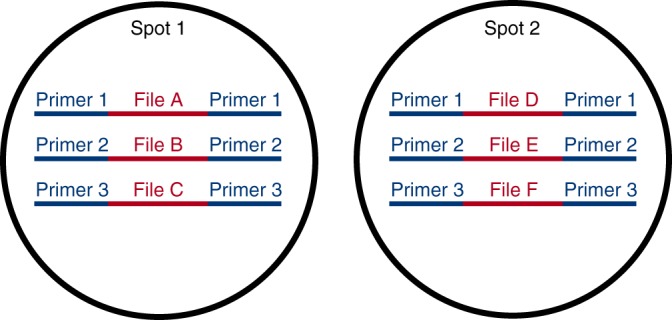
Fig. 1
Fig. 1
Files in physically isolated DNA spots can share the same addresses (primers). Physical isolation is necessary to scale beyond a single address space. The address of a spot would become part of a file’s address; in this example, file D would have address (Spot 2, Primer 1)
Fig. 2
Fig. 2
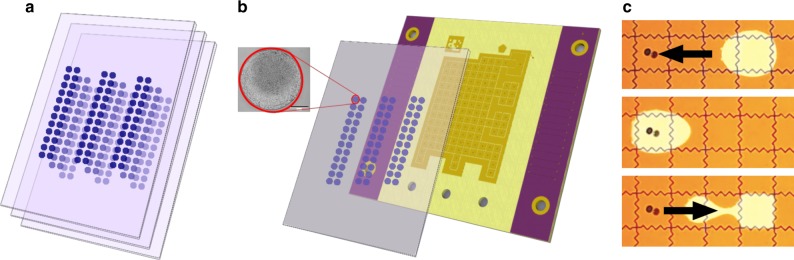
Storing physically isolated spots of dehydrated DNA on glass cartridges enables high information density. a Spotted cartridges can be further organized into decks. b To retrieve data, the desired cartridge is first loaded onto the DMF device consisting of an electrode grid used to perform retrieval functions. An actual magnified spot is depicted, where the scale bar in the inset is 275 um. c Next, a water droplet sandwiched between the cartridge and electrodes is actuated to move under the spotted DNA for rehydration. Depicted is an actual droplet moving on the device. After recovery, we manually recover the sample and analyzed it to assess DNA recovery rate and contamination across samples sharing paths on the DMF device
Fig. 3
Fig. 3
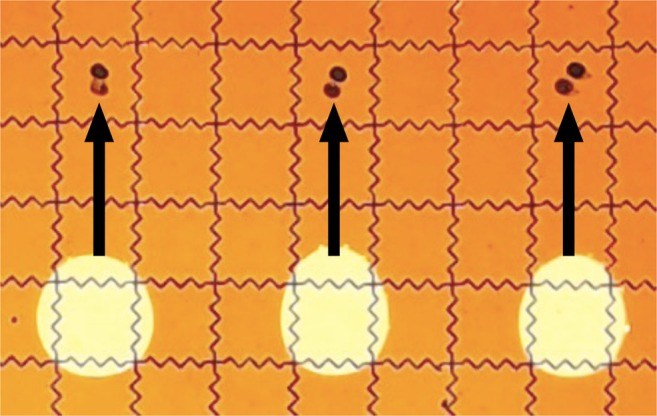
DMF setup to test for contamination through the oil. Black ink is used to visually mark DNA spot locations, and light circular blobs are water droplets. Droplets moved in tandem up to the spot, stayed for 60 s, and returned to their original location
Fig. 4
Fig. 4
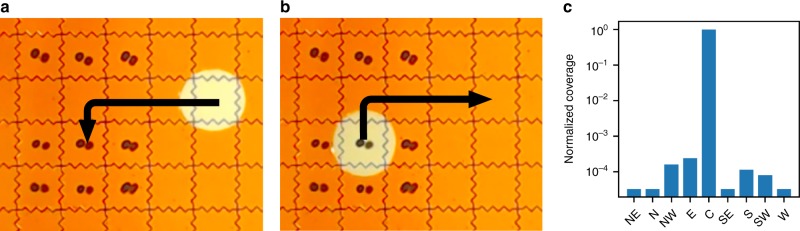
DMF setup for neighbor contamination tests. a Nine uniquely indexed pools are spotted onto a 4 x 3 electrode array with a central row left as an empty path for the recovery droplet. Cardinal directions of file locations are in reference to the central target spot. A droplet is moved to the central storage pool. b The droplet with reconstituted file returns to starting point for manual retrieval and analysis. c NGS coverage of each discovered file in cardinal coordinates (log scale) as seen in Table 1
Fig. 5
Fig. 5
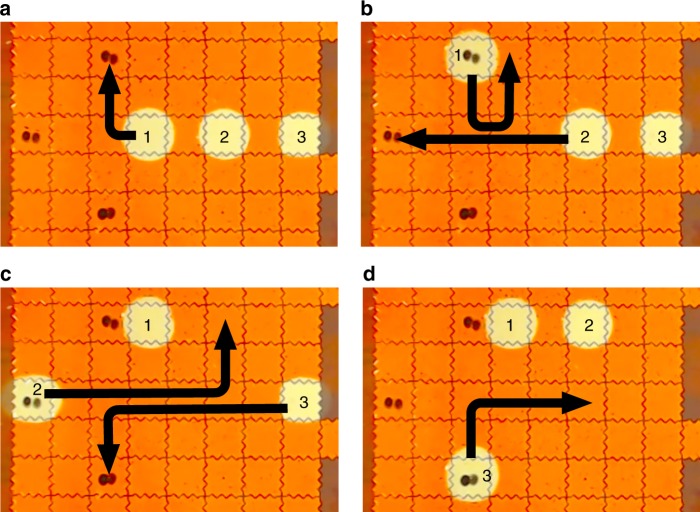
DMF setup for path contamination tests. a Three different files are spotted at different locations on the cartridge. Three retrieval droplets are initiated on the DMF device. Droplet 1 is moved to the north-most file. b Droplet 1 moves to its final coordinate. Droplet 2 then moves to the west-most file, passing two electrodes Droplet 1 had moved across. c Droplet 2 moves to its final coordinate. Droplet 3 moves to the south-most file, using a part of the path both droplets 1 and 2 had used. d Droplet 3 moves to its final coordinate for manual retrieval and analysis

References

    1. Church GM, Gao Y, Kosuri S. Next-generation digital information storage in DNA. Science. 2012;337:1628–1628. doi: 10.1126/science.1226355. - DOI - PubMed
    1. Goldman N, et al. Towards practical, high-capacity, low-maintenance information storage in synthesized DNA. Nature. 2013;494:77–80. doi: 10.1038/nature11875. - DOI - PMC - PubMed
    1. Yazdi SHT, et al. Dna-based storage: trends and methods. IEEE Trans. Mol. Biol. Multi-Scale Commun. 2015;1:230–248. doi: 10.1109/TMBMC.2016.2537305. - DOI
    1. Bornholt, J. et al. A DNA-based archival storage system. ASPLOS, 10.1145/2872362.2872397 (2016).
    1. Erlich Y, Zielinski D. Dna fountain enables a robust and efficient storage architecture. Science. 2017;355:950–954. doi: 10.1126/science.aaj2038. - DOI - PubMed

Publication types