. 2019 Sep;27(9):1398-1405.
doi: 10.1038/s41431-019-0401-x. Epub 2019 Apr 12.

Unique bioinformatic approach and comprehensive reanalysis improve diagnostic yield of clinical exomes

Affiliations

Unique bioinformatic approach and comprehensive reanalysis improve diagnostic yield of clinical exomes

Klaus Schmitz-Abe et al. Eur J Hum Genet. 2019 Sep.

Abstract

Clinical exome sequencing (CES) is increasingly being utilized; however, a large proportion of patients remain undiagnosed, creating a need for a systematic approach to increase the diagnostic yield. We have reanalyzed CES data for a clinically heterogeneous cohort of 102 probands with likely Mendelian conditions, including 74 negative cases and 28 cases with candidate variants, but reanalysis requested by clinicians. Reanalysis was performed by an interdisciplinary team using a validated custom-built pipeline, "Variant Explorer Pipeline" (VExP). This reanalysis approach and results were compared with existing literature. Reanalysis of candidate variants from CES in 28 cases revealed 1 interpretation that needed to be reclassified. A confirmed or potential genetic diagnosis was identified in 24 of 75 CES-negative/reclassified cases (32.0%), including variants in known disease-causing genes (n = 6) or candidate genes (n = 18). This yield was higher compared with similar studies demonstrating the utility of this approach. In summary, reanalysis of negative CES in a research setting enhances diagnostic yield by about a third. This study suggests the need for comprehensive, continued reanalysis of exome data when molecular diagnosis is elusive.


Conflict of interest statement

The authors declare that they have no conflict of interest.

Figures
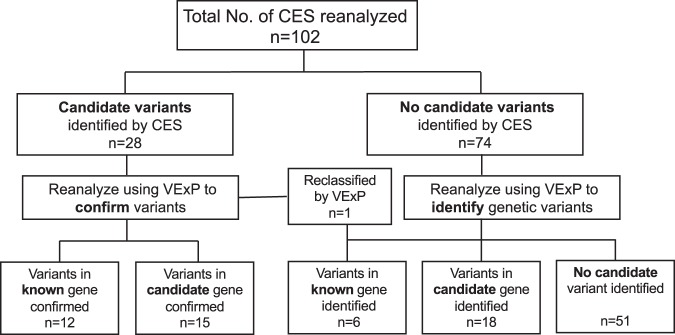
Fig. 1
Fig. 1
Flowchart of CES reanalysis and outcomes. All 102 CES cases with fastq data were reanalyzed by VExP and classified into one of the five following groups: (a) confirmed variants in known disease-causing genes previously identified by CES; (b) confirmed variants in candidate genes previously identified by CES; (c) variants in known disease-causing genes identified on reanalysis; (d) variants in candidate genes identified on reanalysis; and (e) no candidate variant identified on reanalysis. CES, clinical exome sequencing; VExP, Variant Explorer Pipeline
Fig. 2
Fig. 2
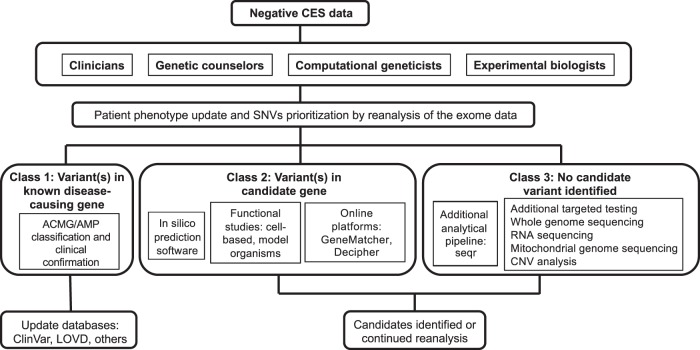
Proposed strategy for reanalyzing negative exomes. Collaborations between multidisciplinary clinical and research teams facilitate reanalysis of negative CES to reach a diagnosis. These negative CES cases can be divided into three classes after reanalysis: (1) candidate variants linked to the phenotype but of limited pathogenic evidence; (2) candidate variants in new genes not linked to the phenotype; (3) no candidate variants detected by CES after reanalysis. CES, clinical exome sequencing; CNV, copy number variation; VExP, Variant Explorer Pipeline

References

    1. Stark Z, Schofield D, Alam K, Wilson W, Mupfeki N, Macciocca I, et al. Prospective comparison of the cost-effectiveness of clinical whole-exome sequencing with that of usual care overwhelmingly supports early use and reimbursement. Genet Med. 2017;19:867–74. doi: 10.1038/gim.2016.221. - DOI - PubMed
    1. Stark Z, Tan TY, Chong B, Brett GR, Yap P, Walsh M, et al. A prospective evaluation of whole-exome sequencing as a first-tier molecular test in infants with suspected monogenic disorders. Genet Med. 2016;18:1090–6. doi: 10.1038/gim.2016.1. - DOI - PubMed
    1. Xue Y, Ankala A, Wilcox WR, Hegde MR. Solving the molecular diagnostic testing conundrum for Mendelian disorders in the era of next-generation sequencing: single-gene, gene panel, or exome/genome sequencing. Genet Med. 2015;17:444–51. doi: 10.1038/gim.2014.122. - DOI - PubMed
    1. Bamshad MJ, Ng SB, Bigham AW, Tabor HK, Emond MJ, Nickerson DA, et al. Exome sequencing as a tool for Mendelian disease gene discovery. Nat Rev Genet. 2011;12:745–55. doi: 10.1038/nrg3031. - DOI - PubMed
    1. Wenger AM, Guturu H, Bernstein JA, Bejerano G. Systematic reanalysis of clinical exome data yields additional diagnoses: implications for providers. Genet Med. 2017;19:209–14. doi: 10.1038/gim.2016.88. - DOI - PubMed

Publication types