


Familial Alzheimer's disease patient-derived neurons reveal distinct mutation-specific effects on amyloid beta
- PMID: 30980041
- PMCID: PMC7577860
- DOI: 10.1038/s41380-019-0410-8
Familial Alzheimer's disease patient-derived neurons reveal distinct mutation-specific effects on amyloid beta
Abstract
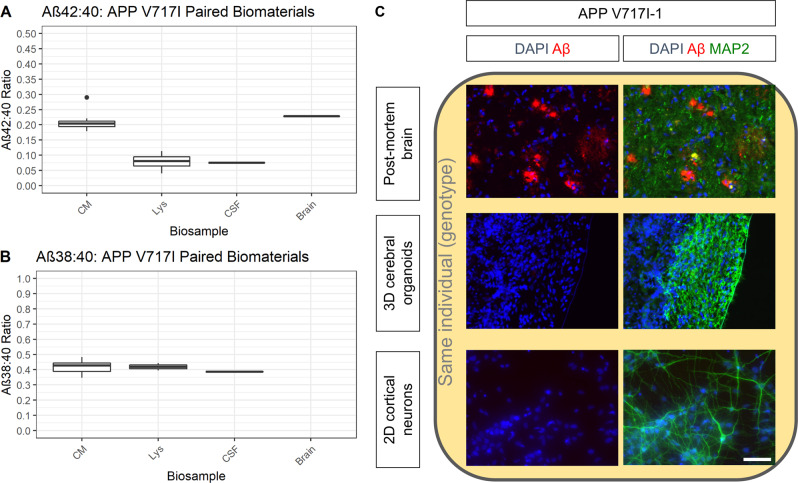
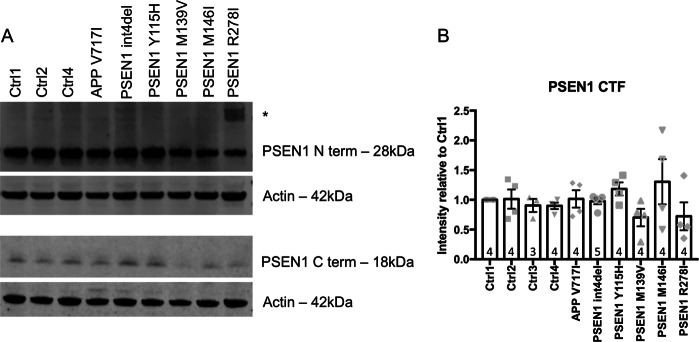
Familial Alzheimer's disease (fAD) mutations alter amyloid precursor protein (APP) cleavage by γ-secretase, increasing the proportion of longer amyloidogenic amyloid-β (Aβ) peptides. Using five control induced pluripotent stem cell (iPSC) lines and seven iPSC lines generated from fAD patients, we investigated the effects of mutations on the Aβ secretome in human neurons generated in 2D and 3D. We also analysed matched CSF, post-mortem brain tissue, and iPSCs from the same participant with the APP V717I mutation. All fAD mutation lines demonstrated an increased Aβ42:40 ratio relative to controls, yet displayed varied signatures for Aβ43, Aβ38, and short Aβ fragments. We propose four qualitatively distinct mechanisms behind raised Aβ42:40. (1) APP V717I mutations alter γ-secretase cleavage site preference. Whereas, distinct presenilin 1 (PSEN1) mutations lead to either (2) reduced γ-secretase activity, (3) altered protein stability or (4) reduced PSEN1 maturation, all culminating in reduced γ-secretase carboxypeptidase-like activity. These data support Aβ mechanistic tenets in a human physiological model and substantiate iPSC-neurons for modelling fAD.
Conflict of interest statement
The authors declare that they have no conflict of interest.
Figures



Comment in
-
Mutation-specific amyloid-β processing in iPSC-derived neurons.Nat Rev Neurol. 2019 Jun;15(6):310. doi: 10.1038/s41582-019-0195-z. Nat Rev Neurol. 2019. PMID: 31036954 No abstract available.
References
Publication types
MeSH terms
Substances
Grants and funding
LinkOut - more resources
Full Text Sources
Medical
Research Materials
