


Cellular senescence and radiation-induced pulmonary fibrosis
- PMID: 30981698
- PMCID: PMC6857805
- DOI: 10.1016/j.trsl.2019.03.006
Cellular senescence and radiation-induced pulmonary fibrosis
Abstract
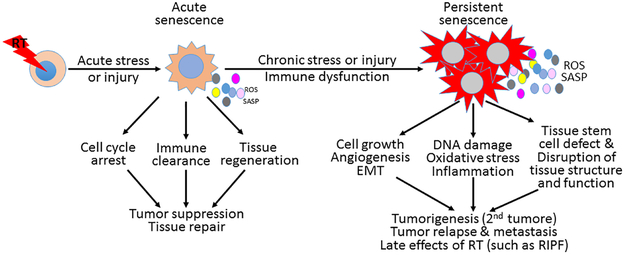
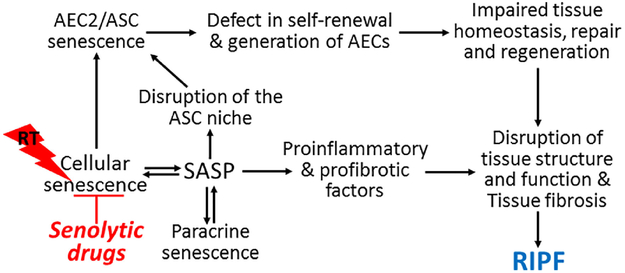
Radiation-induced pulmonary fibrosis (RIPF) is a serious treatment complication that affects about 9%-30% cancer patients receiving radiotherapy for thoracic tumors. RIPF is characterized by progressive and irreversible destruction of lung tissues and deterioration of lung function, which can compromise quality of life and eventually lead to respiratory failure and death. Unfortunately, the mechanisms by which radiation causes RIPF have not been well established nor has an effective treatment for RIPF been developed. Recently, an increasing body of evidence suggests that induction of senescence by radiation may play an important role in RIPF and clearance of senescent cells (SnCs) with a senolytic agent, small molecule that can selectively kill SnCs, has the potential to be developed as a novel therapeutic strategy for RIPF. This review discusses some of these new findings to promote further study on the role of cellular senescence in RIPF and the development of senolytic therapeutics for RIPF.
Copyright © 2019 Elsevier Inc. All rights reserved.
Conflict of interest statement
CONFLICTS OF INTEREST
G.Z. and D.Z. are inventors of a pending patent application for the development of BCL-xL targeted senolytic agents. D.Z. is a co–founder and an advisor of Unity that develops senolytic agents to treat various age-related diseases in humans.
Figures
References
-
- Abid SH, Malhotra V, Perry MC. Radiation-induced and chemotherapy-induced pulmonary injury. Curr Opin Oncol. 2001;13(4):242–248. - PubMed
-
- Carver JR, Shapiro CL, Ng A, et al. American Society of Clinical Oncology clinical evidence review on the ongoing care of adult cancer survivors: cardiac and pulmonary late effects. J Clin Oncol. 2007;25(25):3991–4008. - PubMed
-
- Graves PR, Siddiqui F, Anscher MS, Movsas B. Radiation pulmonary toxicity: from mechanisms to management. Semin Radiat Oncol. 2010;20(3):201–207. - PubMed
-
- King TE, Bradford WZ, Castro-Bernardini S, et al. A phase 3 trial of pirfenidone in patients with idiopathic pulmonary fibrosis. N Engl J Med. 2014;370(22):2083–2092. - PubMed
-
- Richeldi L, du Bois RM, Raghu G, et al. Efficacy and safety of nintedanib in idiopathic pulmonary fibrosis. N Engl J Med. 2014;370(22):2071–2082. - PubMed
Publication types
MeSH terms
Grants and funding
LinkOut - more resources
Full Text Sources
Medical
