


Review
doi: 10.1038/s41386-019-0389-5.
Epub 2019 Apr 14.
How genome-wide association studies (GWAS) made traditional candidate gene studies obsolete
Affiliations
- PMID: 30982060
- PMCID: PMC6785091
- DOI: 10.1038/s41386-019-0389-5
Item in Clipboard
Review
How genome-wide association studies (GWAS) made traditional candidate gene studies obsolete
Neuropsychopharmacology.
2019 Aug.
No abstract available
Conflict of interest statement
The authors declare no competing interests.
Figures
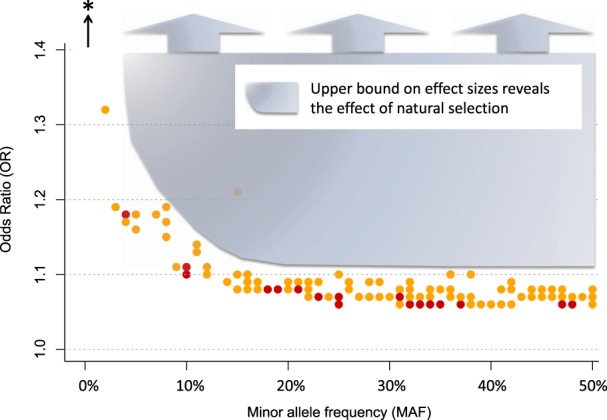
There is an upper bound on the effect sizes of common schizophrenia risk variants, which becomes increasingly stringent as minor allele frequency increases. The shaded region denotes coordinate space in which schizophrenia risk loci have not been not detected (e.g for variants with minor allele frequency greater than 20%, no risk variant has an effect size greater than 1.11). The bottom of the shaded region follows the curved upper bound of effect sizes for schizophrenia risk variants. Note that point color (yellow and red) denotes the sample size used to detect the locus (approximately 80,000 and 150,000, respectively). The black arrow and asterisk represent rare ( <1%) schizophrenia risk variants with larger per-allele effects (e.g. 22q11.2 deletions)
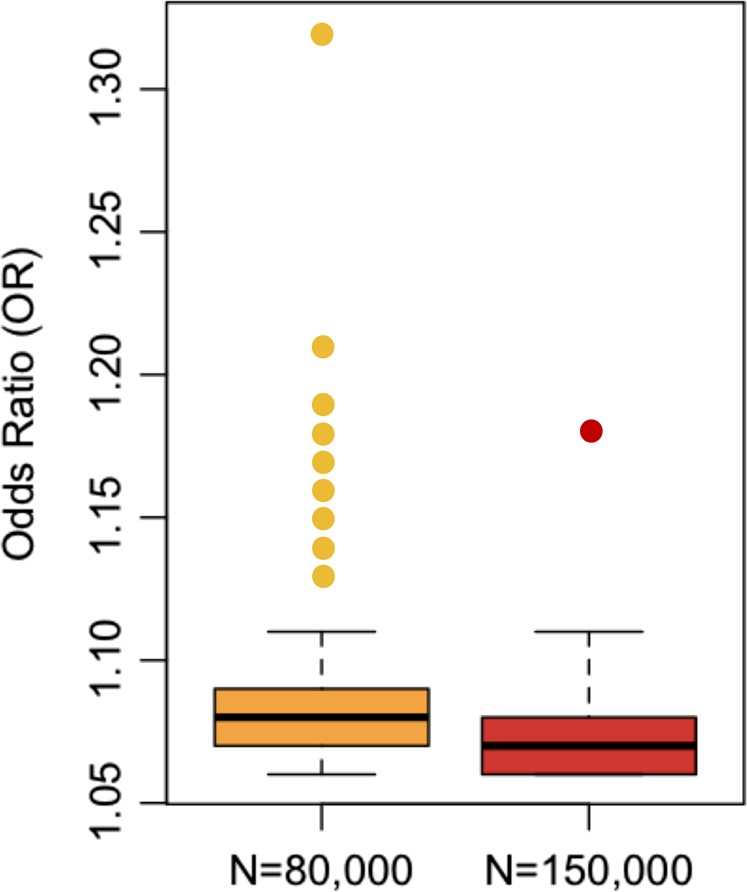
On average, the largest effect loci are detected first in GWAS. As power increases (typically through increased sample size), smaller effect variants are discovered. Each point represents one of the 128 variants from the 2014 publication of the Psychiatric Genomics Consortium (PGC) Schizophrenia Group. Of the 128 loci, 105 variants were significant associated with schizophrenia (i.e. p < 5 × 10⁻⁸) in the smaller sample size of approximately 80,000 (yellow). An additional 23 variants reached genome-wide significance using the larger sample size of approximately 150,000 (red, mostly additional control samples)
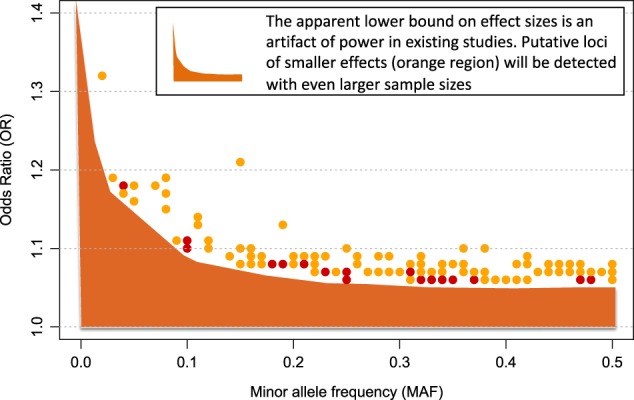
Additional risk variants for schizophrenia will be detected with larger sample sizes. The shaded orange region represents the combination of effect sizes and allele frequencies (of risk variants) that will be detectable with larger sample sizes
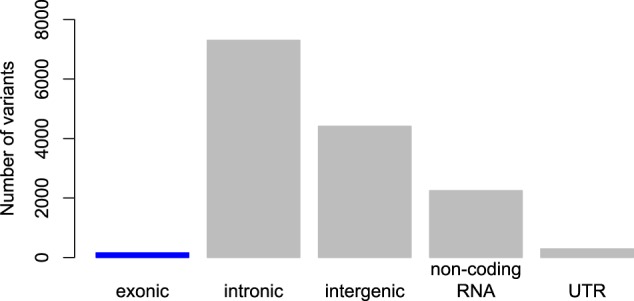
Location of schizophrenia risk variants reveals that very few variants (only 1.1%) are in the most strongly hypothesized regions of the genome, exons, which code for proteins. This demonstrates that current biological knowledge is insufficient to correctly specify most candidate genes/variants given that nearly all known schizophrenia variants fall in relatively poorly understood regions of the genome. This pattern of findings is typical for complex genetic phenotypes
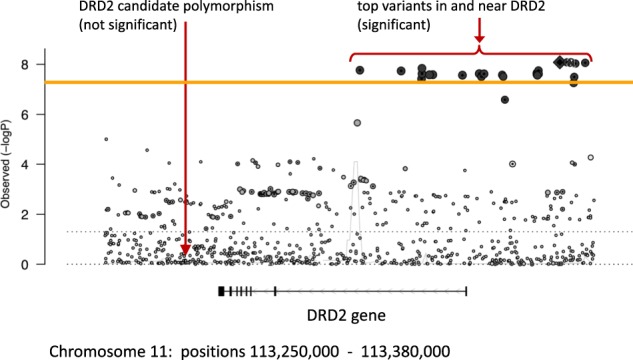
demonstrates that one seemingly true result from the candidate gene era (about DRD2 and schizophrenia) was not actually supported by GWAS results. The orange line denotes genome-wide significance (−log10(5 × 10⁻⁸) = 7.3), and multiple variants on the right side of the figure exceed genome-wide significance. Each point in the figure denotes one genetic variant on chromosome 11 in the region around the D2 dopamine receptor gene (DRD2). The fact that multiple variants exceed genome-wide significance reflects linkage disequilibrium (i.e. correlated alleles). Linkage disequilibrium does not extend, however, to the candidate polymorphism on the left, denoted by the long arrow
References
Publication types
MeSH terms
LinkOut - more resources
Full Text Sources
Medical
