


Association of N-Terminal Pro Brain Natriuretic Peptide and Long-Term Outcome in Patients With Pulmonary Arterial Hypertension
- PMID: 30982349
- PMCID: PMC6530970
- DOI: 10.1161/CIRCULATIONAHA.118.039360
Association of N-Terminal Pro Brain Natriuretic Peptide and Long-Term Outcome in Patients With Pulmonary Arterial Hypertension
Abstract
Background: NT-proBNP (N-terminal pro brain natriuretic peptide) levels are included in the multiparametric risk assessment approach for pulmonary arterial hypertension (PAH) outlined in PAH guidelines. However, data supporting the use of NT-proBNP risk thresholds in assessing prognosis in PAH are limited. The GRIPHON trial (Prostacyclin [PGI2] Receptor Agonist In Pulmonary Arterial Hypertension) provides an opportunity to assess the prognostic value of NT-proBNP thresholds in a controlled clinical trial and to evaluate the response to selexipag according to these thresholds.
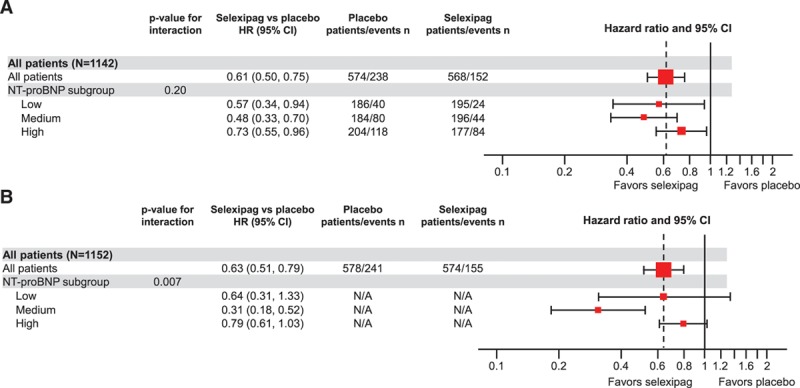
Methods: The event-driven GRIPHON trial randomly assigned patients to selexipag or placebo. NT-proBNP was measured at regular intervals in GRIPHON. Here, patients were categorized post hoc into low, medium, and high NT-proBNP subgroups according to 2 independent sets of thresholds: (1) baseline tertiles: <271 ng/L; 271 to 1165 ng/L; >1165 ng/L; and (2) 2015 European Society of Cardiology/European Respiratory Society guidelines cutoffs: <300 ng/L; 300 to 1400 ng/L; >1400 ng/L. Hazard ratios (selexipag versus placebo) with 95% CIs were calculated for the primary end point (composite morbidity/mortality events) by NT-proBNP category at baseline using Cox proportional-hazards models, and at any time during the exposure period using a time-dependent Cox model.
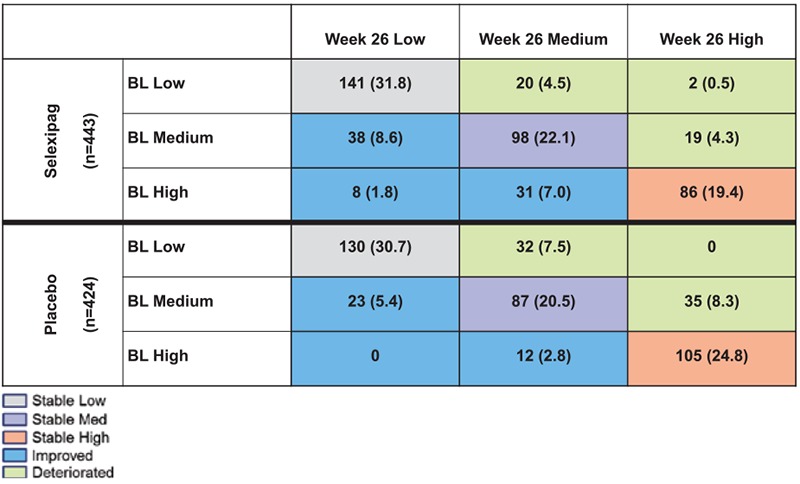
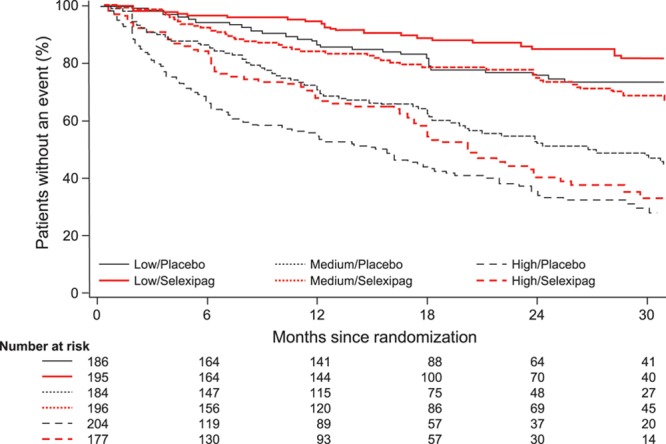
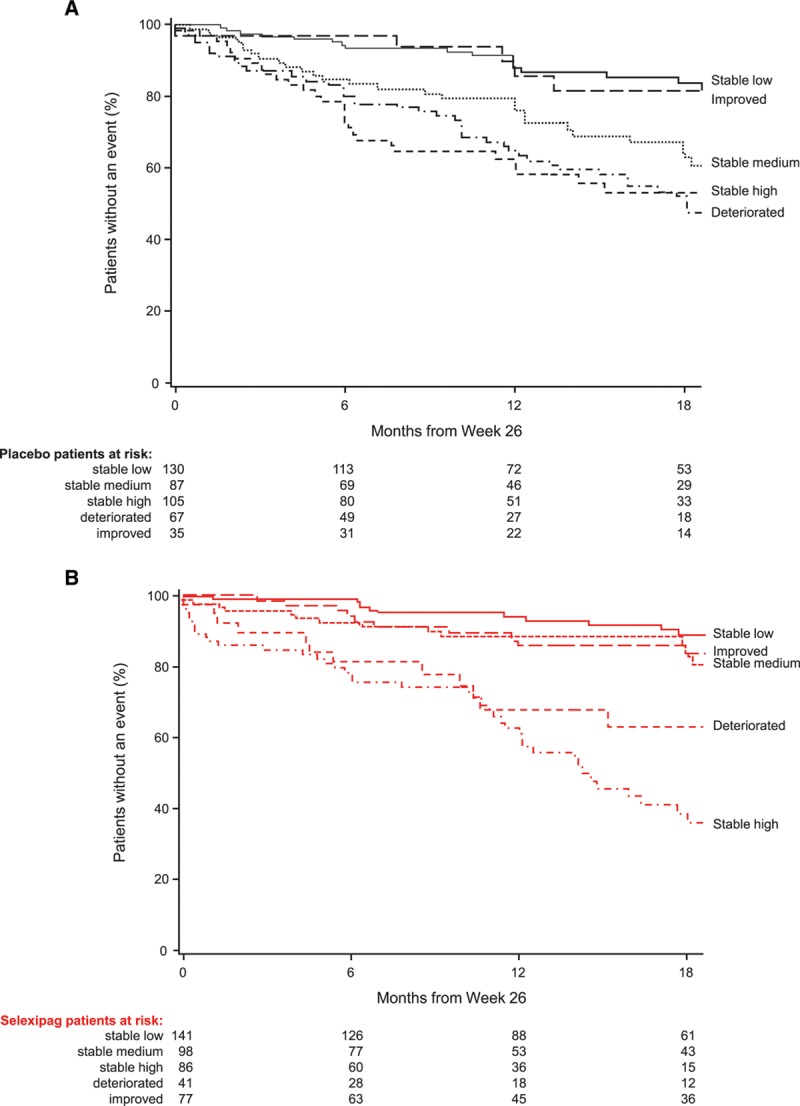
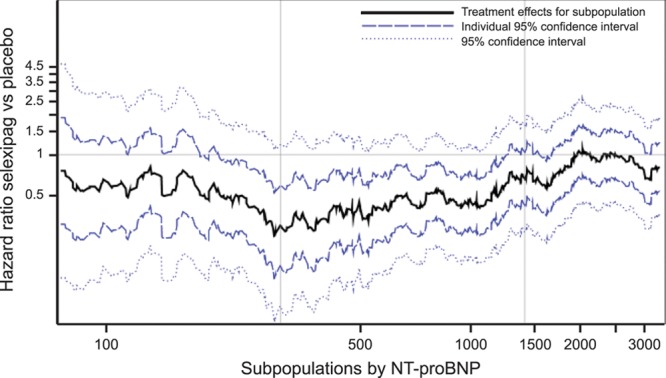
Results: With both thresholds, baseline and follow-up NT-proBNP categories were highly prognostic for future morbidity/mortality events during the study ( P<0.0001). In the time-dependent analysis, the risk of experiencing a morbidity/mortality event was 92% and 83% lower in selexipag-treated patients with a low and medium NT-proBNP level, and 90% and 56% lower in placebo-treated patients with a low and medium NT-proBNP level, in comparison with patients with a high NT-proBNP level. Selexipag reduced the risk of morbidity/mortality events across all 3 NT-proBNP categories in both the baseline and time-dependent analyses, with a more pronounced treatment benefit of selexipag seen in the medium and low NT-proBNP subgroups (interaction P values 0.20 and 0.007 in the baseline and time-dependent analyses).
Conclusions: These analyses further establish the prognostic relevance of NT-proBNP levels in PAH and provide first evidence for the association of NT-proBNP level and treatment response. Using 2 similar sets of thresholds, these analyses support the relevance of the low, medium, and high NT-proBNP categories as part of the multiparametric risk assessment approach outlined in the European Society of Cardiology/European Respiratory Society guidelines for the management of PAH patients.
Clinical trial registration: URL: https://www.clinicaltrials.gov . Unique identifier: NCT01106014.
Keywords: brain natriuretic peptide; hypertension, pulmonary; prostacyclin receptor; risk assessment.
Figures
References
-
- Benza RL, Miller DP, Gomberg-Maitland M, Frantz RP, Foreman AJ, Coffey CS, Frost A, Barst RJ, Badesch DB, Elliott CG, Liou TG, McGoon MD. Predicting survival in pulmonary arterial hypertension: insights from the Registry to Evaluate Early and Long-Term Pulmonary Arterial Hypertension Disease Management (REVEAL). Circulation. 2010;122:164–172. doi: 10.1161/CIRCULATIONAHA.109.898122. - PubMed
-
- Benza RL, Gomberg-Maitland M, Miller DP, Frost A, Frantz RP, Foreman AJ, Badesch DB, McGoon MD. The REVEAL Registry risk score calculator in patients newly diagnosed with pulmonary arterial hypertension. Chest. 2012;141:354–362. doi: 10.1378/chest.11-0676. - PubMed
-
- Galiè N, Humbert M, Vachiery JL, Gibbs S, Lang I, Torbicki A, Simonneau G, Peacock A, Vonk Noordegraaf A, Beghetti M, Ghofrani A, Gomez Sanchez MA, Hansmann G, Klepetko W, Lancellotti P, Matucci M, McDonagh T, Pierard LA, Trindade PT, Zompatori M, Hoeper M ESC Scientific Document Group. 2015 ESC/ERS Guidelines for the diagnosis and treatment of pulmonary hypertension: the Joint Task Force for the Diagnosis and Treatment of Pulmonary Hypertension of the European Society of Cardiology (ESC) and the European Respiratory Society (ERS): endorsed by: Association for European Paediatric and Congenital Cardiology (AEPC), International Society for Heart and Lung Transplantation (ISHLT). Eur Heart J. 2016;37:67–119. doi: 10.1093/eurheartj/ehv317. - PubMed
-
- Galiè N, Humbert M, Vachiery JL, Gibbs S, Lang I, Torbicki A, Simonneau G, Peacock A, Vonk Noordegraaf A, Beghetti M, Ghofrani A, Gomez Sanchez MA, Hansmann G, Klepetko W, Lancellotti P, Matucci M, McDonagh T, Pierard LA, Trindade PT, Zompatori M, Hoeper M. 2015 ESC/ERS Guidelines for the diagnosis and treatment of pulmonary hypertension: the Joint Task Force for the Diagnosis and Treatment of Pulmonary Hypertension of the European Society of Cardiology (ESC) and the European Respiratory Society (ERS): endorsed by: Association for European Paediatric and Congenital Cardiology (AEPC), International Society for Heart and Lung Transplantation (ISHLT). Eur Respir J. 2015;46:903–975. doi: 10.1183/13993003.01032-2015. - PubMed
Publication types
MeSH terms
Substances
Associated data
LinkOut - more resources
Full Text Sources
Medical
Research Materials
Miscellaneous
