


Clinical Efficacy of Telemedicine Compared to Face-to-Face Clinic Visits for Smoking Cessation: Multicenter Open-Label Randomized Controlled Noninferiority Trial
- PMID: 30982776
- PMCID: PMC6660118
- DOI: 10.2196/13520
Clinical Efficacy of Telemedicine Compared to Face-to-Face Clinic Visits for Smoking Cessation: Multicenter Open-Label Randomized Controlled Noninferiority Trial
Abstract
Background: Tobacco is a major public health concern. A 12-week standard smoking cessation program is available in Japan; however, it requires face-to-face clinic visits, which has been one of the key obstacles to completing the program, leading to a low smoking cessation success rate. Telemedicine using internet-based video counseling instead of regular clinic visits could address this obstacle.
Objective: This study aimed to evaluate the efficacy and feasibility of an internet-based remote smoking cessation support program compared with the standard face-to-face clinical visit program among patients with nicotine dependence.
Methods: This study was a randomized, controlled, open-label, multicenter, noninferiority trial. We recruited nicotine-dependent adults from March to June 2018. Participants randomized to the telemedicine arm received internet-based video counseling, whereas control participants received standard face-to-face clinic visits at each time point in the smoking cessation program. Both arms received a CureApp Smoking Cessation smartphone app with a mobile exhaled carbon monoxide checker. The primary outcome was a continuous abstinence rate (CAR) from weeks 9 to 12. Full analysis set was used for data analysis.
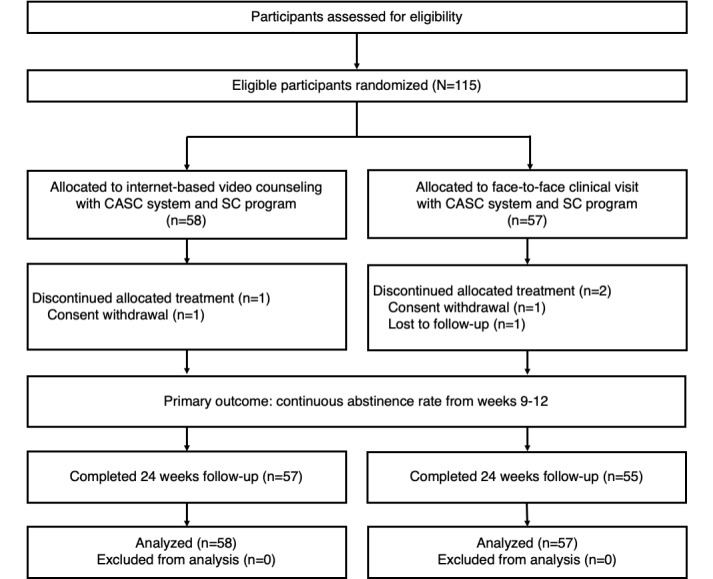
Results: We randomized 115 participants with nicotine dependence: 58 were allocated to the telemedicine (internet-based video counseling) arm and 57, to the control (standard face-to-face clinical visit) arm. We analyzed all 115 participants for the primary outcome. Both telemedicine and control groups had similar CARs from weeks 9 to 12 (81.0% vs 78.9%; absolute difference, 2.1%; 95% CI -12.8 to 17.0), and the lower limit of the difference between groups (-12.8%) was greater than the prespecified limit (-15%).
Conclusions: The application of telemedicine using internet-based video counseling as a smoking cessation program had a similar CAR from weeks 9 to 12 as that of the standard face-to-face clinical visit program. The efficacy of the telemedicine-based smoking cessation program was not inferior to that of the standard visit-based smoking cessation program.
Trial registration: University Hospital Medical Information Network Clinical Trials Registry: UMIN000031620; https://upload.umin.ac.jp/cgi-open-bin/ctr_e/ctr_view.cgi?recptno=R000035975.
Keywords: digital therapeutics; mHealth; mobile phone; nicotine dependence; smoking cessation; telecare; telemedicine.
©Akihiro Nomura, Tomoyuki Tanigawa, Tomoyasu Muto, Takafumi Oga, Yasushi Fukushima, Arihiro Kiyosue, Masaki Miyazaki, Eisuke Hida, Kohta Satake. Originally published in the Journal of Medical Internet Research (http://www.jmir.org), 26.04.2019.
Conflict of interest statement
Conflicts of Interest: This trial was supported by CureApp, Inc. AN received consulting fees from CureApp, Inc. TT and TM are employees of CureApp, Inc. KS is the founder and a shareholder of CureApp, Inc, and patent holder of the CASC system. EH has a consultation contract as a biostatistician with CureApp, Inc. TO, YF, AK and MM received research support fees from CureApp, Inc.
Figures
References
-
- Ikeda N, Inoue M, Iso H, Ikeda S, Satoh T, Noda M, Mizoue T, Imano H, Saito E, Katanoda K, Sobue T, Tsugane S, Naghavi M, Ezzati M, Shibuya K. Adult mortality attributable to preventable risk factors for non-communicable diseases and injuries in Japan: a comparative risk assessment. PLoS Med. 2012 Jan;9(1):e1001160. doi: 10.1371/journal.pmed.1001160. http://dx.plos.org/10.1371/journal.pmed.1001160 PMEDICINE-D-11-00778 - DOI - PMC - PubMed
-
- World Health Organization. [2019-04-19]. WHO Report on the Global Tobacco Epidemic, 2017 http://apps.who.int/iris/bitstream/handle/10665/255874/9789241512824-eng... .
-
- Ikeda N, Saito E, Kondo N, Inoue M, Ikeda S, Satoh T, Wada K, Stickley A, Katanoda K, Mizoue T, Noda M, Iso H, Fujino Y, Sobue T, Tsugane S, Naghavi M, Ezzati M, Shibuya K. What has made the population of Japan healthy? Lancet. 2011 Sep 17;378(9796):1094–105. doi: 10.1016/S0140-6736(11)61055-6.S0140-6736(11)61055-6 - DOI - PubMed
-
- Igarashi A, Goto R, Suwa K, Yoshikawa R, Ward AJ, Moller J. Cost-Effectiveness Analysis of Smoking Cessation Interventions in Japan Using a Discrete-Event Simulation. Appl Health Econ Health Policy. 2016 Feb;14(1):77–87. doi: 10.1007/s40258-015-0204-3. http://europepmc.org/abstract/MED/26597111 10.1007/s40258-015-0204-3 - DOI - PMC - PubMed
-
- The Standard Procedure Book for Smoking Cessation, 6th edition (in Japanese) 2014. Apr, [2018-12-10]. https://www.jrs.or.jp/uploads/ uploads/files/information/non-smoking_06.pdf .
Publication types
MeSH terms
LinkOut - more resources
Full Text Sources
Medical
