


Sex Differences in the Reward-Enhancing Effects of Nicotine on Ethanol Reinforcement: A Reinforcer Demand Analysis
- PMID: 30982885
- PMCID: PMC7297098
- DOI: 10.1093/ntr/ntz056
Sex Differences in the Reward-Enhancing Effects of Nicotine on Ethanol Reinforcement: A Reinforcer Demand Analysis
Abstract
Background: Alcohol is often consumed with tobacco, and dependence to alcohol and tobacco are highly comorbid. In addition, there are differences in the prevalence of nicotine- and alcohol-abuse between the sexes. Nicotine produces enhancing effects on the value of other reinforcers, which may extend to alcohol.
Methods: Male and female Wistar rats were trained to self-administer 15% ethanol solution in 30-minute sessions. Once ethanol self-administration was established, demand for ethanol was evaluated using an exponential reinforcer demand method, in which the response cost per reinforcer delivery was systematically increased over blocks of several sessions. Within each cost condition, rats were preinjected with nicotine (0.05, 0.1, 0.2, or 0.4 mg/kg base, SC) or saline 5 minutes before self-administration sessions. The effects of nicotine dose and biological sex were evaluated using the estimates generated by the reinforcer demand model.
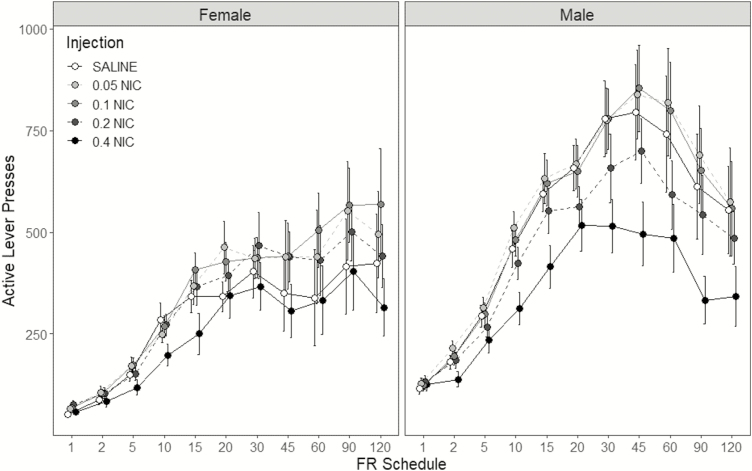
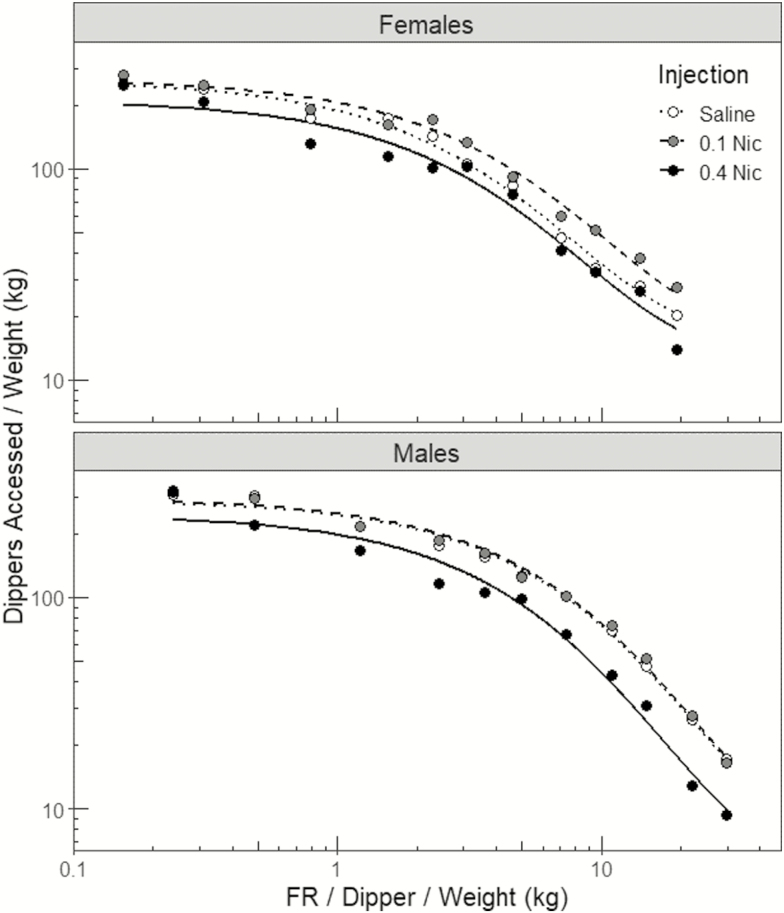
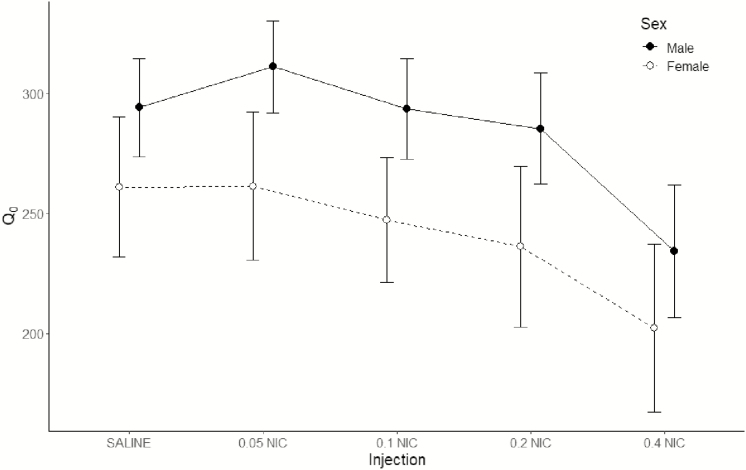
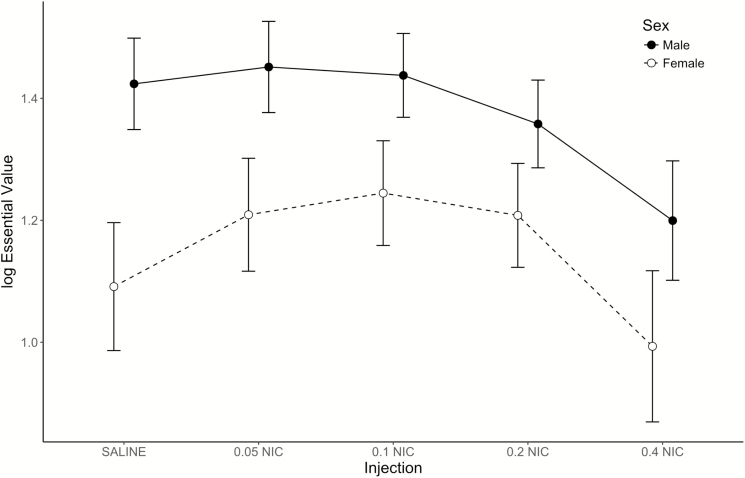
Results: Under saline conditions, males showed greater sensitivity to ethanol reinforcement than females. Nicotine enhanced the reinforcement value of alcohol and this varied with sex. In both sexes, 0.4 mg/kg nicotine decreased intensity of ethanol demand. However, 0.05, 0.1, and 0.2 mg/kg nicotine decreased elasticity of ethanol demand in females, but not in males.
Conclusions: Nicotine enhances ethanol reinforcement, which may partially drive comorbidity between nicotine-abuse and alcohol-abuse. Males showed signs of greater ethanol reinforcement value than females under saline conditions, and nicotine attenuated this effect by increasing ethanol reinforcement value in the females. These findings highlight that a complete understanding of alcohol-abuse must include a thorough study of alcohol use in the context of other drug use, including nicotine.
Implications: Nicotine dose dependently enhances the alcohol reinforcement value in a manner that is clearly influenced by biological sex. Under saline baseline conditions, males show lower elasticity of demand for alcohol reinforcement than females, indicative of greater reinforcement value. However, nicotine attenuated this difference by enhancing alcohol reward in the females. Specifically, low-to-moderate doses (0.05-0.2 mg/kg) of nicotine decreased elasticity of alcohol demand in female rats, increasing the perseverance of their alcohol taking behavior. These data indicate that the well-documented reward-enhancing effects of nicotine on sensory reinforcement extend to alcohol reinforcement and that these vary with biological sex.
© The Author(s) 2019. Published by Oxford University Press on behalf of the Society for Research on Nicotine and Tobacco. All rights reserved. For permissions, please e-mail: journals.permissions@oup.com.
Figures
References
-
- World Health Organization. Neuroscience of Psychoactive Substance Use and Dependence. Geneva, Switzerland: World Health Organization; 2004.
-
- U.S. Department of Health and Human Services. The Health Consequences of Smoking—50 Years of Progress: A Report of the Surgeon General. Atlanta, GA: U.S. Department of Health and Human Services, Centers for Disease Control and Prevention, National Center for Chronic Disease Prevention and Health Promotion, Office on Smoking and Health; 2014.
-
- Caggiula AR, Donny EC, Palmatier MI, Liu X, Chaudhri N, Sved AF. The role of nicotine in smoking: A dual reinforcement model. In: Bevins RA, Caggiula AR, eds. The Motivational Impact of Nicotine and its Role in Tobacco Use. New York, NY: Springer Science and Business Media; 2009:91–109. - PMC - PubMed
-
- U.S. Department of Health and Human Services. Women and Smoking: A Report of the Surgeon General. Atlanta, GA: U.S. Department of Health and Human Services, Centers for Disease Control and Prevention, National Center for Chronic Disease Prevention and Health Promotion, Office on Smoking and Health; 2001.
-
- Perkins KA. Sex differences in nicotine reinforcement and reward: Influences on the persistence of tobacco smoking. In: Bevins RA, Caggiula AR, eds. The Motivational Impact of Nicotine and its Role in Tobacco Use. New York, NY: Springer Science and Business Media; 2009:143–169. - PubMed
Publication types
MeSH terms
Substances
Grants and funding
LinkOut - more resources
Full Text Sources
Medical
