


CGRP and the Trigeminal System in Migraine
- PMID: 30982963
- PMCID: PMC6593989
- DOI: 10.1111/head.13529
CGRP and the Trigeminal System in Migraine
Abstract
Objective: The goal of this narrative review is to provide an overview of migraine pathophysiology, with an emphasis on the role of calcitonin gene-related peptide (CGRP) within the context of the trigeminovascular system.
Background: Migraine is a prevalent and disabling neurological disease that is characterized in part by intense, throbbing, and unilateral headaches. Despite recent advances in understanding its pathophysiology, migraine still represents an unmet medical need, as it is often underrecognized and undertreated. Although CGRP has been known to play a pivotal role in migraine for the last 2 decades, this has now received more interest spurred by the early clinical successes of drugs that block CGRP signaling in the trigeminovascular system.
Design: This narrative review presents an update on the role of CGRP within the trigeminovascular system. PubMed searches were used to find recent (ie, 2016 to November 2018) published articles presenting new study results. Review articles are also included not as primary references but to bring these to the attention of the reader. Original research is referenced in describing the core of the narrative, and review articles are used to support ancillary points.
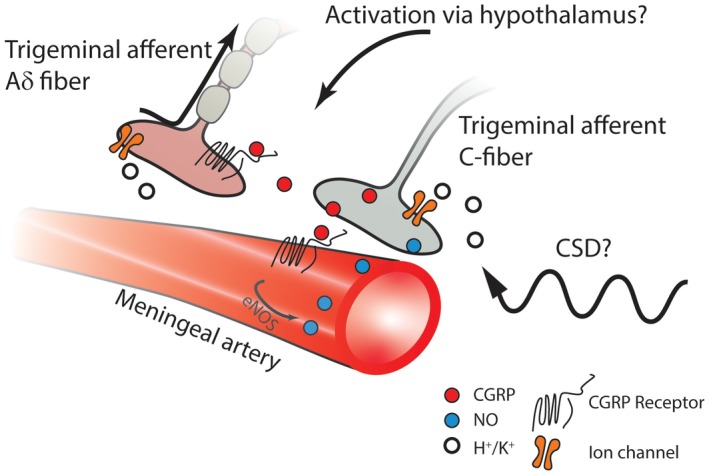
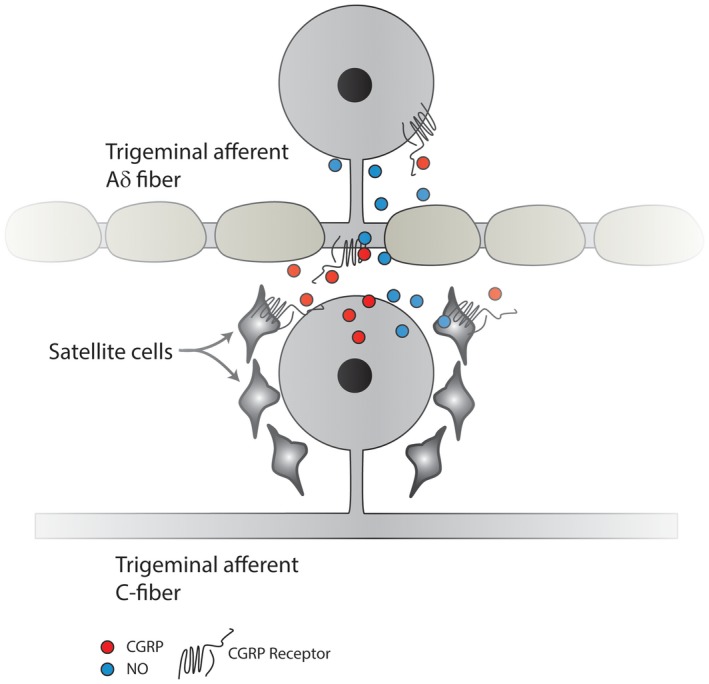
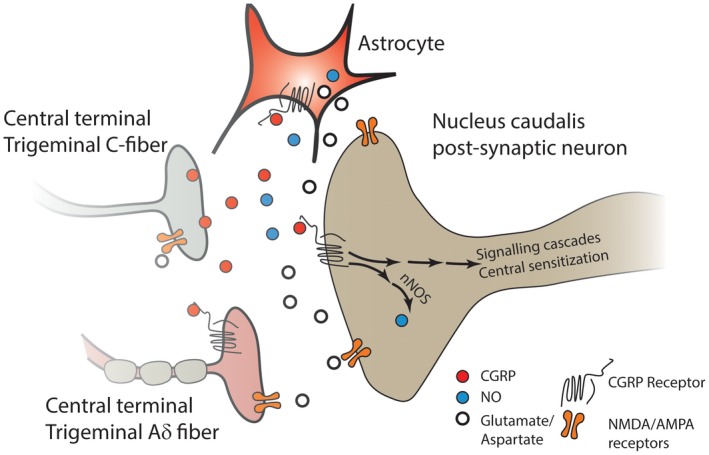
Results: The trigeminal ganglion neurons provide the connection between the periphery, stemming from the interface between the primary afferent fibers of the trigeminal ganglion and the meningeal vasculature and the central terminals in the trigeminal nucleus caudalis. The neuropeptide CGRP is abundant in trigeminal ganglion neurons, and is released from the peripheral nerve and central nerve terminals as well as being secreted within the trigeminal ganglion. Release of CGRP from the peripheral terminals initiates a cascade of events that include increased synthesis of nitric oxide and sensitization of the trigeminal nerves. Secreted CGRP in the trigeminal ganglion interacts with adjacent neurons and satellite glial cells to perpetuate peripheral sensitization, and can drive central sensitization of the second-order neurons. A shift in central sensitization from activity-dependent to activity-independent central sensitization may indicate a mechanism driving the progression of episodic migraine to chronic migraine. The pathophysiology of cluster headache is much more obscure than that of migraine, but emerging evidence suggests that it may also involve hypersensitivity of the trigeminovascular system. Ongoing clinical studies with therapies targeted at CGRP will provide additional, valuable insights into the pathophysiology of this disorder.
Conclusions: CGRP plays an essential role in the pathophysiology of migraine. Treatments that interfere with the functioning of CGRP in the peripheral trigeminal system are effective against migraine. Blocking sensitization of the trigeminal nerve by attenuating CGRP activity in the periphery may be sufficient to block a migraine attack. Additionally, the potential exists that this therapeutic strategy may also alleviate cluster headache as well.
Keywords: calcitonin gene-related peptide; migraine; nitric oxide; sensitization; trigeminal system.
© 2019 The Authors. Headache: The Journal of Head and Face Pain published by Wiley Periodicals, Inc. on behalf of American Headache Society.
Figures
References
-
- Popko L. Some notes on papyrus ebers, ancient egyptian treatments of migraine, and a crocodile on the patient's head. Bull Hist Med. 2018;92:352‐366. - PubMed
-
- Headache Classification Committee of the International Headache Society (IHS) . The International Classification of Headache Disorders. Cephalalgia. 2018;38:1‐211. - PubMed
-
- Lipton RB, Silberstein SD. Episodic and chronic migraine headache: Breaking down barriers to optimal treatment and prevention. Headache. 2015;55(Suppl. 2):103‐122. - PubMed
-
- Peck KR, Johnson YL, Smitherman TA. Migraine. Handb Clin Neurol. 2016;138:283‐293. - PubMed
-
- Tfelt‐Hansen P, Olesen J. Taking the negative view of current migraine treatments: The unmet needs. CNS Drugs. 2012;26:375‐382. - PubMed
Publication types
MeSH terms
Substances
Grants and funding
LinkOut - more resources
Full Text Sources
Other Literature Sources
Medical
Research Materials
