


Strategies used by gay male HIV serodiscordant couples to reduce the risk of HIV transmission from anal intercourse in three countries
- PMID: 30983155
- PMCID: PMC6462805
- DOI: 10.1002/jia2.25277
Strategies used by gay male HIV serodiscordant couples to reduce the risk of HIV transmission from anal intercourse in three countries
Abstract
Introduction: There are few data about the range of strategies used to prevent sexual HIV transmission within gay male serodiscordant couples. We examined HIV prevention strategies used by such couples and compared differences between countries.
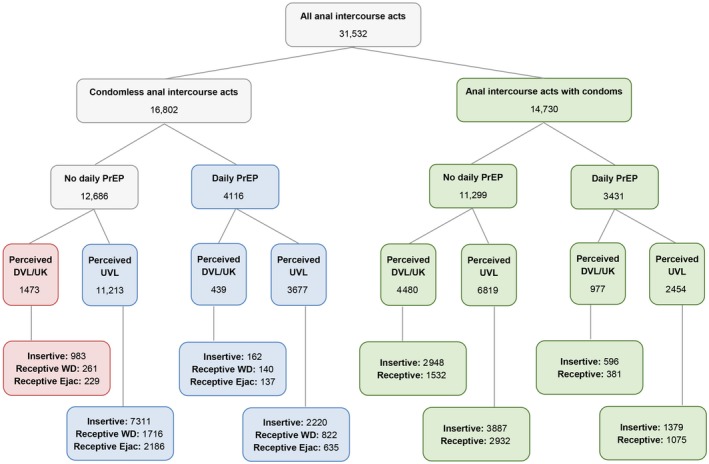
Methods: Opposites Attract was a cohort study of male serodiscordant couples in Australia, Brazil and Thailand, from May 2014 (Australia) or May 2016 (Brazil/Thailand) to December 2016. At visits, HIV-positive partners had viral load (VL) tested; HIV-negative partners reported sexual behaviour and perceptions of their HIV-positive partner's VL results. Within-couple acts of condomless anal intercourse (CLAI) were categorized by strategy: condom-protected, biomedically protected (undetectable VL and/or pre-exposure prophylaxis [PrEP]), or not protected by either (HIV-negative partners engaging in insertive CLAI, receptive CLAI with withdrawal, or receptive CLAI with ejaculation).
Results: A total of 343 couples were included in this analysis (153 in Australia, 93 in Brazil and 97 in Thailand). Three-quarters of HIV-positive partners were consistently virally suppressed (<200 copies/mL) during follow-up, and HIV-negative partners had correct perceptions of their partner's VL result for 76.5% of tests. One-third of HIV-negative partners used daily PrEP during follow-up. Over follow-up, 73.8% of couples had CLAI. HIV-negative partners reported 31,532 acts of anal intercourse with their HIV-positive partner. Of these, 46.7% were protected by condoms, 48.6% by a biomedical strategy and 4.7% of acts were not protected by these strategies. Australian couples had fewer condom-protected acts and a higher proportion of biomedically protected acts than Brazilian and Thai couples. Of the 1473 CLAI acts where the perceived VL was detectable/unknown and were not protected by PrEP (4.7% of all acts), two-thirds (n = 983) were when the HIV-negative partner was insertive (strategic positioning). Of the 490 acts when the HIV-negative partner was receptive, 261 involved withdrawal and 280 involved ejaculation. Thus, <1% of acts were in the highest risk category of receptive CLAI with ejaculation.
Conclusions: Couples used condoms, PrEP or perceived undetectable VL for prevention in the majority of anal intercourse acts. Only a very small proportion of events were not protected by these strategies. Variation between countries may reflect differences in access to HIV treatment, education, knowledge and attitudes.
Keywords: HIV prevention; gay men; homosexual; men who have sex with men; risk reduction strategies; serodiscordant couples; sexual behaviour.
© 2019 The Authors. Journal of the International AIDS Society published by John Wiley & Sons Ltd on behalf of the International AIDS Society.
Figures
References
-
- Down I, Ellard J, Bavinton BR, Brown G, Prestage G. In Australia, most HIV infections among gay and bisexual men are attributable to sex with ‘new’ partners. AIDS Behav. 2017;21(8):2543–50. - PubMed
-
- Sullivan PS, Salazar L, Buchbinder S, Sanchez TH. Estimating the proportion of HIV transmissions from main sex partners among men who have sex with men in five US cities. AIDS. 2009;23(9):1153–62. - PubMed
Publication types
MeSH terms
LinkOut - more resources
Full Text Sources
Medical
Miscellaneous
