


Does the political will exist to bring quality-assured and affordable drugs to low- and middle-income countries?
- PMID: 30983547
- PMCID: PMC6484498
- DOI: 10.1080/16549716.2019.1586317
Does the political will exist to bring quality-assured and affordable drugs to low- and middle-income countries?
Abstract
Background: Increased coverage with antiretroviral therapy for people living with HIV in low- and middle-income countries has increased their life expectancy associated with non-HIV comorbidities and the need for quality-assured and affordable non-communicable diseases drugs . Funders are leaving many middle-income countries that will have to pay and provide quality-assured and affordable HIV and non-HIV drugs, including for non-communicable diseases.
Objective: To estimate costs for originator and generic antiretroviral therapy as the number of people living with HIV are projected to increase between 2016 and 2026, and discuss country, regional and global factors associated with increased access to generic drugs.
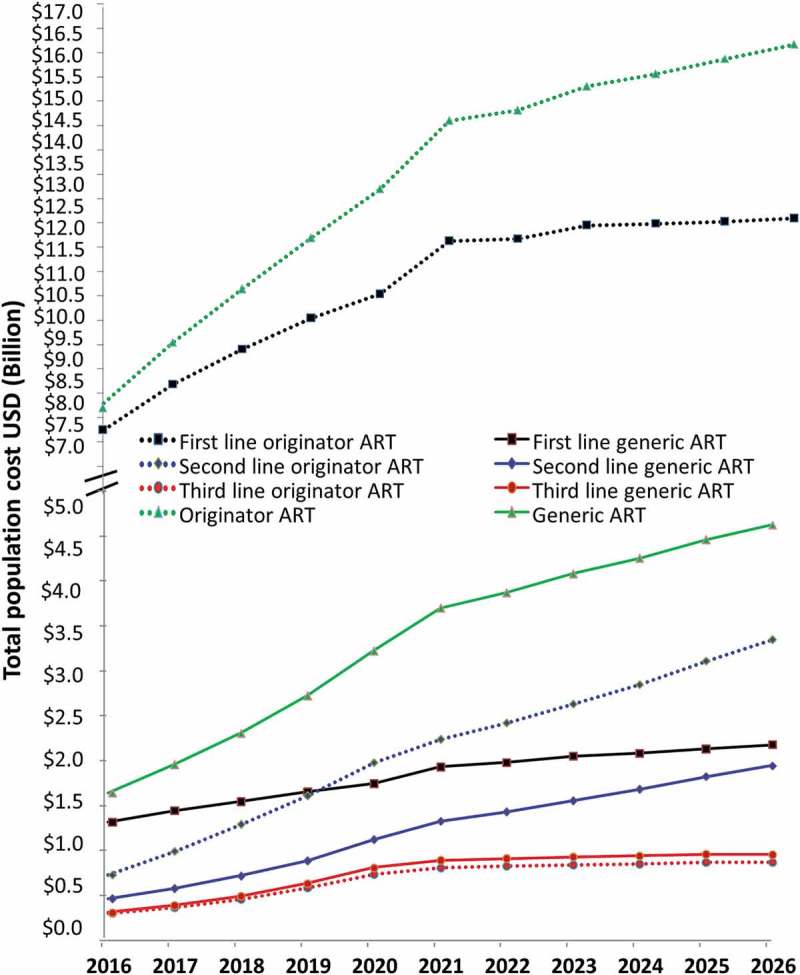
Methods: Based on estimates of annual demand and prices, annual cost estimates were produced for generic and originator antiretroviral drug prices in low- and middle-income countries and projected for 2016-2026.
Results: Drug costs varied between US$1.5 billion and US$4.8 billion for generic drugs and US$ 8.2 billion and US$16.5 billion for originator drugs between 2016 and 2026.
Discussion: The global HIV response increased access to affordable generic drugs in low- and middle-income countries. Cheaper active pharmaceutical ingredients and market competition were responsible for reduced drug costs. The development and implementation of regulatory changes at country, regional and global levels, covering intellectual property rights and public health, and flexibilities in patent laws enabled prices to be reduced. These changes have not yet been applied in many low- and middle-income countries for HIV, nor for other infectious and non-communicable diseases, that lack the profile and political attention of HIV. Licensing backed up with Trade-Related Aspects of Intellectual Property Rights safeguards should become the norm to provide quality-assured and affordable drugs within competitive generic markets.
Conclusion: Does the political will exist among policymakers and other stakeholders to develop and implement these country, regional and global frameworks for non-HIV drugs as they did for antiretroviral drugs?
Keywords: Trade-related aspects of intellectual property rights (TRIPS); annual originator and generic HIV drug cost estimates; intellectual property rights and patents; low-and middle-income countries.
Figures
References
-
- UNAIDS Fast-Track strategy to end the AIDS epidemic by 2030. Geneva: UNAIDS; 2014. [cited 2019 February11]. Available from:http://www.unaids.org/en/resources/campaigns/World-AIDS-Day-Report-2014
-
- UNAIDS 90-90-90 an ambitious treatment target to help end the HIV epidemic. Geneva: UNAIDS; 2014. [cited 2019 February11]. Available from:http://www.unaids.org/en/resources/documents/2017/90-90-90
-
- Hammer SM.Antiretroviral treatment as prevention. N Engl J Med. 2011;365:561–562. - PubMed
-
- World Health Organization Guideline on when to start antiretroviral therapy and on pre-exposure prophylaxis for HIV. Geneva: World Health Organization; 2015. [cited 2019 February11]. Available from:http://apps.who.int/iris/bitstream/10665/186275/1/9789241509565_eng.pdf?... - PubMed
MeSH terms
Substances
Grants and funding
LinkOut - more resources
Full Text Sources
Medical
