. 2019 Mar 28:10:180.
doi: 10.3389/fphar.2019.00180. eCollection 2019.

Gardenia Decoction Prevent Intestinal Mucosal Injury by Inhibiting Pro-inflammatory Cytokines and NF-κB Signaling

Affiliations

Gardenia Decoction Prevent Intestinal Mucosal Injury by Inhibiting Pro-inflammatory Cytokines and NF-κB Signaling

Yizhe Cui et al. Front Pharmacol. .

Abstract

Gardenia jasminoides Ellis, which belongs to the Rubiaceae family, is a widely used traditional Chinese medicine. Although effect of Gardenia jasminoides Ellis has been widely reported, its anti-inflammatory role in intestinal mucosal injury induced by LPS remains unclear. In the present study, we investigated the effects of decoction extracted from Gardenia jasminoides on the morphology and intestinal antioxidant capacity of duodenum induced by LPS in mice. Further analysis was carried out in the expression of inflammatory and anti-inflammatory cytokines. Nuclear factor-kappa B (NF-κB) was determined by Western blot. Gardenia jasminoides water extract was qualitative analyzed by high-performance liquid chromatography coupled with electro spray ionization quadrupole time-of-flight mass spectrometry. The results showed that Gardenia decoction markedly inhibited the LPS-induced Tumor necrosis factor (TNF)-α, Interleukin (IL)-6, IL-8, and IL-1 production. It was also observed that Gardenia decoction attenuated duodenum histopathology changes in the mouse models. Furthermore, Gardenia decoction inhibited the expression of NF-κB in LPS stimulated mouse duodenum. These results suggest that Gardenia decoction exerts an anti-inflammatory and antioxidant property by up-regulating the activities of the total antioxidant capacity (T-AOC), the total superoxide dismutase (T-SOD), and glutathione peroxidase (GSH-Px). Gardenia decoction is highly effective in inhibiting intestinal mucosal damage and may be a promising potential therapeutic reagent for intestinal mucosal damage treatment.

Keywords: Gardenia jasminoides; Lipopolysaccharide; NfκB; cytokine; decoction.


Figures
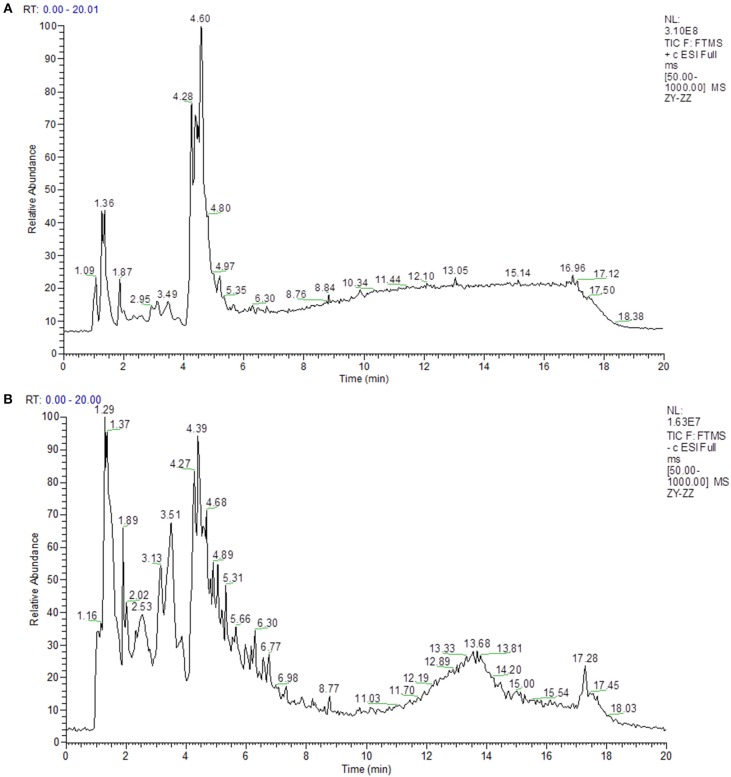
Figure 1
Figure 1
The Total Ion Chromatogram of GD. (A) The Total Ion Chromatogram of GD (ESI+). (ESI+) represents the positive ion detection mode, in which the mass analyzer scans only positive charged ions and filters out negative charged ions to obtain positive charged ions information during the detection process. (B) The Total Ion Chromatogram of GD (ESI–). (ESI–) denotes the negative ion detection mode, in which the mass analyzer scans only negative charged ions and filters out positive charged ions, thus obtaining the information of negative charged ions.
Figure 2
Figure 2
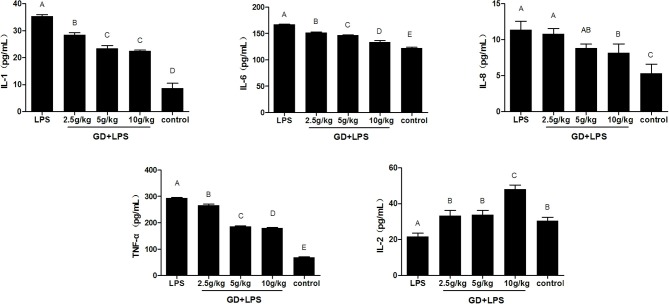
Effects of GD on the production of inflammatory cytokines in the serum. The data are expressed as the mean ± SD (n = 10 per treatment group). The values with same superscript letters between groups are of no significant difference (P > 0.05), those with same letters are of significant difference (P < 0.05). Interleukin (IL)−1, IL-2, IL-6, IL-8, and Tumor necrosis factor (TNF)-α.
Figure 3
Figure 3
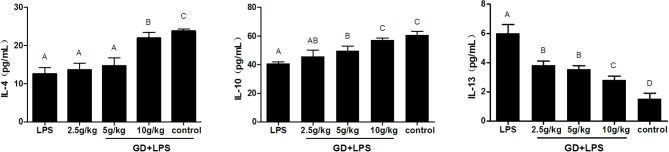
Effects of GD on the production of anti-inflammatory cytokines in the serum. The data are expressed as the mean ± SD (n = 10 per treatment group). The values with same superscript letters between groups are of no significant difference (P > 0.05), those with different letters are of significant difference (P < 0.05). Interleukin (IL)−4, IL-10, and IL-13.
Figure 4
Figure 4
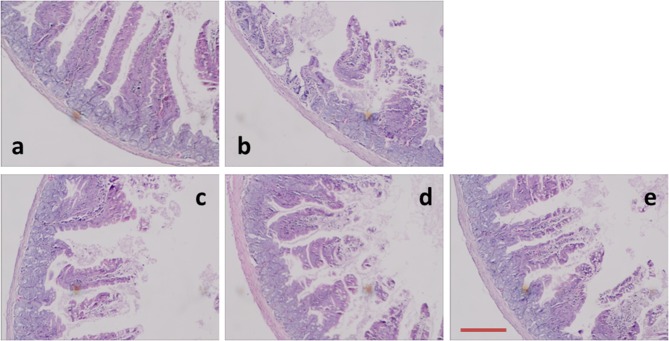
Photomicrographs of mice duodenum tissues. (a) Control group, (b) LPS group, (c) GD low-dose group, (d) GD medium-dose group, and (e) GD high-dose group. Histological appearance of mice intestinal mucosa after hematoxylin and eosin (H&E) stain (original magnification 100×). Scale bars: 50 μm.
Figure 5
Figure 5
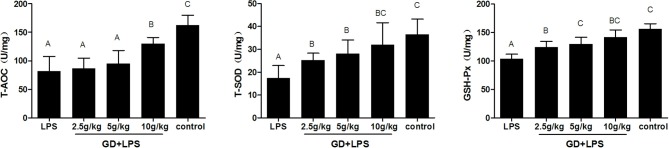
Effects of GD on the antioxidant status of duodenum in the mice. The data are expressed as the mean ± SD (n = 10 per treatment group). The total superoxide dismutase (T-SOD), total antioxidant capacity (T-AOC), glutathione peroxidase (GSH-Px). The values with same letters between groups are of no significant difference (P > 0.05), those with different letters are of significant difference (P < 0.05).
Figure 6
Figure 6
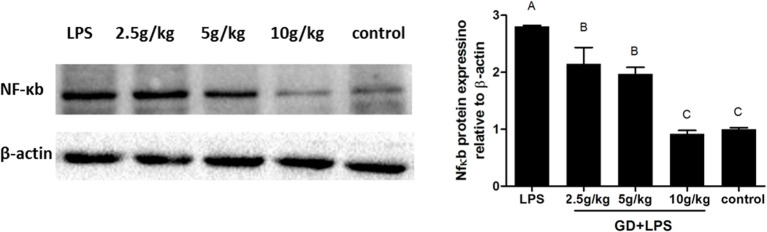
Effects of GD on NF-κB signaling pathway activation. Western blot analysis was used to assess the expression of NF-κB from each group and quantitated protein band intensities presented as β-actin normalized mean values. Representative western blot images and quantified expression levels are presented. Values are expressed as the mean ± standard deviation (n = 10). The values with same letters between groups are of no significant difference (P > 0.05), those with different letters are of significant difference (P < 0.05). NF-κB, nuclear factor-κB.

References

    1. Boyman O., Kolios A. G., Raeber M. E. (2015). Modulation of T cell responses by IL-2 and IL-2 complexes. Clin. Exp. Rheumatol. 33, S54–57. 10.5167/uzh-123113 - DOI - PubMed
    1. Chen S., Zhao X., Sun P., Qian J., Shi Y., Wang R. (2017). Preventive effect of Gardenia jasminoides on HCl/ethanol induced gastric injury in mice. J. Pharmacol. Sci. 133, 1–8. 10.1016/j.jphs.2016.05.011 - DOI - PubMed
    1. Chiu C. J., Mcardle A. H., Brown R., Scott H. J., Gurd F. N. (1970). Intestinal mucosal lesion in low-flow states. I. A morphological, hemodynamic, and metabolic reappraisal. Arch. Surg. 101, 478–483. 10.1001/archsurg.1970.01340280030009 - DOI - PubMed
    1. Collins J. T., Bhimji S. S. (2017). Anatomy, Abdomen, Small Intestine. Treasure Island, FL: StatPearls.
    1. Cui Y., Sun R., Wang Q., Wang M. (2017). Hepatotoxicity induced by intragastrically administrated with Gardenia decoction in mice. Nat. Prod. Res. 31, 2824–2827. 10.1080/14786419.2017.1297934 - DOI - PubMed

LinkOut - more resources