Review
. 2019 Mar 21:10:478.
doi: 10.3389/fimmu.2019.00478. eCollection 2019.

Therapeutic Potential of Regulatory T Cells in Preeclampsia-Opportunities and Challenges

Affiliations
Review

Therapeutic Potential of Regulatory T Cells in Preeclampsia-Opportunities and Challenges

Sarah A Robertson et al. Front Immunol. .

Abstract

Inflammation is a central feature and is implicated as a causal factor in preeclampsia and other hypertensive disorders of pregnancy. Inflammatory mediators and leukocytes, which are elevated in peripheral blood and gestational tissues, contribute to the uterine vascular anomalies and compromised placental function that characterize particularly the severe, early onset form of disease. Regulatory T (Treg) cells are central mediators of pregnancy tolerance and direct other immune cells to counteract inflammation and promote robust placentation. Treg cells are commonly perturbed in preeclampsia, and there is evidence Treg cell insufficiency predates onset of symptoms. A causal role is implied by mouse studies showing sufficient numbers of functionally competent Treg cells must be present in the uterus from conception, to support maternal vascular adaptation and prevent later placental inflammatory pathology. Treg cells may therefore provide a tractable target for both preventative strategies and treatment interventions in preeclampsia. Steps to boost Treg cell activity require investigation and could be incorporated into pregnancy planning and preconception care. Pharmacological interventions developed to target Treg cells in autoimmune conditions warrant consideration for evaluation, utilizing rigorous clinical trial methodology, and ensuring safety is paramount. Emerging cell therapy tools involving in vitro Treg cell generation and/or expansion may in time become relevant. The success of preventative and therapeutic approaches will depend on resolving several challenges including developing informative diagnostic tests for Treg cell activity applicable before conception or during early pregnancy, selection of relevant patient subgroups, and identification of appropriate windows of gestation for intervention.

Keywords: Treg cells; embryo implantation; immune tolerance; inflammation; maternal vascular adaptation; placenta; preeclampsia; pregnancy.


Figures
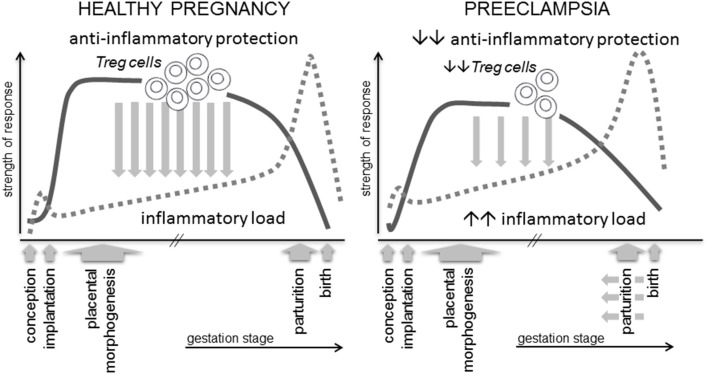
Figure 1
Figure 1
A robust immune response is essential for healthy pregnancy. Regulatory T cells (Treg cells) are a critical and rate-limiting element of the anti-inflammatory protection required to suppress inflammation and prevent adverse effects of anti-fetal effector immune responses. Treg cells arise as a consequence of an inflammation-like response during the peri-conception phase, and their abundance, suppressive function and stability are influenced by events prior to and during early pregnancy. Insufficient numbers, reduced suppressive function or instability are linked with preeclampsia and IUGR, potentially mediated by insufficient Treg cell capacity to support normal placental development and to suppress the elevated inflammatory load typical of this condition.
Figure 2
Figure 2
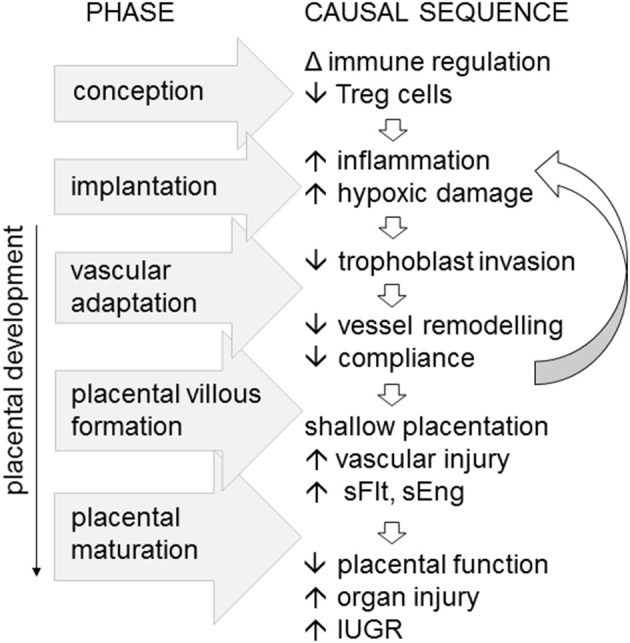
Immune imbalance associated with insufficient or incompetent Treg cells are implicated as an upstream cause of preeclampsia, particularly in severe, early onset disease. In a working model of the sequence of pathophysiological events, fewer Treg cells generated at conception impact the decidual environment at implantation, to limit trophoblast invasion, constrain maternal vascular adaptation, and vessel compliance. The resulting “shallow” placentation causes vascular inflammatory injury accompanied by elevated soluble Fms-like tyrosine kinase (sFlt) and soluble endoglin (eEng), reducing placental function, and causing maternal organ injury and in utero growth restriction (IUGR) of the fetus.
Figure 3
Figure 3
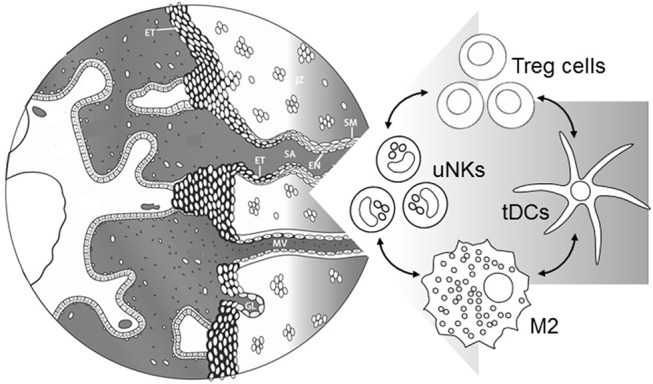
Events during early placental development require immune cells in the decidua to support maternal blood vessel (MV) adaptation and spiral artery (SA) transformation. Treg cells interact with uNK cells, M2 macrophages, and tDCs to suppress inflammation and provide secretory factors regulating extravillous trophoblast (ET) invasion, and functional changes in endothelial cells (EN) and surrounding smooth muscle (SM). Severe early-onset preeclampsia is accompanied by insufficient Treg cells, which in turn would be expected to contribute directly and indirectly through immune cell networks to impair vascular adaptations required for robust placental development. Left hand part of Figure is adapted from Steegers et al. (1).

References

    1. Steegers EA, von Dadelszen P, Duvekot JJ, Pijnenborg R. Pre-eclampsia. Lancet. (2010) 376:631–44. 10.1016/S0140-6736(10)60279-6 - DOI - PubMed
    1. Stevens W, Shih T, Incerti D, Ton TGN, Lee HC, Peneva D, et al. Short-term costs of preeclampsia to the United States health care system. Am J Obstet Gynecol. (2017) 2017:32 10.1016/j.ajog.2017.04.032 - DOI - PubMed
    1. Saigal S, Doyle LW. An overview of mortality and sequelae of preterm birth from infancy to adulthood. Lancet. (2008) 371:261–9. 10.1016/S0140-6736(08)60136-1 - DOI - PubMed
    1. Duley L. The global impact of pre-eclampsia and eclampsia. Semin Perinatol. (2009) 33:130–7. 10.1053/j.semperi.2009.02.010 - DOI - PubMed
    1. Turanov AA, Lo A, Hassler MR, Makris A, Ashar-Patel A, Alterman JF, et al. RNAi modulation of placental sFLT1 for the treatment of preeclampsia. Nat Biotechnol. (2018) 2018:4297 10.1038/nbt.4297 - DOI - PMC - PubMed

Publication types

LinkOut - more resources