Review
. 2019 Mar 28:10:603.
doi: 10.3389/fimmu.2019.00603. eCollection 2019.

The Tumor Immune Contexture of Prostate Cancer

Affiliations
Review

The Tumor Immune Contexture of Prostate Cancer

Natasha Vitkin et al. Front Immunol. .

Abstract

One in seven men in North America is expected to be diagnosed with prostate cancer (PCa) during their lifetime (1, 2). While a wide range of treatment options including surgery, radiation, androgen deprivation and chemotherapy have been in practice for the last few decades, there are limited treatment options for metastatic and treatment resistant disease. Immunotherapy targeting T-cell associated immune checkpoints such as CTLA-4, PD-L1, and PD-1 have not yet proven to be efficacious in PCa. Tumor mutational burden, mutations in DNA damage repair genes, immune cell composition and density in combination with their spatial organization, and expression of immune checkpoint proteins are some of the factors influencing the success of immune checkpoint inhibitor therapies. The paucity of these features in PCa potentially makes them unresponsive to contemporary immune checkpoint inhibition. In this review, we highlight the hallmark events in the PCa tumor immune microenvironment and provide insights into the current state of knowledge in this field with a focus on the role of tumor cell intrinsic events that potentially regulate immune related events and determine therapeutic outcomes. We surmise that the cumulative impact of factors such as the pre-treatment immune status, PTEN expression, DNA damage repair gene mutations, and the effects of conventionally used treatments on the anti-tumor immune response should be considered in immunotherapy trial design in PCa.

Keywords: DNA damage response; PTEN; hormone therapy; immune checkpoint; immunotherapy; prostate cancer; tumor immune microenvironment (TIME).


Figures
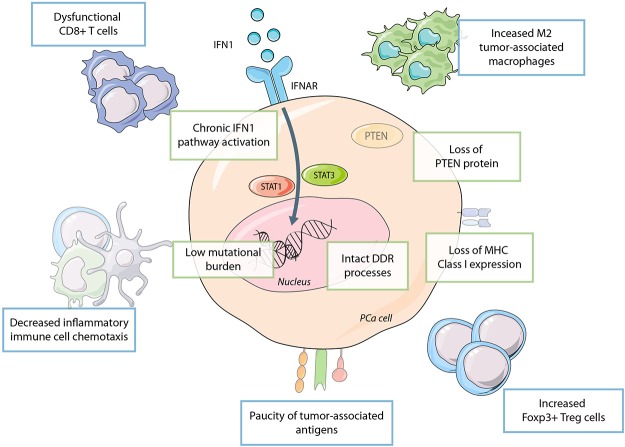
Figure 1
Figure 1
Schematic illustrating the various factors impacting the PCa TIME and their propose on the TIME. Numerous cancer cell-intrinsic factors drive the evolution of a the heterogenous pre-treatment TIME. In PCa, loss of PTEN could lead to a dysfunctional IFN1 signaling. Other features include low tumor-associated antigen expression, decreased MHC Class I expression, which could potentially contribute to immune escape. These, in combination with the pre-existing immune contexture led by other factors, are thought to be critical in determining the balance between activated and suppressive states of TILs including classical or alternatively activated tumor-associated macrophages.
Figure 2
Figure 2
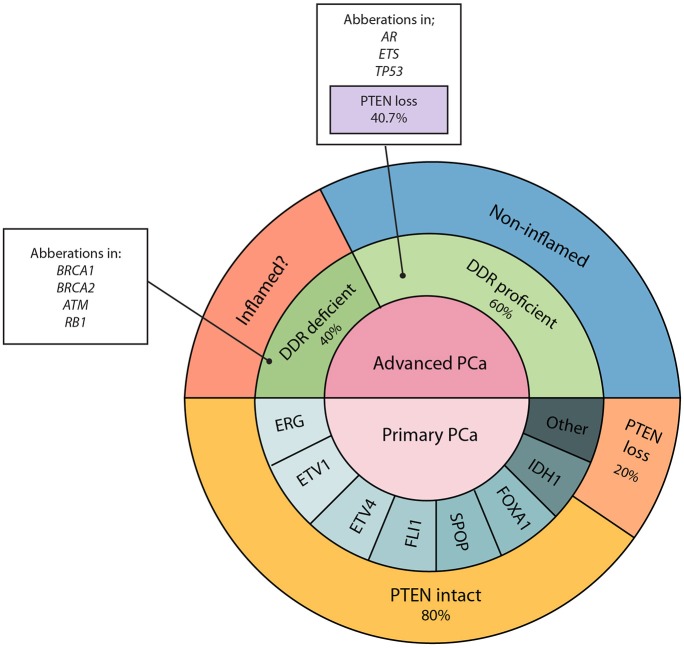
Genetic aberrations associated with primary and advanced PCa. PTEN loss is associated with 20% primary and 40.7% of advanced PCa. Increased proportions of mutations in DNA damage repair genes, BRCA1, BRCA2, ATM, and RB1, have mostly been reported in advanced PCa. While DDR deficient tumors may exhibit increased numbers of oncogenic mutations, we speculate that this may result in a more immunogenic phenotype and give rise to an inflamed TIME as observed in some other solid tumors.

References

    1. Wilt TJ, Brawer MK, Jones KM, Barry MJ, Aronson WJ, Fox S, et al. . Radical prostatectomy versus observation for localized prostate cancer. N Engl J Med. (2012) 367:203–13. 10.1056/NEJMoa1113162 - DOI - PMC - PubMed
    1. Siegel RL, Miller KD, Jemal A. Cancer statistics, 2017. CA Cancer J Clin. (2017) 67:7–30. 10.3322/caac.21387 - DOI - PubMed
    1. Siegel RL, Miller KD, Jemal A. Cancer statistics, 2018. CA Cancer J Clin. (2018) 68:7–30. 10.3322/caac.21442 - DOI - PubMed
    1. Heidenreich A, Bastian PJ, Bellmunt J, Bolla M, Joniau S, van der Kwast T, et al. EAU guidelines on prostate cancer. Part 1: screening, diagnosis, and local treatment with curative intent - update 2013. Eur Urol. (2014) 65:124–37. 10.1016/j.eururo.2013.09.046 - DOI - PubMed
    1. Freedland SJ, Humphreys EB, Mangold LA, Eisenberger M, Dorey FJ, Walsh PC, et al. . Risk of prostate cancer-specific mortality following biochemical recurrence after radical prostatectomy. J Am Med Assoc. (2013) 294:433–9. 10.1001/jama.294.4.433 - DOI - PubMed

Publication types