


Prevalence and Risk Factors of Helicobacter pylori Infection among Children Aged 1 to 15 Years at Holy Innocents Children's Hospital, Mbarara, South Western Uganda
- PMID: 30984271
- PMCID: PMC6431523
- DOI: 10.1155/2019/9303072
Prevalence and Risk Factors of Helicobacter pylori Infection among Children Aged 1 to 15 Years at Holy Innocents Children's Hospital, Mbarara, South Western Uganda
Abstract
Background: Helicobacter pylori infection affects more than half of the world's population. The infection is generally acquired during childhood but can remain asymptomatic, with long-term clinical sequelae including gastritis, peptic ulcer disease, and stomach cancer.
Methods: The study was approved by Institutional Review Committee of Mbarara University of Science and Technology. After obtaining informed consent from parents/legal guardians, illegible children who presented with gastrointestinal complaints at Holy Innocents Children's Hospital were recruited; structured questionnaires were administered to the parents/guardians to collect information on sociodemographic data and risk factors of H. pylori infection. Four (4) millilitres of blood was collected from each child and tested for H. pylori blood Antibody test and stool specimens were used for H. pylori antigen test.
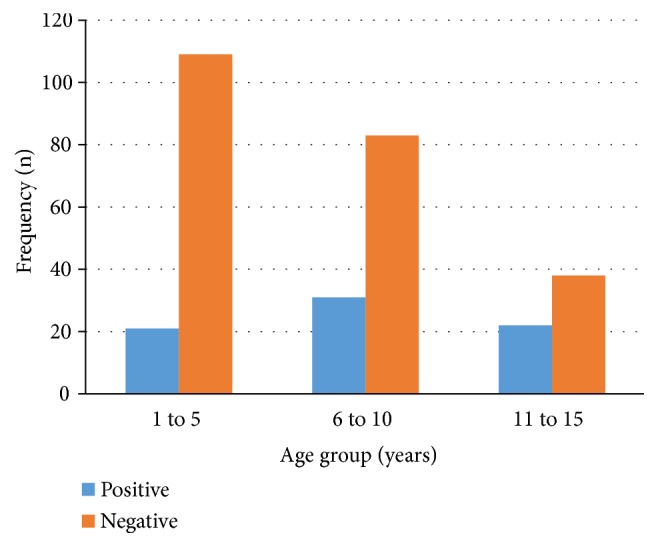
Results: The prevalence of H. pylori infection among the study participants was 24.3%. The infection rate increased with increase in age of the participants, from 16.2% among 1to 5 years old to 27.2% among 6 to 10 years. Infections were higher among school going children (68/74, p=0.003, OR 3.9; CI: 1.5 to 10.6) and children from crowded households (59/74, p<0.001, OR 2.6, and CI 1.3 to 5.0), unsafe source of drinking water at schools (46/74, p=0.003), and lack of sanitary facility at homes (57/74, p=0.001, and OR 1.6 CI 0.7 to 3.6).
Conclusion: The prevalence of H. pylori infection among children aged 1 to 15 years at Holy Innocents Children's Hospital was high and increases with age. School attendance, lack of sanitary facility, lack of safe drinking water, and overcrowding were the risk factors associated with H. pylori infection.
Figures
References
-
- Eshraghian A. Epidemiology of Helicobacter pylori infection among the healthy population in iran and countries of the eastern mediterranean region: a systematic review of prevalence and risk factors. World Journal of Gastroenterology: WJG. 2014;20(46):17618–17625. doi: 10.3748/wjg.v20.i46.17618. - DOI - PMC - PubMed
LinkOut - more resources
Full Text Sources
