Review
. 2019 Mar 7:2019:6173412.
doi: 10.1155/2019/6173412. eCollection 2019.

Acupuncture-Analgesia-Mediated Alleviation of Central Sensitization

Affiliations
Review

Acupuncture-Analgesia-Mediated Alleviation of Central Sensitization

Hsiang-Chun Lai et al. Evid Based Complement Alternat Med. .

Abstract

Pain can trigger central amplification called central sensitization, which ultimately results in hyperalgesia and/or allodynia. Many reports have showed acupuncture has an analgesic effect. We searched the related article on PubMed database and Cochrane database to discover central sensitization pathway in acupuncture analgesia. We summarized that acupuncture enhances the descending inhibitory effect and modulates the feeling of pain, thus modifying central sensitization. The possible mechanisms underlying the analgesic effects of acupuncture include segmental inhibition and the activation of the endogenous opioid, adrenergic, 5-hydroxytryptamine, and N-methyl-D-aspartic acid, α-amino-3-hydroxy-5-methyl-4-isoxazolepropionic acid/kainate pathways. Moreover, acupuncture can locally reduce the levels of inflammatory mediators. In clinical settings, acupuncture can be used to treat headache, neuropathic pain, low back pain, osteoarthritis, and irritable bowel syndrome. These mechanisms of acupuncture analgesia may be involved in the alleviation of central sensitization.


Figures
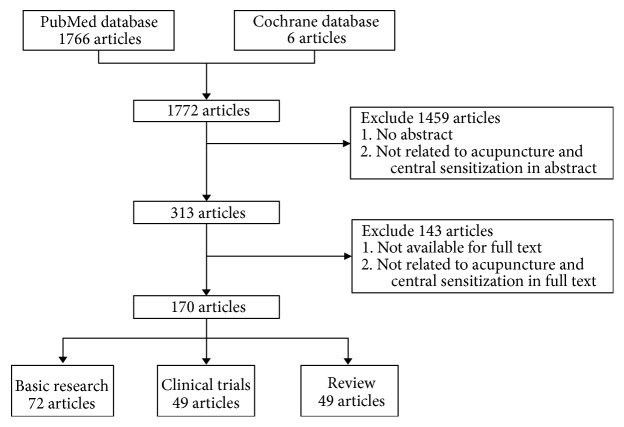
Figure 1
Figure 1
Flow chart of the search processes.
Figure 2
Figure 2
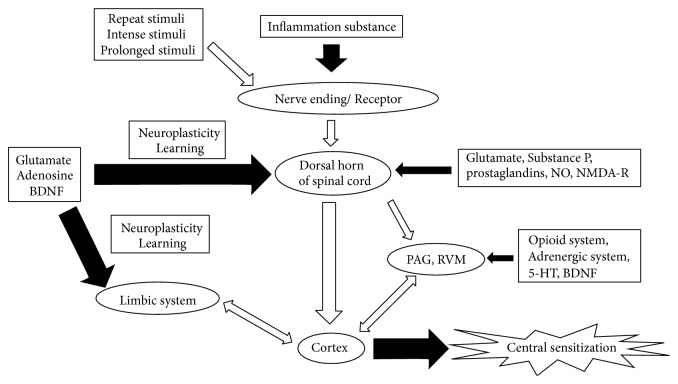
Mechanisms of pain-induced central sensitization. Pain transduction pathway (hollow arrows); upregulation of central sensitization (solid broad arrows); downregulation of central sensitization (solid thin arrows). 5-HT: 5-hydroxytryptamine; BDNF: brain-derived neurotrophic factor; NDMA: N-methyl-D-aspartic acid; NO: nitric oxide; PAG: periaqueductal gray; RVM: rostral ventromedial medulla.

References

    1. Crofford L. J. Chronic pain: Where the body meets the brain. Transactions of the American Clinical and Climatological Association. 2015;126:167–183. - PMC - PubMed
    1. Woolf C. J. Pain: Moving from symptom control toward mechanism-specific pharmacologic management. Annals of Internal Medicine. 2004;140(6):441–451. doi: 10.7326/0003-4819-140-8-200404200-00010. - DOI - PubMed
    1. Takai Y., Yamamoto-Mitani N., Abe Y., Suzuki M. Literature review of pain management for people with chronic pain. Japan Journal of Nursing Science. 2015;12(3):167–183. doi: 10.1111/jjns.12065. - DOI - PubMed
    1. Woolf C. J. Central sensitization: Implications for the diagnosis and treatment of pain. Pain. 2011;152(3):S2–S15. doi: 10.1016/j.pain.2010.09.030. - DOI - PMC - PubMed
    1. Sandkühler J. Models and mechanisms of hyperalgesia and allodynia. Physiological Reviews. 2009;89(2):707–758. doi: 10.1152/physrev.00025.2008. - DOI - PubMed

LinkOut - more resources