. 2019 Mar 8:10:7.
doi: 10.4103/jpi.jpi_87_18. eCollection 2019.

Automated Detection of Celiac Disease on Duodenal Biopsy Slides: A Deep Learning Approach

Affiliations

Automated Detection of Celiac Disease on Duodenal Biopsy Slides: A Deep Learning Approach

Jason W Wei et al. J Pathol Inform. .

Abstract

Context: Celiac disease (CD) prevalence and diagnosis have increased substantially in recent years. The current gold standard for CD confirmation is visual examination of duodenal mucosal biopsies. An accurate computer-aided biopsy analysis system using deep learning can help pathologists diagnose CD more efficiently.

Subjects and methods: In this study, we trained a deep learning model to detect CD on duodenal biopsy images. Our model uses a state-of-the-art residual convolutional neural network to evaluate patches of duodenal tissue and then aggregates those predictions for whole-slide classification. We tested the model on an independent set of 212 images and evaluated its classification results against reference standards established by pathologists.

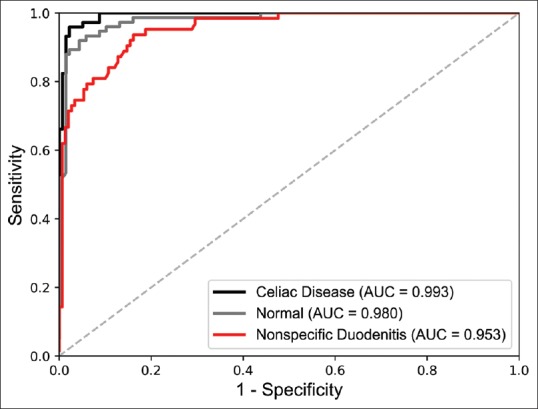
Results: Our model identified CD, normal tissue, and nonspecific duodenitis with accuracies of 95.3%, 91.0%, and 89.2%, respectively. The area under the receiver operating characteristic curve was >0.95 for all classes.

Conclusions: We have developed an automated biopsy analysis system that achieves high performance in detecting CD on biopsy slides. Our system can highlight areas of interest and provide preliminary classification of duodenal biopsies before review by pathologists. This technology has great potential for improving the accuracy and efficiency of CD diagnosis.

Keywords: Celiac disease; deep learning; digital pathology; duodenal biopsy; whole-slide imaging.


Conflict of interest statement

There are no conflicts of interest.

Figures
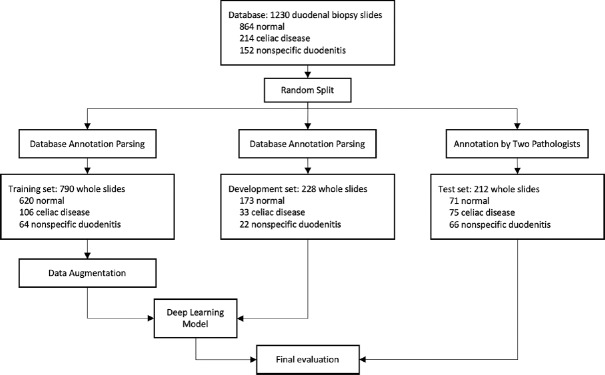
Figure 1
Figure 1
Data flow diagram for allocating whole slides for training, development, and testing of our model. For training, patches were generated using the sliding window algorithm to train our residual network patch classifier. The development set was used to fine-tune hyperparameters and thresholds of our neural network. Finally, we evaluated our model on the test set of 212 whole-slide images with reference labels
Figure 2
Figure 2
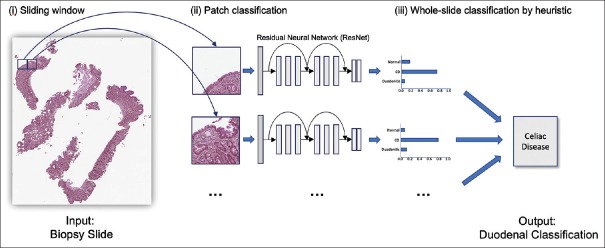
Overview of detection of celiac disease on whole-slide biopsy images. We used a sliding window approach on a whole-slide image to generate patches, classified each patch with a residual network model, and used a heuristic on the aggregated patch predictions to classify the whole slide
Figure 3
Figure 3
Receiver operating characteristic curves and their area under the curve for our model's classifications on the independent test set of 212 whole-slide biopsy images
Figure 4
Figure 4
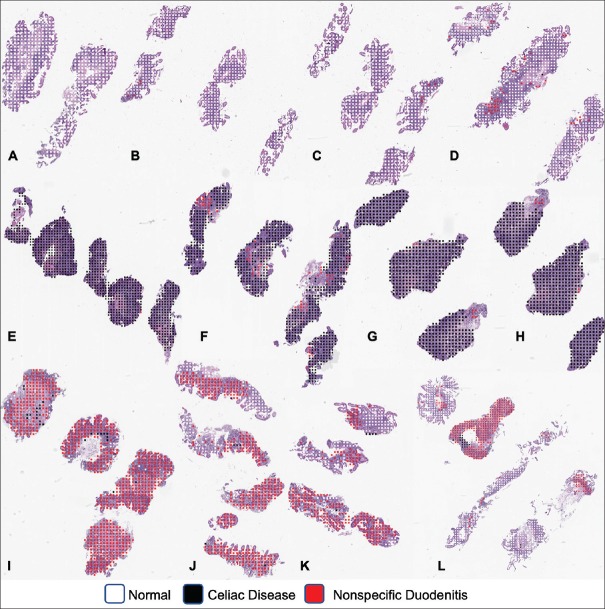
Visualization of patch predictions of our model at the whole-slide level (a-d) was correctly classified as normal, (e-h) was correctly classified as celiac disease, and (i-l) was correctly classified as nonspecific duodenitis
Figure 5
Figure 5
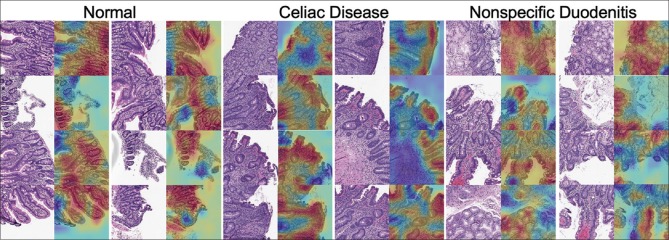
Class activation mapping heat maps highlighting the most informative regions of patches relevant to normal, celiac disease, and nonspecific duodenitis classes. Red regions indicate areas of attention for our residual neural network

References

    1. Green PH, Cellier C. Celiac disease. N Engl J Med. 2007;357:1731–43. - PubMed
    1. Mustalahti K, Catassi C, Reunanen A, Fabiani E, Heier M, McMillan S, et al. The prevalence of celiac disease in Europe: Results of a centralized, international mass screening project. Ann Med. 2010;42:587–95. - PubMed
    1. Rubio-Tapia A, Hill ID, Kelly CP, Calderwood AH, Murray JA. American College of Gastroenterology. ACG clinical guidelines: Diagnosis and management of celiac disease. Am J Gastroenterol. 2013;108:656–76. - PMC - PubMed
    1. Rubio-Tapia A, Kyle RA, Kaplan EL, Johnson DR, Page W, Erdtmann F, et al. Increased prevalence and mortality in undiagnosed celiac disease. Gastroenterology. 2009;137:88–93. - PMC - PubMed
    1. Godfrey JD, Brantner TL, Brinjikji W, Christensen KN, Brogan DL, Van Dyke CT, et al. Morbidity and mortality among older individuals with undiagnosed celiac disease. Gastroenterology. 2010;139:763–9. - PMC - PubMed