


Novel Risk Factors for Posttraumatic Stress Disorder Symptoms in Family Members of Acute Respiratory Distress Syndrome Survivors
- PMID: 30985448
- PMCID: PMC6601635
- DOI: 10.1097/CCM.0000000000003774
Novel Risk Factors for Posttraumatic Stress Disorder Symptoms in Family Members of Acute Respiratory Distress Syndrome Survivors
Abstract
Objectives: Family members of ICU survivors report long-term psychologic symptoms of posttraumatic stress disorder. We describe patient- and family-member risk factors for posttraumatic stress disorder symptoms among family members of survivors of acute respiratory distress syndrome.
Design: Prospective cohort study of family members of acute respiratory distress syndrome survivors.
Setting: Single tertiary care center in Seattle, Washington.
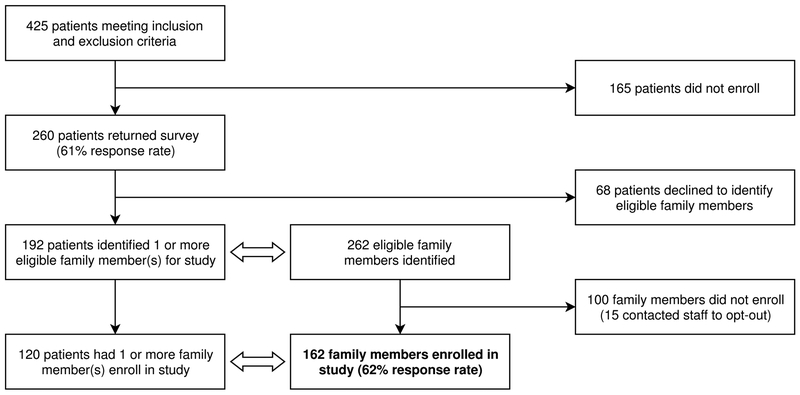
Subjects: From 2010 to 2015, we assembled an inception cohort of adult acute respiratory distress syndrome survivors who identified family members involved in ICU and post-ICU care. One-hundred sixty-two family members enrolled in the study, corresponding to 120 patients.
Interventions: None.
Measurements and main results: Family members were assessed for self-reported psychologic symptoms 6 months after patient discharge using the Posttraumatic Stress Disorder Checklist-Civilian Version, the Patient Health Questionnaire 9-item depression scale, and the Generalized Anxiety Disorder 7-item scale. The primary outcome was posttraumatic stress disorder symptoms, and secondary outcomes were symptoms of depression and anxiety. We used clustered multivariable logistic regression to identify patient- and family-member risk factors for psychologic symptoms. Posttraumatic stress disorder symptoms were present in 31% (95% CI, 24-39%) of family participants. Family member risk factors for posttraumatic stress disorder symptoms included preexisting mental health disorders (adjusted odds ratio, 3.22; 95% CI, 1.42-7.31), recent personal experience of serious physical illness (adjusted odds ratio, 3.07; 95% CI, 1.40-6.75), and female gender (adjusted odds ratio, 5.18; 95% CI, 1.74-15.4). Family members of previously healthy patients (Charlson index of zero) had higher frequency of posttraumatic stress disorder symptoms (adjusted odds ratio, 2.25; 95% CI, 1.06-4.77). Markers of patient illness severity were not associated with family posttraumatic stress disorder symptoms.
Conclusions: The prevalence of long-term posttraumatic stress disorder symptoms among family members of acute respiratory distress syndrome survivors is high. Family members with preexisting mental health disorders, recent experiences of serious physical illness, and family members of previously healthy patients are at increased risk for posttraumatic stress disorder symptoms.
Figures
Comment in
-
Psychopathologic Symptoms in Survivors of Critical Illness and Their Relatives-What to Expect From a Screening Tool.Crit Care Med. 2019 Jul;47(7):1002-1004. doi: 10.1097/CCM.0000000000003793. Crit Care Med. 2019. PMID: 31205083 No abstract available.
References
-
- Davidson JE. Family-centered care: meeting the needs of patients’ families and helping families adapt to critical illness. Crit Care Nurse. 2009;29(3):28–34; quiz 35. - PubMed
-
- Cameron JI, Herridge MS, Tansey CM, et al. Well-being in informal caregivers of survivors of acute respiratory distress syndrome. Crit Care Med. 2006;34(1):81–86. - PubMed
-
- Herridge MS, Moss M, Hough CL, et al. Recovery and outcomes after the acute respiratory distress syndrome (ARDS) in patients and their family caregivers. Intensive Care Med. 2016;42(5):725–738. - PubMed
-
- Davidson JE, Jones C, Bienvenu OJ. Family response to critical illness: postintensive care syndrome-family. Crit Care Med. 2012;40(2):618–624. - PubMed
MeSH terms
Grants and funding
LinkOut - more resources
Full Text Sources
Medical
