


A prospective study of risk factors for in-hospital mortality in patients with malignant obstructive jaundice undergoing percutaneous biliary drainage
- PMID: 30985679
- PMCID: PMC6485810
- DOI: 10.1097/MD.0000000000015131
A prospective study of risk factors for in-hospital mortality in patients with malignant obstructive jaundice undergoing percutaneous biliary drainage
Abstract
Background: The in-hospital mortality rate in patients undergoing percutaneous transhepatic biliary drainage (PTBD) for malignant obstructive jaundice (MOJ) is high. There are few reports on the risk factors associated with hospital death after MOJ, with most of them being retrospective analyses of single factors. Therefore, this study aimed to assess pre-, intra-, and post-procedure risk factors that were independently associated with increased in-hospital mortality in MOJ patients who underwent PTBD.
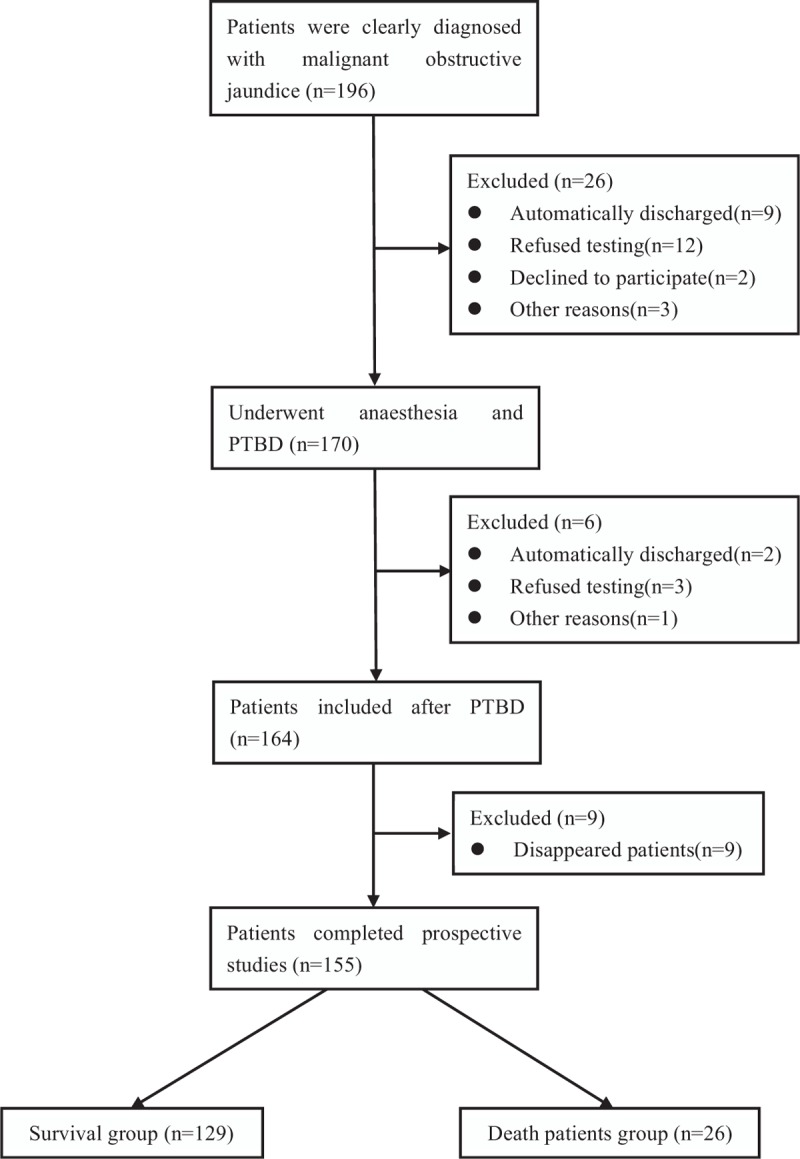
Methods: One-hundred fifty-five patients with MOJ who underwent initial PTBD were included in this study. A total of 25 pre-, 4 intra-, and 6 post-procedure factors potentially related to in-hospital mortality were assessed by univariate and multivariate analyses.
Results: The in-hospital mortality rate was 16.8% (26/155). Of 25 pre-procedure variables analyzed, Child-Pugh classification C, creatinine level ≥6.93 μmol/L, and quality-of-life score (≤30) were found to be significant in univariate and multivariate analyses. Increased mortality was observed in patients with 2 or more risk factors, which was significantly different from patients with no risk factors or one risk factor (P < .01). None of the intra-procedure factors were important in identifying patients at risk of death. Multivariate analysis indicated post-PTBD cholangitis and unsuccessful drainage as post-procedure risk factors that correlated with in-hospital death.
Conclusion: It was identified that in-hospital mortality was associated with 3 pre-procedure and 2 post-procedure risk factors, such as the liver function classification, quality-of-life score of cancer patients, creatinine level, PTBD-associated biliary duct infection, and unsuccessful drainage.
Conflict of interest statement
The authors declare that they have no conflict of interest.
References
-
- van Delden OM, Lameris JS. Percutaneous drainage and stenting for palliation of malignant bile duct obstruction. Eur Radiol 2008;18:448–56. - PubMed
-
- Comparison of endoscopic ultrasonography guided biliary drainage and percutaneous transhepatic biliary drainage in the management of malignant obstructive jaundice after failed ERCP: Erratum. Surg Laparosc Endosc Percutan Tech 2018;28:133. - PubMed
-
- Inal M, Akgul E, Aksungur E, et al. Percutaneous self-expandable uncovered metallic stents in malignant biliary obstruction. Complications, follow-up and reintervention in 154 patients. Acta Radiol 2003;44:139–46. - PubMed
-
- Stoker J, Lameris JS, Jeekel J. Percutaneously placed Wallstent endoprosthesis in patients with malignant distal biliary obstruction. Br J Surg 1993;80:1185–7. - PubMed
Publication types
MeSH terms
LinkOut - more resources
Full Text Sources
