


Extended-release vs. oral naltrexone for alcohol dependence treatment in primary care (XON)
- PMID: 30986535
- PMCID: PMC6701869
- DOI: 10.1016/j.cct.2019.04.006
Extended-release vs. oral naltrexone for alcohol dependence treatment in primary care (XON)
Abstract
Background: Extended-release naltrexone (XR-NTX, Vivitrol®) and daily oral naltrexone tablets (O-NTX) are FDA-approved mu opioid receptor antagonist medications for alcohol dependence treatment. Despite the efficacy of O-NTX, non-adherence and poor treatment retention have limited its adoption into primary care. XR-NTX is a once-a-month injectable formulation that offers a potentially more effective treatment option in reducing alcohol consumption and heavy drinking episodes among persons with alcohol use disorders.
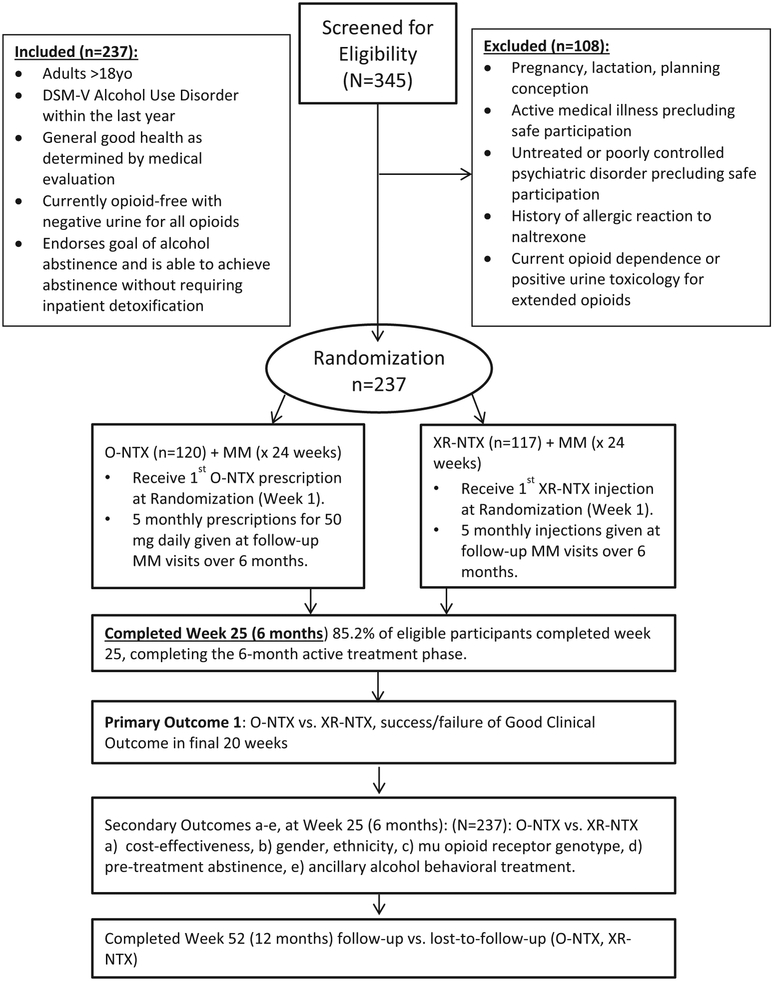
Methods: This pragmatic, open-label, randomized controlled trial examines the effectiveness of XR-NTX vs. O-NTX in producing a Good Clinical Outcome, defined as abstinence or moderate drinking (<2 drinks/day, men; <1 drink/day, women; and < 2 heavy drinking occasions/month) during the final 20 of 24 weeks of primary care-based Medical Management treatment for alcohol dependence. Secondary aims will estimate the cost effectiveness of XR-NTX vs. O-NTX, in conjunction with primary-care based Medical Management for both groups, and patient-level characteristics associated with effectiveness in both arms. Alcohol dependent persons are recruited from the community into treatment in a New York City public hospital primary care setting (Bellevue Hospital Center) for 24 weeks of either XR-NTX (n = 117) or O-NTX (n = 120).
Results: We describe the rationale, specific aims, design, and recruitment results to date. Alternative design considerations and secondary aims and outcomes are reported.
Conclusions: XR-NTX treatment in a primary care setting is potentially more efficacious, feasible, and cost-effective than oral naltrexone when treating community-dwelling persons with alcohol use disorders. This study will estimate XR-NTX's treatment and cost effectiveness relative to oral naltrexone.
Keywords: Alcohol dependence; Alcohol use disorder; Extended-release naltrexone; Medical management; Naltrexone; Primary care treatment.
Copyright © 2019. Published by Elsevier Inc.
Conflict of interest statement
Conflicts of interest
We wish to confirm that there are no known conflicts of interest associated with this publication and there has been no significant financial support for this work that could have influenced its outcome.
References
-
- Substance Abuse and Mental Health Services Administration, Key substance use and mental health indicators in the United States: Results from the 2016 National Survey on Drug Use and Health, HHS Publication No. SMA 17–05==5044, NSDUH Series H-52, 2017. https://www.samhsa.gov/data/, Accessed date: 4 June 2018.
-
- Hasin DS, Dasin FS, Ogburn E, Grant BF, Prevalence, correlates, disability, and comorbidity of DSM-IV alcohol abuse and dependence in the United States: results from the National Epidemiologic Survey on Alcohol and Related Conditions, Arch. Gen. Psychiatry 64 (7) (2007) 830–842, 10.1001/archpsyc.64.7.830. - DOI - PubMed
Publication types
MeSH terms
Substances
Grants and funding
LinkOut - more resources
Full Text Sources
Medical
Research Materials
