. 2019 Apr 2;10(4):266.
doi: 10.3390/genes10040266.

An Integrated Analysis of Cashmere Fineness lncRNAs in Cashmere Goats

Affiliations

An Integrated Analysis of Cashmere Fineness lncRNAs in Cashmere Goats

Yuan Y Zheng et al. Genes (Basel). .

Abstract

Animal growth and development are regulated by long non-coding RNAs (lncRNAs). However, the functions of lncRNAs in regulating cashmere fineness are poorly understood. To identify the key lncRNAs that are related to cashmere fineness in skin, we have collected skin samples of Liaoning cashmere goats (LCG) and Inner Mongolia cashmere goats (MCG) in the anagen phase, and have performed RNA sequencing (RNA-seq) approach on these samples. The high-throughput sequencing and bioinformatics analyses identified 437 novel lncRNAs, including 93 differentially expressed lncRNAs. We also identified 3,084 differentially expressed messenger RNAs (mRNAs) out of 27,947 mRNAs. Gene ontology (GO) analyses of lncRNAs and target genes in cis show a predominant enrichment of targets that are related to intermediate filament and intermediate filament cytoskeleton. According to the Kyoto Encyclopedia of Genes and Genomes (KEGG) analysis, sphingolipid metabolism is a significant pathway for lncRNA targets. In addition, this is the first report to reveal the possible lncRNA-mRNA regulatory network for cashmere fineness in cashmere goats. We also found that lncRNA XLOC_008679 and its target gene, KRT35, may be related to cashmere fineness in the anagen phase. The characterization and expression analyses of lncRNAs will facilitate future studies on the potential value of fiber development in LCG.

Keywords: RNA-seq; cashmere fineness; differently expressed genes; lncRNA; lncRNA–targets.


Conflict of interest statement

The authors declare no conflicts of interest.

Figures
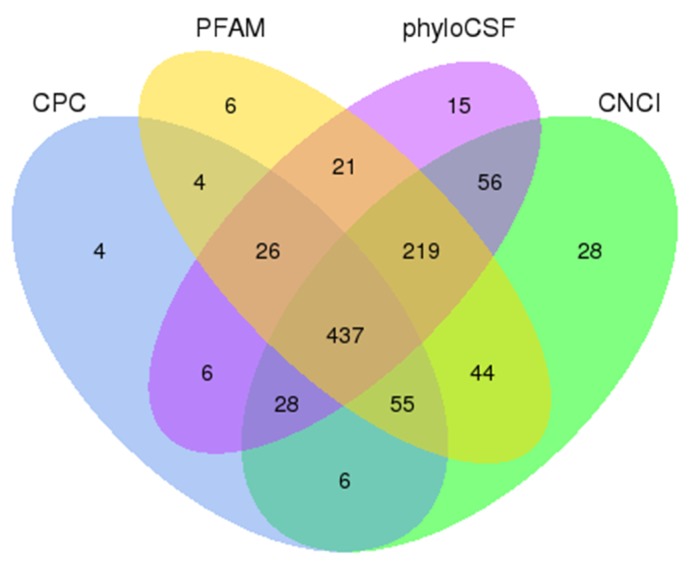
Figure 1
Figure 1
Identification of long non-coding RNAs (lncRNAs). The overlapping of noncoding transcripts shared by four software programs. The sum of the numbers in each large circle represents the total number of noncoding transcripts that are detected by the software.
Figure 2
Figure 2
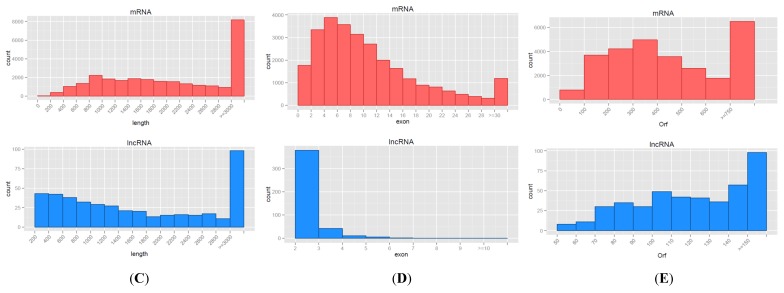
Characteristics of lncRNAs. (A) Expression-level analysis for messenger RNAs (mRNAs) and lncRNAs. (B) Conservative analysis of sequences in mRNAs and lncRNAs. (C) Length distribution of mRNAs (red) and lncRNAs (blue), unit of the length is bp. (D) Exon number distribution for mRNAs and lncRNAs. (E) Open reading frame (ORF) length distribution for mRNAs and lncRNAs.
Figure 2
Figure 2
Characteristics of lncRNAs. (A) Expression-level analysis for messenger RNAs (mRNAs) and lncRNAs. (B) Conservative analysis of sequences in mRNAs and lncRNAs. (C) Length distribution of mRNAs (red) and lncRNAs (blue), unit of the length is bp. (D) Exon number distribution for mRNAs and lncRNAs. (E) Open reading frame (ORF) length distribution for mRNAs and lncRNAs.
Figure 3
Figure 3
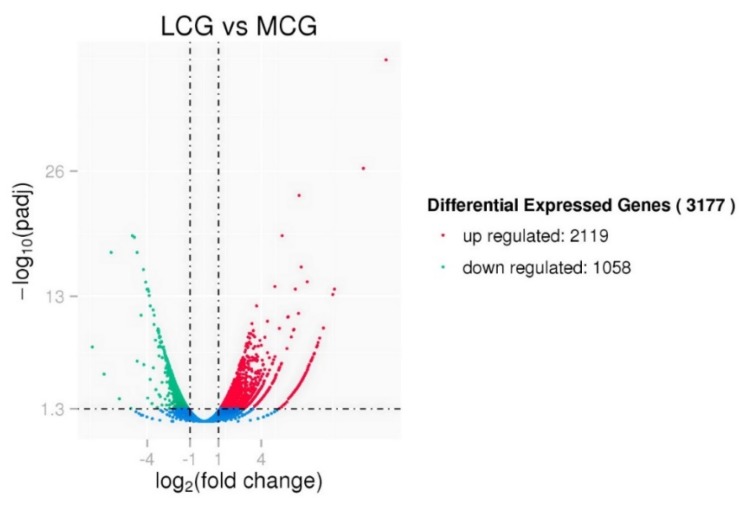
Volcano plot of differentially expressed genes in Liaoning cashmere goats (LCG) and Mongolia cashmere goats (MCG).
Figure 4
Figure 4
Target genes enrichment analysis. (A) GO enrichment analysis for target gene functions of predicted lncRNAs (CC: Cellular component). (B) Kyoto Encyclopedia of Genes and Genomes (KEGG) annotation for the target gene functions of predicted lncRNAs. The size of the dot indicates the number of target genes in the pathway, and the color of the dot corresponds to different q-value ranges.
Figure 5
Figure 5
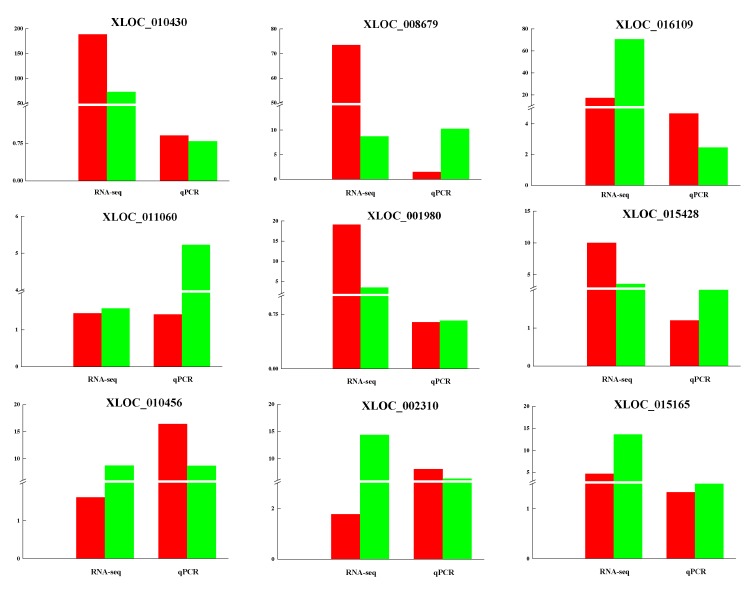
qRT-PCR validation of lncRNAs. RNA sequencing (RNA-seq) was used in verifying the expression of LCG and MCG, red: LCG, green: MCG. qPCR validation compared coarse-type and fine-type LCG, red: Coarse type, green: Fine type.
Figure 6
Figure 6
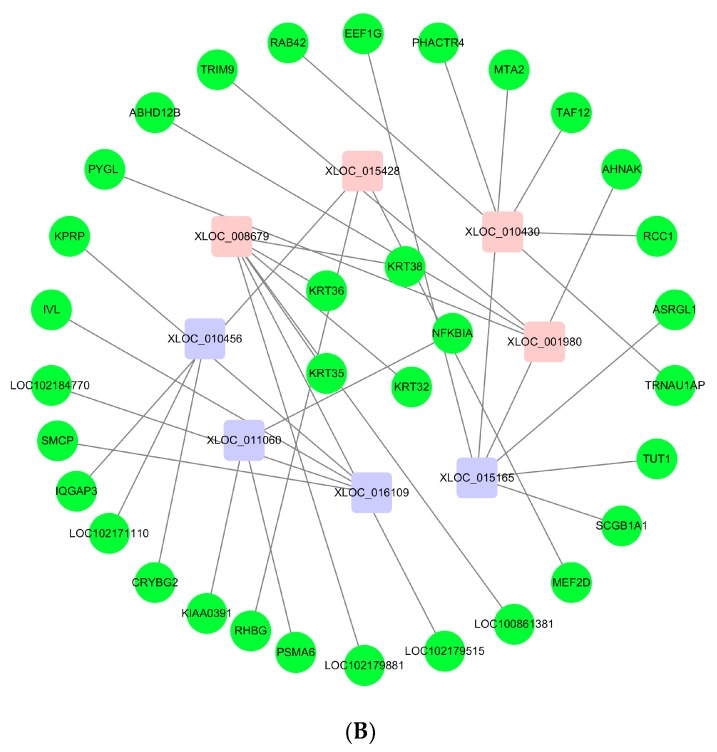
The network of differentially expressed lncRNAs. (A) Network of differentially expressed lncRNAs and target genes. Light pink: Up-regulation gene, lilac colour: Down-regulation gene, green: Target gene, light blue: Co-up-regulated and down-regulated target gene. (B) Network of qRT-PCR verification for lncRNAs and target genes. Light pink: Up-regulation gene, lilac colour: Down-regulation gene, green: Target gene.
Figure 6
Figure 6
The network of differentially expressed lncRNAs. (A) Network of differentially expressed lncRNAs and target genes. Light pink: Up-regulation gene, lilac colour: Down-regulation gene, green: Target gene, light blue: Co-up-regulated and down-regulated target gene. (B) Network of qRT-PCR verification for lncRNAs and target genes. Light pink: Up-regulation gene, lilac colour: Down-regulation gene, green: Target gene.

References

    1. Zhang B., Chang L., Lan Y.X., Asif N., Guan F.L., Fu D.K., Li B., Yan X.Y., Zhang H.B., Zhang X.Y., et al. Genome-wide definition of selective sweeps reveals molecular evidence of trait-driven domestication among elite goat (Capra species) breeds for the production of dairy, cashmere, and meat. Gigascience. 2018;7 doi: 10.1093/gigascience/giy105. - DOI - PMC - PubMed
    1. Bai W.L., Dang Y.L., Wang J.J., Yin R.H., Wang Z.Y., Zhu Y.B., Cong Y.Y., Xue H.L., Deng L., Guo D., et al. Molecular characterization, expression and methylation status analysis of BMP4 gene in skin tissue of Liaoning cashmere goat during hair follicle cycle. Genetica. 2016;144:457–467. doi: 10.1007/s10709-016-9914-1. - DOI - PubMed
    1. Xia T., Chen S.C., Jiang Z., Shao Y.F., Jiang X.M., Li P.F., Xiao B.X., Guo J.M. Long noncoding RNA FER1L4 suppresses cancer cell growth by acting as a competing endogenous RNA and regulating PTEN expression. Sci. Rep. 2015;5:13445. doi: 10.1038/srep13445. - DOI - PMC - PubMed
    1. Yang G., Lu X., Yuan L. LncRNA: A link between RNA and cancer. Biochim. Biophys. Acta. 2014;1839:1097–1109. doi: 10.1016/j.bbagrm.2014.08.012. - DOI - PubMed
    1. Liang L., Ai L., Qian J., Fang J.Y., Xu J. Long noncoding RNA expression profiles in gut tissues constitute molecular signatures that reflect the types of microbes. Sci. Rep. 2015;5:11763. doi: 10.1038/srep11763. - DOI - PMC - PubMed

Publication types

LinkOut - more resources