Review
. 2019 Apr 4;20(7):1692.
doi: 10.3390/ijms20071692.

Targeting the PD-1/PD-L1 Pathway in Renal Cell Carcinoma

Affiliations
Review

Targeting the PD-1/PD-L1 Pathway in Renal Cell Carcinoma

Solène-Florence Kammerer-Jacquet et al. Int J Mol Sci. .

Abstract

Renal cell carcinoma encompass distinct diseases with different pathologic features and distinct molecular pathways. Immune checkpoint inhibitors targeting the programmed death receptor ligand 1 (PD-L1)/programmed death receptor 1 (PD-1) pathway alone or in combination have greatly changed clinical management of metastatic renal cell carcinoma, now competing with antiangiogenic drugs in monotherapy for first-line treatment. However, long-term response rates are low, and biomarkers are needed to predict treatment response. Quantification of PD-L1 expression by immunohistochemistry was developed as a promising biomarker in clinical trials, but with many limitations (different antibodies, tumour heterogeneity, specimens, and different thresholds of positivity). Other biomarkers, including tumour mutational burden and molecular signatures, are also developed and discussed in this review.

Keywords: PD-1; PD-L1; biomarker; immune checkpoint inhibition; immunotherapy; renal cell carcinoma; tumour mutational burden.


Conflict of interest statement

The authors declare no conflict of interest.

Figures
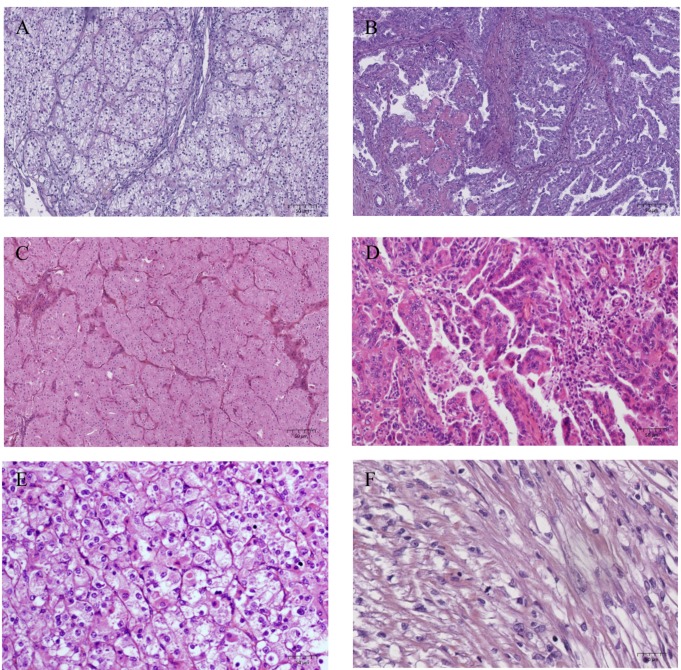
Figure 1
Figure 1
Histological features of renal cell carcinoma, HES staining, x200. (A) clear cell renal cell carcinoma, (B) papillary renal cell carcinoma, (C) chromophobe renal cell carcinoma, (D) TFE3 translocation renal cell carcinoma, (E) TFEB translocation renal cell carcinoma, (F) sarcomatoid component.
Figure 2
Figure 2
Rationale for combining immune checkpoint inhibitors with antiangiogenic drugs, anti-tumor immune response modulation adapted from Amin et al. Frontiers in Oncology. 2019. TCR, T cell receptor; MDSC, myeloid derived suppressor cells; VEGF, vascular endothelial growth factor; PD-1, programmed death 1; PD-L1, programmed death ligand 1; CTLA 4, cytotoxic T lymphocyte antigen 4.

References

    1. Ferlay J., Soerjomataram I., Dikshit R., Eser S., Mathers C., Rebelo M., Parkin D.M., Forman D., Bray F. Cancer incidence and mortality worldwide: Sources, methods and major patterns in GLOBOCAN 2012. Int. J. Cancer. 2015;136:E359–E386. doi: 10.1002/ijc.29210. - DOI - PubMed
    1. Levi F., Ferlay J., Galeone C., Lucchini F., Negri E., Boyle P., La Vecchia C. The changing pattern of kidney cancer incidence and mortality in Europe. BJU Int. 2008;101:949–958. doi: 10.1111/j.1464-410X.2008.07451.x. - DOI - PubMed
    1. King S.C., Pollack L.A., Li J., King J.B., Master V.A. Continued increase in incidence of renal cell carcinoma, especially in young patients and high grade disease: United States 2001 to 2010. J. Urol. 2014;191:1665–1670. doi: 10.1016/j.juro.2013.12.046. - DOI - PMC - PubMed
    1. Moch H., Cubilla A.L., Humphrey P.A., Reuter V.E., Ulbright T.M. The 2016 WHO Classification of Tumours of the Urinary System and Male Genital Organs-Part A: Renal, Penile, and Testicular Tumours. Eur. Urol. 2016;70:93–105. doi: 10.1016/j.eururo.2016.02.029. - DOI - PubMed
    1. Malouf G.G., Comperat E., Yao H., Mouawad R., Lindner V., Rioux-Leclercq N., Verkarre V., Leroy X., Dainese L., Classe M., et al. Unique Transcriptomic Profile of Collecting Duct Carcinomas Relative to Upper Tract Urothelial Carcinomas and other Kidney Carcinomas. Sci. Rep. 2016;6:30988. doi: 10.1038/srep30988. - DOI - PMC - PubMed

Substances
