Review
. 2019 Apr 4;20(7):1694.
doi: 10.3390/ijms20071694.

Regulation of Proliferation, Differentiation and Functions of Osteoblasts by Runx2

Affiliations
Review

Regulation of Proliferation, Differentiation and Functions of Osteoblasts by Runx2

Toshihisa Komori. Int J Mol Sci. .

Abstract

Runx2 is essential for osteoblast differentiation and chondrocyte maturation. During osteoblast differentiation, Runx2 is weakly expressed in uncommitted mesenchymal cells, and its expression is upregulated in preosteoblasts, reaches the maximal level in immature osteoblasts, and is down-regulated in mature osteoblasts. Runx2 enhances the proliferation of osteoblast progenitors by directly regulating Fgfr2 and Fgfr3. Runx2 enhances the proliferation of suture mesenchymal cells and induces their commitment into osteoblast lineage cells through the direct regulation of hedgehog (Ihh, Gli1, and Ptch1), Fgf (Fgfr2 and Fgfr3), Wnt (Tcf7, Wnt10b, and Wnt1), and Pthlh (Pthr1) signaling pathway genes, and Dlx5. Runx2 heterozygous mutation causes open fontanelle and sutures because more than half of the Runx2 gene dosage is required for the induction of these genes in suture mesenchymal cells. Runx2 regulates the proliferation of osteoblast progenitors and their differentiation into osteoblasts via reciprocal regulation with hedgehog, Fgf, Wnt, and Pthlh signaling molecules, and transcription factors, including Dlx5 and Sp7. Runx2 induces the expression of major bone matrix protein genes, including Col1a1, Spp1, Ibsp, Bglap2, and Fn1, in vitro. However, the functions of Runx2 in differentiated osteoblasts in the expression of these genes in vivo require further investigation.

Keywords: Fgfr; Pthr1; Runx2; Sp7; Wnt; cleidocranial dysplasia; differentiation; hedgehog; osteoblast; proliferation.


Conflict of interest statement

The authors declare no conflict of interest.

Figures
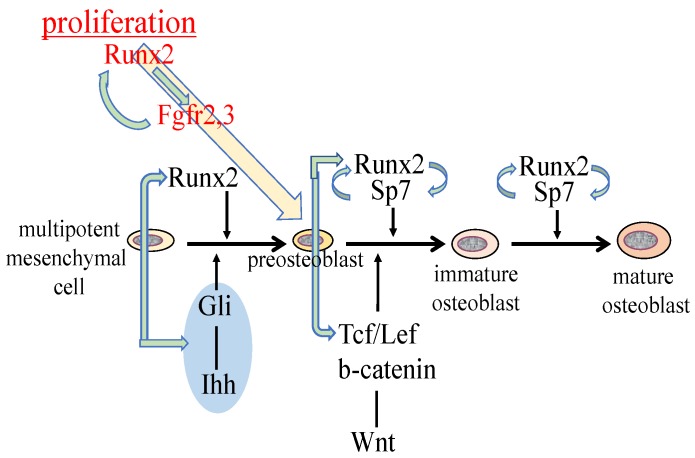
Figure 1
Figure 1
Regulation of osteoblast proliferation and differentiation by transcription factors. Runx2 induces the differentiation of multipotent mesenchymal cells into preosteoblasts. Ihh is required for the expression of Runx2 in the perichondrium of endochondral bones. Runx2 induces Sp7 expression, and Runx2, Sp7, and canonical Wnt signaling induce the differentiation of preosteoblasts into immature osteoblasts. Runx2 and Sp7 are also involved in the maturation of osteoblasts. Runx2 regulates the proliferation of preosteoblasts by inducing Fgfr2 and Fgfr3. Runx2 expression and that of hedgehog, Fgf, and Wnt signaling pathway genes, and Sp7 are reciprocally regulated.
Figure 2
Figure 2
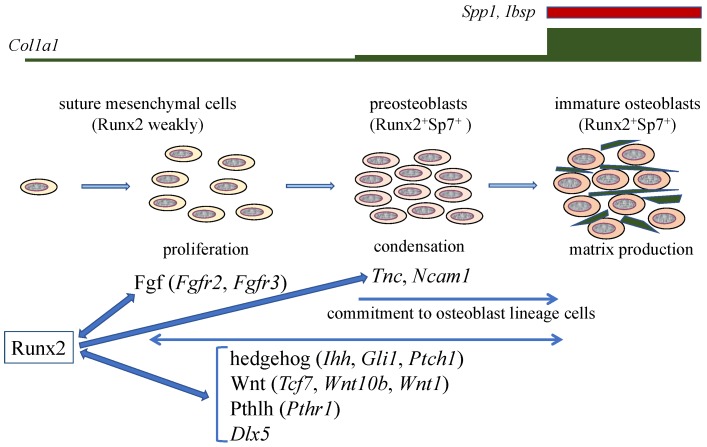
Calvarial bone development and suture closure. Suture mesenchymal cells weakly express Runx2, and its expression is upregulated in preosteoblasts and reaches the maximum level in immature osteoblasts. Runx2 induces Sp7 expression at the preosteoblast stage. Col1a1 expression is weak in suture mesenchymal cells, slightly upregulated in preosteoblasts, and markedly upregulated in immature osteoblasts, which also express Spp1 and Ibsp. Runx2 increases the proliferation of suture mesenchymal cells and induces their commitment into osteoblast lineage cells through the induction of Fgf (Fgfr2 and Fgfr3), hedgehog (Ihh, Gli1, and Ptch1), Wnt (Tcf7, Wnt10b, and Wnt1), and Pthlh (Pthr1) signaling pathway genes, and Dlx5. Fgf signaling plays a role in proliferation, whereas the other genes function in both proliferation and commitment. There is reciprocal regulation between Runx2, and these signaling pathways and Dlx5. In the processes of commitment into osteoblast lineage cells, Runx2 also induces Tnc and Ncam1, which likely play roles in the condensation of suture mesenchymal cells, and these condensed mesenchymal cells then become preosteoblasts. The preosteoblasts become immature osteoblasts in the sagittal (SAG) suture, but not in the posterior frontal (PF) suture, where they become chondrocytes due, at least in part, to the reduction of Wnt signaling.

References

    1. Komori T. Roles of Runx2 in Skeletal Development. Adv. Exp. Med. Biol. 2017;962:83–93. - PubMed
    1. Kundu M., Javed A., Jeon J.P., Horner A., Shum L., Eckhaus M., Muenke M., Lian J.B., Yang Y., Nuckolls G.H., et al. Cbfbeta interacts with Runx2 and has a critical role in bone development. Nat. Genet. 2002;32:639–644. doi: 10.1038/ng1050. - DOI - PubMed
    1. Miller J., Horner A., Stacy T., Lowrey C., Lian J.B., Stein G., Nuckolls G.H., Speck N.A. The core-binding factor beta subunit is required for bone formation and hematopoietic maturation. Nat. Genet. 2002;32:645–649. doi: 10.1038/ng1049. - DOI - PubMed
    1. Yoshida C.A., Furuichi T., Fujita T., Fukuyama R., Kanatani N., Kobayashi S., Satake M., Takada K., Komori T. Core-binding factor beta interacts with Runx2 and is required for skeletal development. Nat. Genet. 2002;32:633. doi: 10.1038/ng1015. - DOI - PubMed
    1. Qin X., Jiang Q., Matsuo Y., Kawane T., Komori H., Moriishi T., Taniuchi I., Ito K., Kawai Y., Rokutanda S., et al. Cbfb regulates bone development by stabilizing Runx family proteins. J. Bone Miner. Res. 2015;30:706–714. doi: 10.1002/jbmr.2379. - DOI - PubMed

Substances