


Systematic assessment of the sex ratio at birth for all countries and estimation of national imbalances and regional reference levels
- PMID: 30988199
- PMCID: PMC6511063
- DOI: 10.1073/pnas.1812593116
Systematic assessment of the sex ratio at birth for all countries and estimation of national imbalances and regional reference levels
Erratum in
-
Correction for Chao et al., Systematic assessment of the sex ratio at birth for all countries and estimation of national imbalances and regional reference levels.Proc Natl Acad Sci U S A. 2019 Jul 2;116(27):13700. doi: 10.1073/pnas.1908359116. Epub 2019 Jun 24. Proc Natl Acad Sci U S A. 2019. PMID: 31235577 Free PMC article. No abstract available.
Abstract
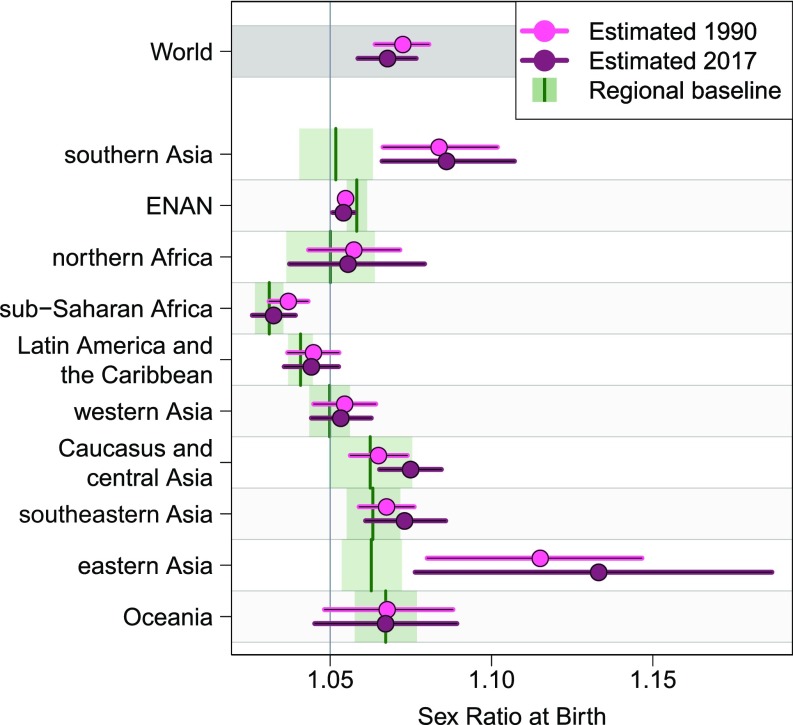
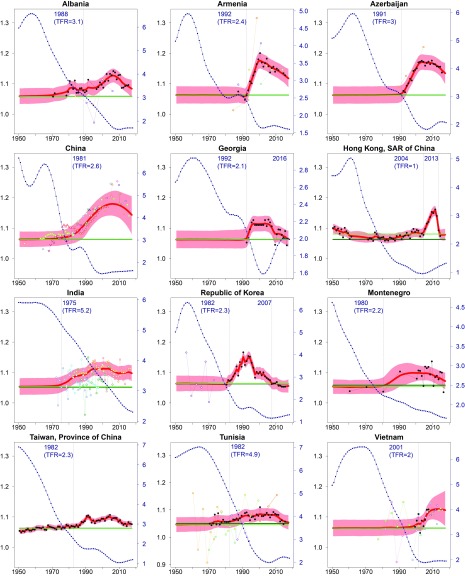
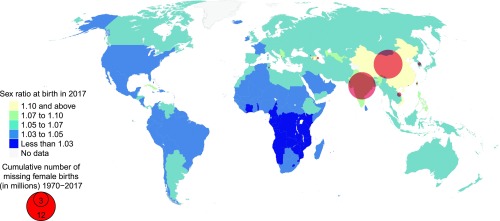
The sex ratio at birth (SRB; ratio of male to female live births) imbalance in parts of the world over the past few decades is a direct consequence of sex-selective abortion, driven by the coexistence of son preference, readily available technology of prenatal sex determination, and fertility decline. Estimation of the degree of SRB imbalance is complicated because of unknown SRB reference levels and because of the uncertainty associated with SRB observations. There are needs for reproducible methods to construct SRB estimates with uncertainty, and to assess SRB inflation due to sex-selective abortion. We compile an extensive database from vital registration systems, censuses and surveys with 10,835 observations, and 16,602 country-years of information from 202 countries. We develop Bayesian methods for SRB estimation for all countries from 1950 to 2017. We model the SRB regional and national reference levels, the fluctuation around national reference levels, and the inflation. The estimated regional reference levels range from 1.031 (95% uncertainty interval [1.027; 1.036]) in sub-Saharan Africa to 1.063 [1.055; 1.072] in southeastern Asia, 1.063 [1.054; 1.072] in eastern Asia, and 1.067 [1.058; 1.077] in Oceania. We identify 12 countries with strong statistical evidence of SRB imbalance during 1970-2017, resulting in 23.1 [19.0; 28.3] million missing female births globally. The majority of those missing female births are in China, with 11.9 [8.5; 15.8] million, and in India, with 10.6 [8.0; 13.6] million.
Keywords: Bayesian hierarchical model; missing female births; sex ratio at birth; sex-selective abortion; son preference.
Copyright © 2019 the Author(s). Published by PNAS.
Conflict of interest statement
The authors declare no conflict of interest.
Figures
References
-
- Chahnazarian A. Determinants of the sex ratio at birth: Review of recent literature. Soc Biol. 1988;35:214–235. - PubMed
-
- Dubuc S, Coleman D. An increase in the sex ratio of births to India-born mothers in England and Wales: Evidence for sex-selective abortion. Popul Dev Rev. 2007;33:383–400.
-
- Garenne M. Sex ratios at birth in African populations: A review of survey data. Hum Biol. 2002;74:889–900. - PubMed
-
- Garenne M. Poisson variations of the sex ratio at birth in African demographic surveys. Hum Biol. 2008;80:473–482. - PubMed
-
- Graffelman J, Hoekstra RF. A statistical analysis of the effect of warfare on the human secondary sex ratio. Hum Biol. 2000;80:433–445. - PubMed
Publication types
MeSH terms
LinkOut - more resources
Full Text Sources
Miscellaneous
