. 2019;20(8):1097-1104.
doi: 10.1080/15384047.2019.1595280. Epub 2019 Apr 16.

The in cis compound EGFR mutations in Chinese advanced non-small cell lung cancer patients

Affiliations

The in cis compound EGFR mutations in Chinese advanced non-small cell lung cancer patients

Min Li et al. Cancer Biol Ther. 2019.

Abstract

Literatures regarding the prevalence and clinical significance of compound EGFR mutations are limited. Until now, none of retrospective or prospective research has focused on in cis compound EGFR mutations except case reports. In this study, we screened a cohort of 3,000 treatment-naïve Chinese advanced NSCLC patients using capture-based ultra-deep targeted sequencing to evaluate the prevalence of EGFR in cis compound mutations and the efficacy of EGFR-TKI in this population. Of the 3,000 patients screened, 1,266 (42.2%) had EGFR mutation; among them, 15 patients (1.2%) harboring in cis compound EGFR mutations, with 10 patients carrying EGFR L858R in combination with a rare mutation and five patients carrying two rare EGFR mutations. No patient with EGFR 19del was observed. Interestingly, no in trans configuration was identified in this cohort. All of the patients harboring in cis compound EGFR mutations were non-smokers, histologically diagnosed with adenocarcinoma and received first-generation EGFR-TKI. Furthermore, our data also revealed that patients with in cis compound EGFR mutations exhibit comparable PFS to first generation EGFR-TKI comparing to patients with single activating EGFR mutation. This observation was further supported by in silico molecular modeling analyses which demonstrated in cis compound mutations do not alter the ATP-binding pocket of EGFR, thus having no effect on the interaction between gefitinib and EGFR.

Keywords: Chinese; EGFR; In cis; compound mutations; non-small cell lung cancer.


Figures
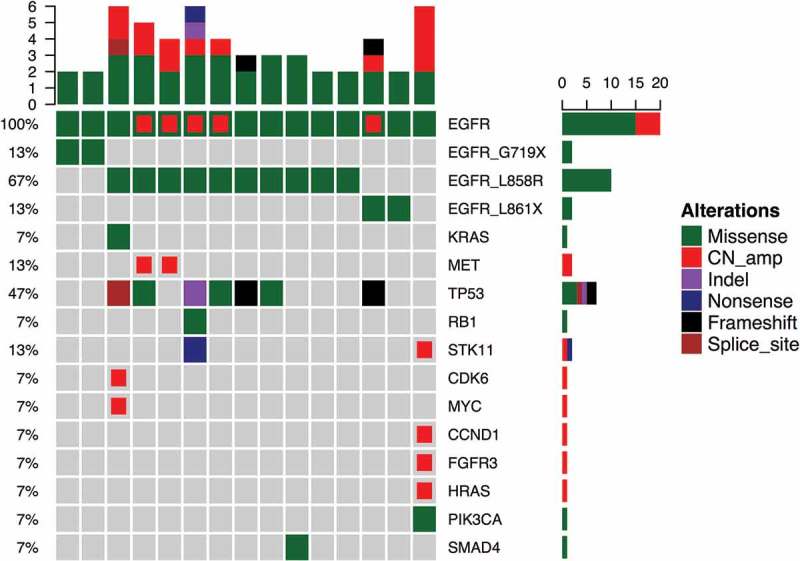
Figure 1.
Figure 1.
Mutational Profile of the 15 patients with compound EGFR mutations. Each column represents a patient and each row represents a gene. Top bars represent the number of mutations a patient carried and sidebars represents the percentage of patients with a certain mutation. Different colors denote different types of mutation.
Figure 2.
Figure 2.
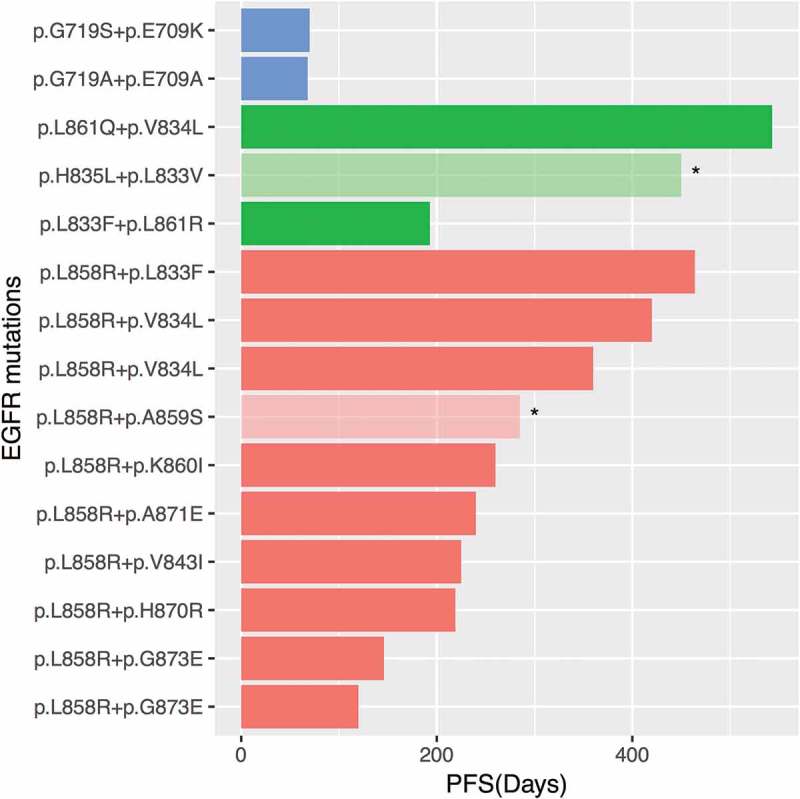
Compound EGFR mutations and treatment response of each patient. X-axis indicates the progression-free survival (PFS) of each patient. Y-axis denotes the compound EGFR mutations of each patient. Orange bars denote compound mutations with L858R. Green bars denote compound mutations in exon 21, and blue bars denote compound mutations in exon 18. Asterisks denote patients who have not experienced progression at the time of the last follow-up on August 30, 2018.
Figure 3.
Figure 3.
Kaplan-Meier analysis of patients with compound mutations. (a). Comparison between compound EGFR and single EGFR L858R mutations. Group A includes patients with a single L858R mutation (n = 23); Group B includes all 15 patients with compound EGFR mutations. (b-c). Comparison between compound EGFR mutation patients with and without concurrent variations. B. EGFR amplification. EGFR_ normal denotes patients without concurrent EGFR amplification (n = 10). EGFR_amp denotes patients with concurrent EGFR amplification (n = 5). (c). TP53 mutation. TP53- denotes patients without concurrent TP53 mutation (n = 9). TP53+ denotes patients with concurrent TP53 mutation (n = 6). X-axis represents progression-free survival (PFS) expressed in days. Y-axis denotes the PFS ratio.
Figure 4.
Figure 4.
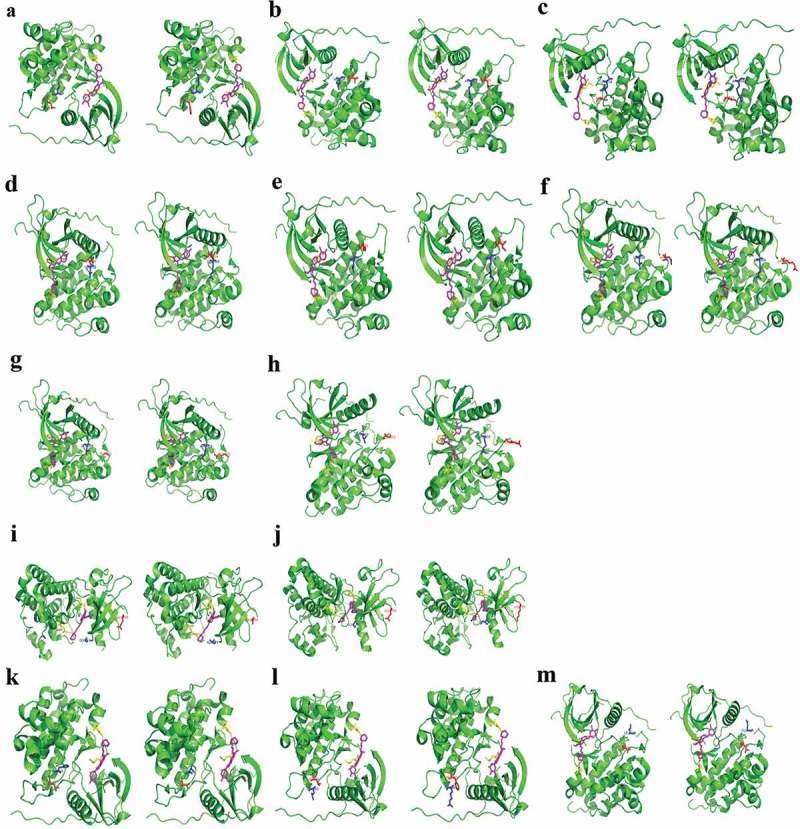
EGFR conformation transitions in patients with in cis compound EGFR mutations. (a). EGFR L858R+L833F; (b). EGFR L858R+V834L; c. EGFR L858R+V843I; d. EGFR L858R+A859S; €. EGFR L858R+K860I; (f). EGFR L858R+H870R; (g). EGFR L858R+A871E; (h). EGFR L858R+G873E; i. EGFR G719A+E709A; j. EGFR G719S+E709K; (k). EGFR H835L+L833V; (l). EGFR L861R+L833F; (m). EGFR L861Q+V834L. EGFR protein is represented by green alpha helix, beta folding, loop. Gefitinib is represented by a magenta stick. The in cis compound mutations of EGFR protein are represented by blue and red sticks. Met793 and Asp800 of EGFR protein are represented by yellow sticks. The hydrogen bond is represented by a yellow dashed line.

References

    1. Mitsudomi T, Yatabe Y.. 2007. Mutations of the epidermal growth factor receptor gene and related genes as determinants of epidermal growth factor receptor tyrosine kinase inhibitors sensitivity in lung cancer. Cancer Sci. 98(12):1817–1824. doi: 10.1111/j.1349-7006.2007.00607.x. - DOI - PMC - PubMed
    1. Takano T, Fukui T, Ohe Y, Tsuta K, Yamamoto S, Nokihara H, Yamamoto N, Sekine I, Kunitoh H, Furuta K, et al. 2008. EGFR mutations predict survival benefit from gefitinib in patients with advanced lung adenocarcinoma: A historical comparison of patients treated before and after gefitinib approval in Japan. J Clinl Oncol. 26(34):5589–5595. doi: 10.1200/JCO.2008.16.7254. - DOI - PubMed
    1. Miller VA, Hirsh V, Cadranel J, Chen YM, Park K, Kim SW, Zhou C, Su WC, Wang M, Sun Y, et al. 2012. Afatinib versus placebo for patients with advanced, metastatic non-small-cell lung cancer after failure of erlotinib, gefitinib, or both, and one or two lines of chemotherapy (LUX-Lung 1): a phase 2b/3 randomised trial. Lancet Oncol. 13(5):528–538. doi: 10.1016/S1470-2045(12)70087-6. - DOI - PubMed
    1. Stasi I, Cappuzzo F.. 2014. Second generation tyrosine kinase inhibitors for the treatment of metastatic non-small-cell lung cancer. Transl Respir Med. 2:2. doi: 10.1186/2213-0802-2-2. - DOI - PMC - PubMed
    1. Jänne PA, Yang JC, Kim DW, Planchard D, Ohe Y, Ramalingam SS, Ahn MJ, Kim SW, Su WC, Horn L, et al. 2015. AZD9291 in EGFR inhibitor-resistant non-small-cell lung cancer. N Engl J Med. 372(18):1689–1699. doi: 10.1056/NEJMoa1411817. - DOI - PubMed

Publication types

MeSH terms